New standardized test causing stress, conflict for students, parents and schools
Mar 12, 2015, 11:58 AM | Updated: 2:12 pm
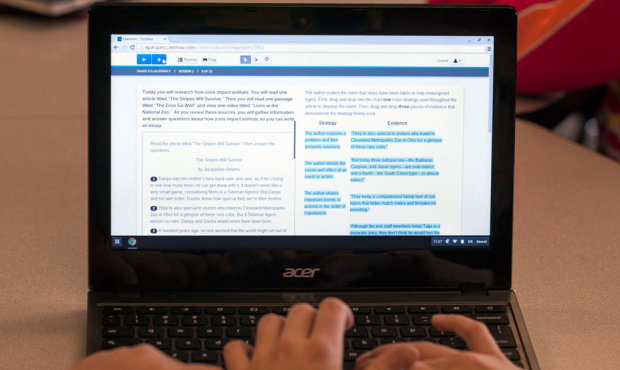
Students around the state have started taking the new Smarter Balanced Assessment, a controversial exam critics say is too difficult and time consuming. (AP)
(AP)

There’s plenty of stress for students around the state as they begin taking a new standardized test that’s drawing criticism for both its rigor and its length.
The Smarter Balanced Assessment features math and English language arts tests, and replaces parts of the Measurements of Student Progress or MSP – which continues to be used to evaluate science knowledge for students in fifth and eighth grade.
Related: Are you smarter than fifth grader? Take the Smarter Balanced practice tests
The new test for third through eighth graders and high school juniors is much tougher than previous exams.
Rather than simply multiple choice or fill in the blank, they require far more analysis, performance of a number of tasks, and detailed explanations of how they got their answers.
The computerized test is called an adaptive online test – meaning if a student answers a question correctly the next question gets more challenging.
The test is being administered for the first time statewide this spring over the next 12 weeks to evaluate how students are doing with the newly adopted Common Core standards.
Advocates such as the Partnership for Learning, a Seattle-based education foundation, say both the new standards and the testing are critical to improve the state’s education system and prepare students for a successful life.
“We know there’s a severe job skills gap in STEM and health care industry, technology, mathematics – and we need to expect more from our students,” said Chris Barron, Partnership for Learning spokesman. “As a parent myself, I want my children to be better prepared for life in college and career.”
But a number of critics say more testing, especially the Smarter Balanced Assessment, is not the answer. And they argue since so many students will score low on the more challenging exams, they serve little purpose other than to cause more stress and label many as failures.
A leadership team of teachers, parents, administrators and students at Seattle’s Nathan Hale High School voted last month to boycott the test for 11th graders, saying they’re already tested enough.
That’s drawn the wrath of state schools superintendent Randy Dorn, who says not taking the test hurts students and could cause the state to lose some federal funding.
According to Dorn, students who score low on the test can take additional preparatory courses to get them up to speed for college, while those who score higher can move straight to college-level classes.
“It’s also important to understand that the tests measure career and college readiness. So students who score a 1 or 2 will need an additional course or courses to be ready for life after high school, whether it’s college or career,” said Dorn in a statement.
“Not having students take the new tests robs educators of a fair and equitable measure of student progress. They won’t be able to see gaps between groups of students, which means the students who most need help may not get it.”
Dorn tells parents he does sympathize with their concerns about students being subjected to too much testing, and has proposed a bill dropping passage of a high school competency test for students to graduate.
But many opponents argue while they don’t oppose testing, Smarter Balanced is overkill.
Carolyn Leith, the parent of a third grader at Seattle’s Olympic View Elementary, says all of the preparation by both her daughter and teachers has taken far too much time and caused significant stress.
“My 9-year-old’s class for third grade has six hours of testing for English language arts and another six hours of testing for math. So there’s a 9-year-old expected to sit for 12 hours for testing. It’s too much,” she said.
Leith is among many parents expressing concerns the test is too complex for younger students, partly because it requires so much typing and partly because there’s just so much being asked of the students.
“For example, on the math test you have to master certain strategies and there’s like six or seven steps to a strategy plus sometimes you have to do a drawing and you have to write out an answer, so it’s very, very involved,” she said.
But supporters of both the testing and the Common Core curriculum argue that’s the point.
“If we’re going to compete in the future, we need to up the bar,” Barron said. “Tests are a part of life. Just about every level you reach in your life is some sort of test or measure. You need good data to measure.”
Opposition to Smarter Balanced and other standardized testing continues to grow. Many parents are choosing to opt their children out of the tests, and a number of groups have sprung up in Washington and around the country to oppose them.