Owner of Seattle’s Uncle Ike’s Pot Shop speaks out about controversy
May 4, 2016, 7:42 AM | Updated: 8:58 am
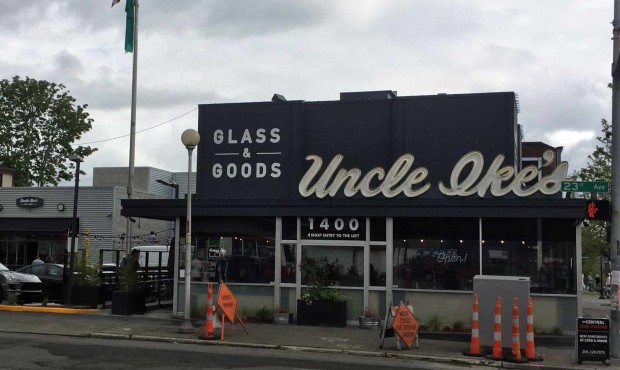
Uncle Ike's Pot Shop has been targeted by protests and heavy criticism from locals. (Contributed photo)
(Contributed photo)
Ian Eisenberg opened Uncle Ike’s Pot Shop in Seattle Central District in September 2014. Since then, the shop has been targeted by protests and heavy criticism from locals who object to its location — it’s near a teen center and a church — and it’s role in the gentrification of the area.
Related: Gentrification in Seattle’s Central District about more than pot shop
Seattle hip-hop artist Draze released a song about Uncle Ike’s called “Irony on 23rd,” that points out that black men were arrested for decades for selling pot on the same corner the legal shop is now located on.
“I agree. I agree that it’s ironic. I don’t agree with pot prohibition,” Eisenberg said. “But there is a big difference between selling something that is legal and illegal. Cigarettes are legal — unstamped, untaxed cigarettes are illegal.”
Eisenberg explained to KIRO Radio’s Seattle’s Morning News his understanding of how his shop has been received in the immediate area. Despite the protests, he says there is some support.
“I’m from the central area, I live in the central area. I’ve owned the property where Uncle Ike’s Pot Shop is since 2010,” Eisenberg said. “My family, to my great-great grandparents, lived on 23rd and Cherry at the turn of the century. I’m very familiar with the neighborhood.”
“I think it’s basically (about) a white guy selling pot in what was predominantly an African-American neighborhood from the ’50s through the ’90s,” he said. “People are mad about gentrification &mdash, and I think displacement is a real issue. There is a lot of resentment that people who lived here for a generation can’t afford to live here anymore. I think Uncle Ike’s was the first new business here in, really, decades — and in a flashy way with bright lights and signs. It’s an easy target.”
That target has been hit with at least two protests, including a demonstration that halted traffic at the shop.
“There are very few of the protesters that are from this neighborhood. It was people coming to this neighborhood protesting us,” Eisenberg said. “There was a protest on Martin Luther King Day and they actually chained our front door shut and presented me with a list of demands that I meet or else — like an old fashioned shakedown.”
One such demand was that he was to turn over 54 percent of this real estate holdings to the Seattle Black Book Club. Eisenberg said that he doesn’t know where the 54 percent figure came from. He also said that he is generally confused over what protesters really want.
“I don’t know what they want,” he said. Last week’s protest included people demanding that he turn the property over to indigenous tribes of Seattle, to accusations of white supremacy, he added. “There were so many mixed messages going on. The only thing that I could tell was going on was Draze was filming a music video with a backdrop of an army of Seattle police and protesters screaming about whatever.”
“There were a lot of people at the protest talking about all the people who went to jail here for possession of marijuana,” Eisenberg said. “I doubt there is anybody left in jail in King County for possession of marijuana. Maybe possession with intent to distribute … A lot of us voted for legalizing marijuana not because we just love pot, but for social justice issues. Getting rid of the illicit market really was one of the main reasons people wanted legalization.”
Moving forward, Eisenberg said that he doesn’t think he will ever win over any of his critics, but that there are plenty of supporters in the area, too.
“I don’t feel it’s possible [to smooth things over with neighbors]. I’ve been a part of this community, at various community councils and different committees for five or six years. And I’m going to these meetings at least once a week,” he said.
“Everybody in the neighborhood seems to be happy with us,” Eisenberg said. “I took over a corner that was crime-ridden. When I bought it we had illegal dealing, prostitution, shootings — and now it’s a safe clean environment. Most of the community that I’ve talked to seems to have no problem with it.”
Follow @https://twitter.com/DyerOxley