Western Washington enters dangerous wildfire territory ahead of weekend heatwave
Jun 23, 2021, 5:09 AM | Updated: 11:07 am
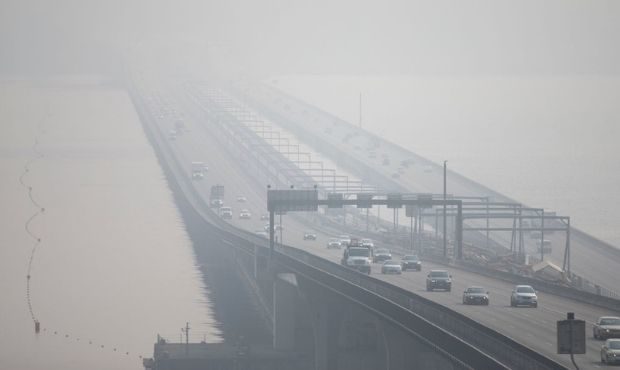
The I-90 bridge over Lake Washington disappears through heavy smoke from wildfires on Sept. 11, 2020 in Seattle, Washington. (Photo by Lindsey Wasson/Getty Images)
(Photo by Lindsey Wasson/Getty Images)
With drought conditions and record heat in Washington, it unfortunately looks like the trend of summer wildfires in Washington will continue this year. But there are steps you can take now to protect yourself from wildfire smoke.
Already, red flag fire warnings are going up in parts of the state, as even Western Washington looks to head for triple digits this weekend.
“Looking at the forecast coming up here, we might be on the precipice of another pretty significant season yet again,” Steve Ready with the National Weather Service told KIRO Radio.
He noted wildfire season used to start in July, but in recent years, it is trending earlier. And while the state’s snowpack was in good shape earlier this month, that is quickly changing with this week’s hot temperatures, leading to drier conditions.
Wildfire smoke ruins Redmond winery’s entire 2020 vintage
With wildfire smoke comes a whole host of health dangers, as exposure to smoke — even for just a few days in an otherwise pristine state — can be very damaging to your health.
“That week that we had smoke last year, September 2020, those concentrations made up about one-third of the pollution for the entire year in one week,” said Graeme Carvlin, air resource specialist at the Puget Sound Clean Air Agency.
Carvlin noted that for the elderly, small children, pregnant women, and especially for people with pre-existing respiratory conditions like asthma, wildfire smoke can increase the chances of getting very sick or can potentially be fatal. And even those who are young and in good health are not immune to long-term health problems from smoke exposure.
“Even months later, if you have a high exposure, you can have lingering health effects,” Carvlin warned.
This can show up by, for example, having a difficult bout of flu the winter after a smoke-filled summer. And while research is still ongoing, it is also possible that a person exposed to wildfire smoke could be at risk for a more severe case of COVID-19. Carvlin noted that the link between COVID and people living in smoggy conditions has already been studied.
“There’s a pretty clear connection between higher levels of pollution and an increased chance to catch COVID-19 and have worse symptoms,” Carvlin explained.
So what should you do to stay on guard when the smoke starts filling the skies?
Carvlin suggests you create a clean air space in your home by closing all the windows and using an air filtration system. This can be done with an air cleaner, or, for a less expensive route, you can also create your own filter with a box fan. Puget Sound Clean Air has instructions online for how to take this DIY approach.
But just cleaning the air is not enough.
“When you’re creating a clean indoor air space, you want to keep the windows and doors closed, filter the air, but also reduce the sources of pollution from inside your house,” Carvlin said.
That means you should avoid burning candles, frying foods, and vacuuming in the clean air space, as these can spread dust and other particles throughout the house.
When the weather gets hot like it is this week and wildfire chances are high, it’s a good idea to keep an eye on air conditions so you can plan for the worst. Puget Sound Clean Air’s online air quality map shows you the level of pollutants in the region, so you can check on a daily basis if things seem to be headed in the wrong direction. You should stock up on groceries ahead of a smoke episode if possible, so you can limit your trips outdoors.
If you do need to go out, a tight mask like an N95 or KN95 mask will help. In case you aren’t able to find one of those masks online, an N95-style home repair work mask from a hardware store like Home Depot or Lowe’s will also keep out the smoke.
“Those don’t work for COVID, because then you’re exhaling particles, but they’re fine for wildfire smoke,” Carvlin said. “Those should be available, people should be able to buy them. If you have to go somewhere that requires a mask for COVID reasons, you can just put a surgical mask over it.”
For more wildfire smoke tips, visit Puget Sound Clean Air’s website.
KIRO Radio’s Diane Duthweiler contributed to this report.