Eight new Seattle cameras will automatically ticket drivers starting in March
Feb 20, 2022, 8:03 AM
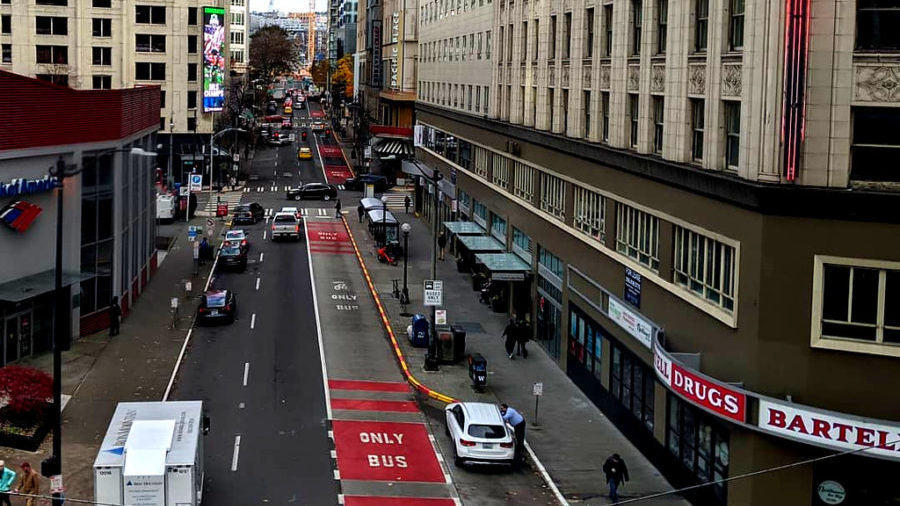
A red marked bus lane on Olive Way in Seattle. (Photo courtesy of SDOT/Flickr)
(Photo courtesy of SDOT/Flickr)
Starting in March, new traffic cameras in downtown Seattle may send you a ticket if you illegally drive in a bus lane or block a crosswalk or intersection.
John & Shari: Perhaps red light cameras are more trouble than good
The Seattle Department of Transportation has installed traffic cameras at eight major intersections in downtown Seattle and will turn them on in March. The cameras will be turned on gradually over several weeks in order to test the system in each location and give the public time to adjust, SDOT says.
The new cameras will take a photo of your license plates — and not of the people in the car, for privacy reasons — if you violate a rule. The photos are only intended to be used for enforcing the bus lane and blocking the box laws, not for other law enforcement action.
The first time you’re caught, you will be mailed a warning letter. After that, it will be a $75 ticket.
All locations, SDOT explains, have “clear signs and pavement markings,” with white lines to indicate where the “box” begins and markings to indicate which lanes are restricted to buses.
SDOT says this will make traffic enforcement “more consistent, objective, and fair.” It will also allow Seattle police officers to focus their attention on other public safety needs.
Here are the locations where traffic cameras are being installed:
- Aurora Ave N at Galer St (Transit Lane)
- 3rd Ave at James St (Transit Lane)
- 1st Ave at Columbia St (Transit Lane)
- 3rd Ave and Stewart St (Transit Lane)
- 4th Ave at Battery St (Don’t Block the Box)
- 4th Ave at Jackson St (Don’t Block the Box)
- Westlake Ave N at Valley St/Roy St (Don’t Block the Box)
- 5th Ave at Olive Way (Both Transit Lane and Don’t Block the Box)
According to an SDOT blog post, the state Legislature authorized the use of cameras to enforce bus lane and intersection violations in 2020.
Under state law, half of the net revenue from the traffic cameras will go to a Washington Traffic Safety Commission fund for bicycle and pedestrian safety projects, and the other half must be used to build safety and mobility improvements for people with disabilities in Seattle.
KIRO Newsradio’s Chris Martin contributed to this report.
Follow @http://twitter.com/Mynorthwest