Engineer ‘didn’t recall seeing’ speed sign before DuPont train derailment
Jan 25, 2018, 9:14 AM | Updated: 10:49 am
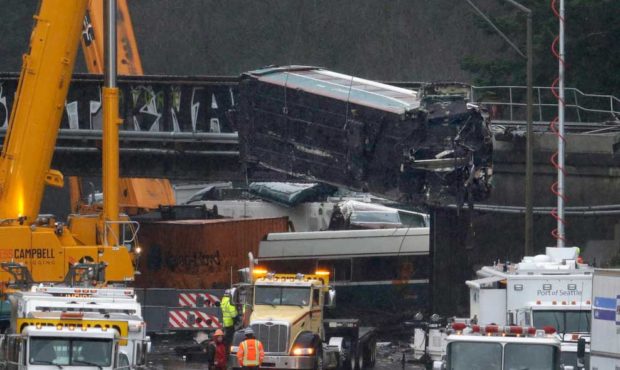
Cars from an Amtrak train lay spilled onto Interstate 5 below alongside smashed vehicles after the derailment. (File, Associated Press)
(File, Associated Press)
Neither the engineer or qualifying conductor who were in the lead locomotive during the train derailment in DuPont say they were distracted at the time.
Safety system could’ve prevented wreck
However, the engineer told the National Transportation Safety Board that he was aware of the curve where the train derailed and what milepost it was located near. However, he “didn’t recall seeing milepost 18 or the 30 mph advance speed sign,” which was posted two miles ahead of the curve.
The qualifying conductor told the NTSB that just before the derailment, he looked down at his copies of the track bulletins, heard the engineer “say or mumble something,” then looked up and “sensed that the train was becoming airborne.”
On Thursday, NTSB released highlights from the agency’s interview with the conductor and engineer:
- The engineer, a 55-year-old male, was hired by Amtrak in 2004 as a conductor and then promoted to locomotive engineer in 2013.
- In the five weeks preceding the derailment, the engineer had qualified on the Point Defiance Bypass section of track following the completion of seven to 10 observational trips in the locomotive as well as three trips operating the equipment, two northbound and one southbound.
- The engineer said he felt rested at the start of his shift.
- The engineer recalled that as the train passed milepost 15.5 it was traveling about 79 mph.
- The engineer told investigators that he was aware that the curve with the 30 mph speed restriction was at milepost 19.8, and that he had planned to initiate braking about one mile prior to the curve.
- The engineer said that he saw mileposts 16 and 17 but didn’t recall seeing milepost 18 or the 30 mph advance speed sign, which was posted two miles ahead of the speed-restricted curve.
- The engineer said that he did see the wayside signal at milepost 19.8 (at the accident curve) but mistook it for another signal, which was north of the curve.
- He said that as soon as he saw the 30 mph sign at the start of the curve, he applied brakes. Seconds later, the train derailed as it entered the curve.
- The engineer said that he didn’t feel that having a qualifying conductor in the locomotive with him was a distraction.
- The engineer also said that he would not have gotten behind the throttle if he had any reservations about his readiness to operate the train.
- The qualifying conductor, a 48-year-old male, was hired by Amtrak in 2010 as an assistant conductor and was promoted to conductor in 2011.
- At start of shift, he said he took part in the job briefing conducted by the conductor and the engineer. They went over general track bulletins and other items.
- The qualifying conductor told investigators that he felt rested and alert at the start of his shift. He had never worked with the engineer before. He told investigators that the engineer appeared alert during the job briefing and while operating the train.
- The qualifying conductor told investigators that there was minimal conversation between himself and the engineer during the trip. Instead he said he spent time looking at his paperwork to help learn the territory.
- Just prior to the derailment, the qualifying conductor said he looked down at his copies of the general track bulletins. He then heard the engineer say or mumble something. He then looked up and sensed that the train was becoming “airborne.”
Three people were killed and dozens more were injured when the Amtrak train derailed in December. The NTSB confirmed the train was traveling just under 80 mph at the time it entered a 30 mph zone and curve that takes the track over I-5.
A safety system, known as Positive Train Control, was not in operation at the time of the crash. Since the crash, Secretary of Transportation Elaine Chao has told all executive officers of the nation’s Class I railroads that Positive Train Control needs to be implemented by the end of the year.
Follow @http://twitter.com/Mynorthwest