‘Very small chance’ of bigger earthquake after series of tremors in Fall City
Dec 19, 2019, 1:52 PM
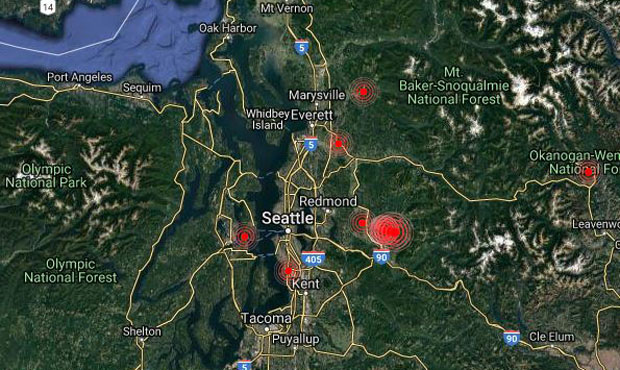
A series of tremors hit Fall City between Wednesday and Thursday. (MyNorthwest Earthquake Tracker)
(MyNorthwest Earthquake Tracker)

A cluster of earthquakes have been occurring near Fall City between Wednesday and Thursday, producing a very slight chance of a larger quake sometime in the future.
PNW’s Shake Alert earthquake warning system awarded $10.4 million
“I would predict more — some smaller aftershocks,” said Bill Steele with the Pacific Northwest Seismic Network. “There’s always a chance though when we have a little sequence like this that one of these earthquakes will start and keep going, so there’s a very small chance that we could have a bigger earthquake.”
The area has seen upwards of six separate earthquakes ranging between 1.4 and 3.4 in magnitude, starting just after 7 p.m. Wednesday. The quakes persisted into Thursday morning, varying in size and reports of people who felt them.
The biggest quake was reported by 1,300 people, while smaller ones were felt by less than a couple dozen in the Fall City area.
KIRO 7 reports people in Granite Falls, Bothell, North Bend, Issaquah, Snoqualmie and Lynnwood could feel shaking for the first (and largest) of the earthquakes.
“It’s not that unusual, but it was felt well in the area,” said Steele.
This all comes hot on the heels of a recent study from the U.S. Geological Survey, stating that the Puget Sound area has a 75 percent or greater chance of being hit by a damaging earthquake sometime in the next 100 years.
A new models examined which areas are in the worst danger zones, and on it, Puget Sound possessed the same level of potential danger as California, with the remainder of Western Washington at a not-as-bad 36 to 74 percent chance of being struck.
Check out the MyNorthwest Earthquake Tracker
It’s been more than 300 years since Cascadia last quaked. The Cascadia subduction zone covers the offshore area where the Juan de Fuca tectonic plate pushes under the larger North American plate, and produces megathrust quakes every 300 to 600 years. Some experts believe it’s long overdue and has the potential to devastate Western Washington should it ever arrive.
As for tremors like the ones Fall City has seen over the last 24 hours, it’s actually helped the PNSN better understand these kinds of earthquakes.
“Understanding how the fault systems work in Western Washington is something of current research interest,” Steele pointed out. “This little cluster of earthquakes gives us more information, and we’re always watching.”