Stricken with rare disease, film documents woman’s climb up Mt. Kilimanjaro
Aug 7, 2012, 5:59 PM | Updated: Aug 8, 2012, 6:23 am

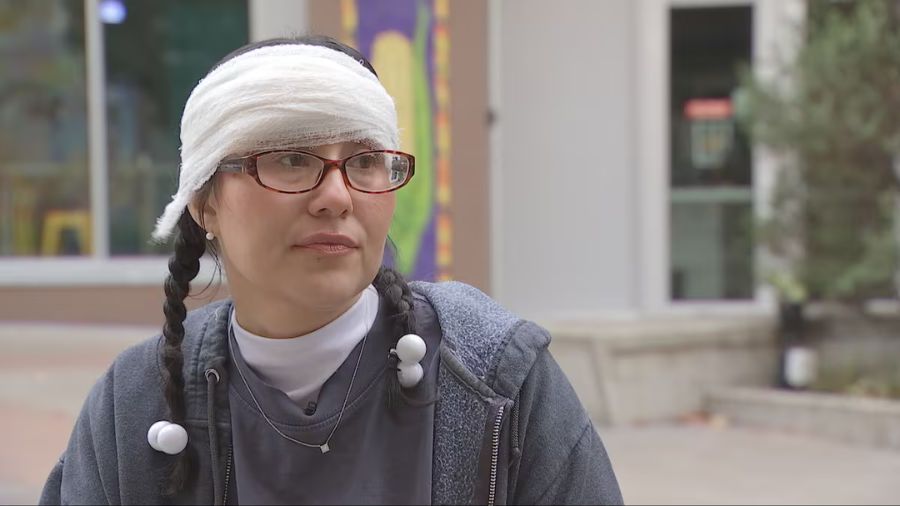
Despite a debilitating disease known as Neurofibromatosis Type 2, Rebecca Dufek climbed Mount Mt. Kilimanjaro. Her journey will be the subject on a new documentary. (Photo: Cesari Direct)
(Photo: Cesari Direct)

Rebecca Dufek sat next to her husband at his office in Redmond, Wash., as he relayed questions to her in sign language.
She was wearing a baby blue shirt that read, “Never Give Up.”
When Dufek is asked how she reacted when a doctor told her she had too many tumors to count, she laughed.
“Relieved,” she said. “I was like, thank God it isn’t brain cancer.”
Dufek, now 40, had already been diagnosed with and beaten cancer at the age of 21. She didn’t want to do it again.
But her new diagnosis would end up being much more complex and rare.
It was July of 1999 when a doctor told Dufek she had a disease known as Neurofibromatosis Type 2, also called NF2. Her brain and spinal cord were covered with masses of tiny tumors that were “too numerous to count.”
“I just knew that it was bad,” said her husband, Harley Dufek.
When the couple got married a year after her diagnosis, in 2000, Rebecca had already begun to lose her hearing as the tumors grew inside her brain.
“One of my main worries was that she wouldn’t even be able to hear our wedding vows,” Harley said. “She was losing hearing so rapidly.”
Doctors warned that she would soon become deaf.
After their honeymoon, Rebecca lost her hearing for good. One of the last things she listened to was a song called “1979,” by The Smashing Pumpkins.
Hearing loss was followed by facial paralysis, loss of balance and problems with her eyesight. The once avid outdoorswoman was told she could no longer water ski, motorcycle, scuba dive or hike.
“You see somebody that you love just being taken away from you one piece at a time,” her husband said. “That’s really hard.”
An estimated 1 in 25,000 to 1 in 40,000 people worldwide are born with NF2. While it can be inherited, the disease can also be caused by a genetic mutation. There is no known cure and the average life expectancy of those diagnosed with the disease is around 36 years of age.
Even today, the number of tumors in Rebecca’s body are too numerous to remove. Her husband likens it to mashing together wet spaghetti and peanut butter.
“And saying, OK, we need to take a scalpel and try and get out all this peanut butter, but don’t nick any of that spaghetti,” he said. “It’s impossible.”
Unlike cancer, Rebecca Dufek knew that she wasn’t going to beat NF2. She would have to live with it.
She and her husband started Help Stop NF2, a charity to raise awareness for the disease.
But for Dufek, it wasn’t enough. She wanted to bring attention to NF2 in a big way. In 2009, just before she was to undergo her second brain surgery, she had an idea.
“Do you think that the doctor will let me climb Mount Kilimanjaro after this next surgery?” she asked.
“What do you say to that?” her husband laughed. “Other than, ‘You know honey, I think you can do anything you want to do.'”
It was decided. If Rebecca lived through her next surgery, they would climb Africa’s highest peak.
Less than a year after her surgery, with $225,000 in donations, Rebecca and Harley set out with a 10-person team to climb the 19,340-foot giant. A crew filmed the journey for an upcoming documentary called “Pole’ Pole’,” which is Swahili for “Slowly, Slowly.”
The title is indicative not only of the climb, but of Rebecca’s disease.
“It’s a metaphor for her disease,” Harley said. “It’s a slow killer.”
Pole’ Pole’ will premiere at the SIFF cinema at the Uptown in Queen Anne on Thursday, August 9 at 7 p.m.