Giant forgotten sign said ‘WELCOME HOME’ to returning veterans
Jun 9, 2023, 9:27 AM | Updated: 9:41 am



When members of the “Greatest Generation” – veterans of World War II – began returning to the United States via the Pacific Northwest when the war was over, festive banners were hung on piers in Elliott Bay, and bands played to welcome everyone home. The celebrations were repeated day after day as ships, sometimes carrying as many as 3,000 veterans, steamed into downtown Seattle. Similar scenes played out in San Francisco, Los Angeles, Boston, and New York.
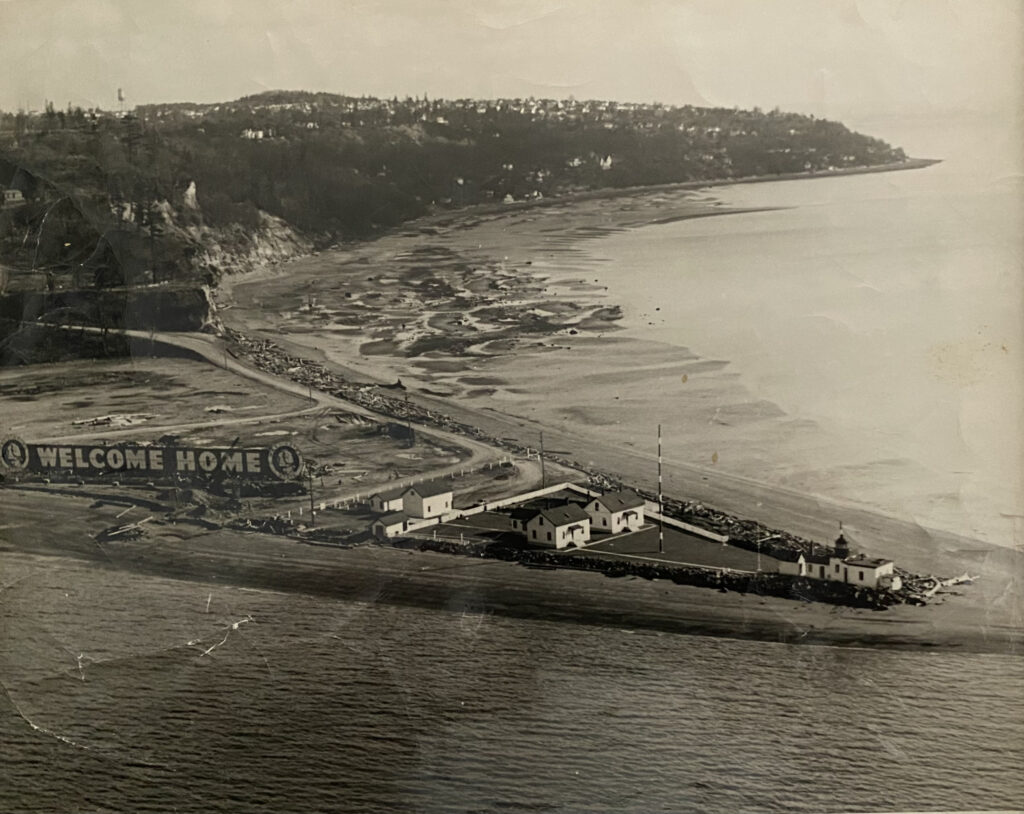
The Evergreen State’s greeting to the returning troops had one more special element that those other places lacked: a gigantic illuminated sign, now long forgotten, that greeted hundreds of thousands of men and women as they steamed past what’s now Discovery Park on troop ships and other vessels bound for Seattle.
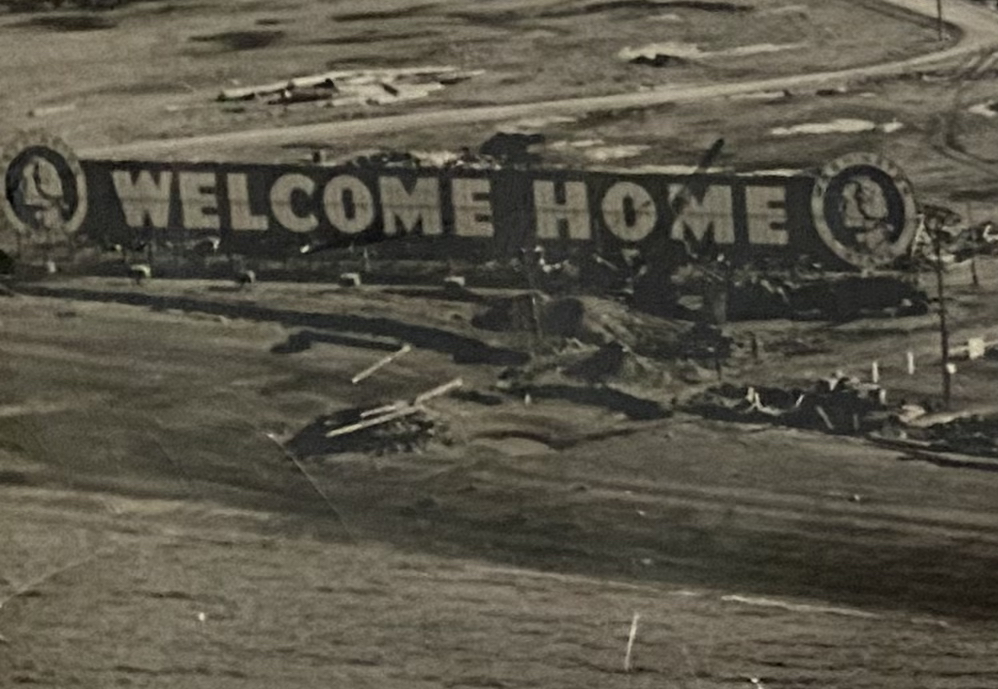
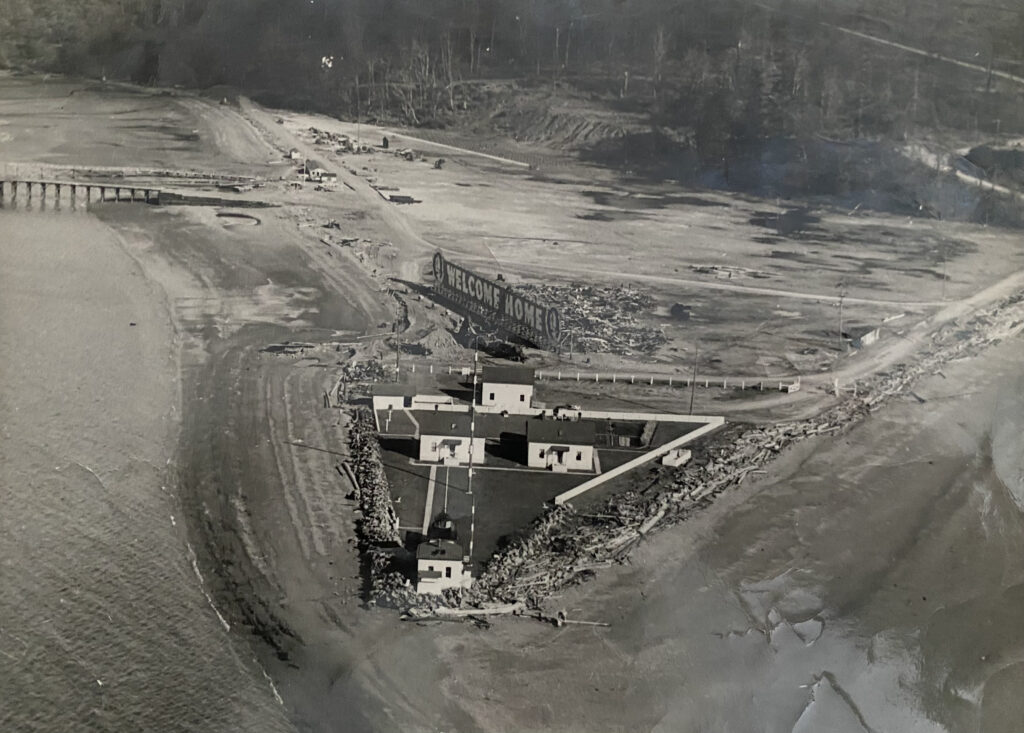
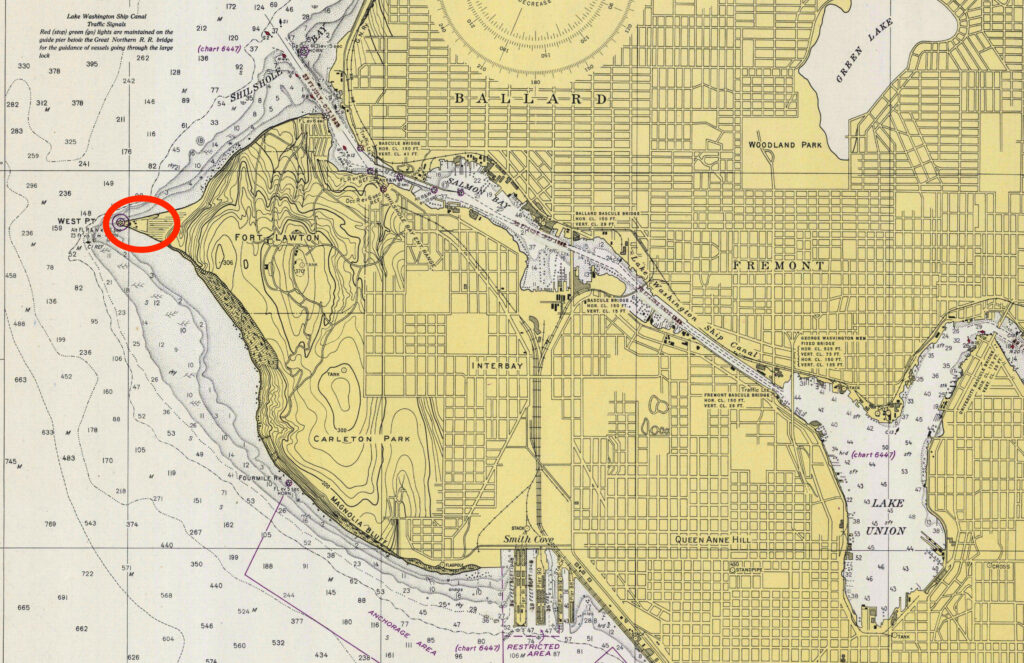
It was the autumn of 1945, not long after the end of World War II, when elected officials and local charities combined forces to build a giant “WELCOME HOME” sign in Seattle’s Magnolia neighborhood at what was then Fort Lawton. The giant sign was constructed just north and east of the famously photogenic West Point Lighthouse, which has been a Northwest landmark since 1881.
The word “giant” is not an exaggeration. The sign, which was essentially an overgrown billboard, was built by Sunset Outdoor Advertising Company and appears to have been constructed from plywood. Most newspaper accounts at the time say it was 20 feet tall and 268 feet long.
It had a version of the state seal on the left end and the right end – a big George Washington head and the words “Washington State” in a circle – though it’s believed to have originally been designed to feature a City of Seattle seal instead of two state seals (more on that below).
In giant white letters on a dark blue background, the sign said “WELCOME HOME” in all caps. This message was illuminated by a row of electric floodlights mounted on the ground, and it was said to be visible anywhere from six to 15 miles where it pointed north out into Puget Sound.
The idea was that hundreds of thousands of veterans would be coming through what was called the Seattle Port of Embarkation after the war effectively ended on VJ-Day and then officially came to a close with the Japanese surrender Sept. 2, 1945.
Since all of those men and women would sail past West Point, it was the perfect location for the giant sign. More than a half-million shipped out from Seattle during the war, and by February 1946, that same number, a half-million, had already returned through Seattle. That total figure likely grew as 1946 progressed.
Credit for conceiving the giant welcome goes to then-Governor Mon Wallgren. The total cost was about $9,000, with the state paying half, and after the Seattle City Council backed out of paying the other half, a Seattle group called the War Athletic Council raised the rest from private donors – which is the likely reason why no City of Seattle seal was featured. The $9,000 cost of the sign in 1945 would be approximately $160,000 in 2023 dollars.
When famous local sports columnist Royal Brougham stepped up to help raise the $4,500 to fill the gap, he wrote in the Seattle Post-Intelligencer, we “assumed responsibility for financing the huge 275-foot sign with its 18-foot letters, which in two flaming words will express the following sentiment to every weary warrior as his ship plows up the Sound to the first state-side port which spells Home – ‘Hi there Buddy! Are we glad you’re back! Just around the bend is a friendly city known as Seattle, where the latchstring is out . . . nothing is too good for you fellows who did the terrific job over yonder. Welcome Home, and that’s from deep down inside!’”
Construction began in early November 1945 and was likely completed sometime that month. The superstructure appears to be made of lumber set into fairly small concrete footings.
As this is the good old Pacific Northwest, the otherwise innocent gesture of welcoming home veterans was apparently rife with at least a modicum of controversy (in addition to the city funding kerfuffle).
A photo in a Seattle newspaper of Seattle Mayor William Devin standing in front of the sign is said to have irked Governor Wallgren since the sign was his idea and since Seattle didn’t support the project.
And, of course, Tacoma was reportedly jealous of state funding for a sign in Seattle since there was no state funding for a similar sign in Tacoma. Newspaper reports say that Governor Wallgren told anyone willing to listen that the sign was meant as a welcome to Washington and that any ship headed to Tacoma, or Olympia, or anywhere south of West Point would pass the giant WELCOME HOME on their way past.
While newspaper coverage of the construction of the sign was thorough, it’s difficult to find any coverage of when the sign ceased being illuminated and/or when it was dismantled or otherwise fell down. Examining vintage nautical charts and contemporaneous editions of the “Coast Pilot” for the Pacific Coast – that special government guidebook for mariners – reveals nothing about the sign.
Another giant local display – the old “PORT OF SEATTLE” neon sign on Elliott Bay – was such a highly visible landmark it was actually shown on nautical charts and described in the Coast Pilot for decades. The best guess is that the West Point “WELCOME HOME” sign remained in use throughout 1946 and was either ultimately demolished or blown down in a windstorm.
KIRO Newsradio visited West Point on Thursday to see if there is any evidence remaining of the old sign – concrete footings, landscape contouring, a conduit for the floodlights – but no obvious clues could be spotted in the area near the lighthouse, which is now covered by dense brush.
KIRO Newsradio has “two flaming words” for the dedicated volunteers who run the Coast Guard Museum Northwest in Seattle for sharing photos of this otherwise forgotten yet meaningful tribute to returning World War II veterans: thank you!
You can hear Feliks every Wednesday and Friday morning on Seattle’s Morning News with Dave Ross and Colleen O’Brien, read more from him here, and subscribe to The Resident Historian Podcast here. If you have a story idea, please email Feliks here.