Environmental group sues over denied endangered species listing for Whidbey Island moth
Feb 27, 2025, 5:58 AM
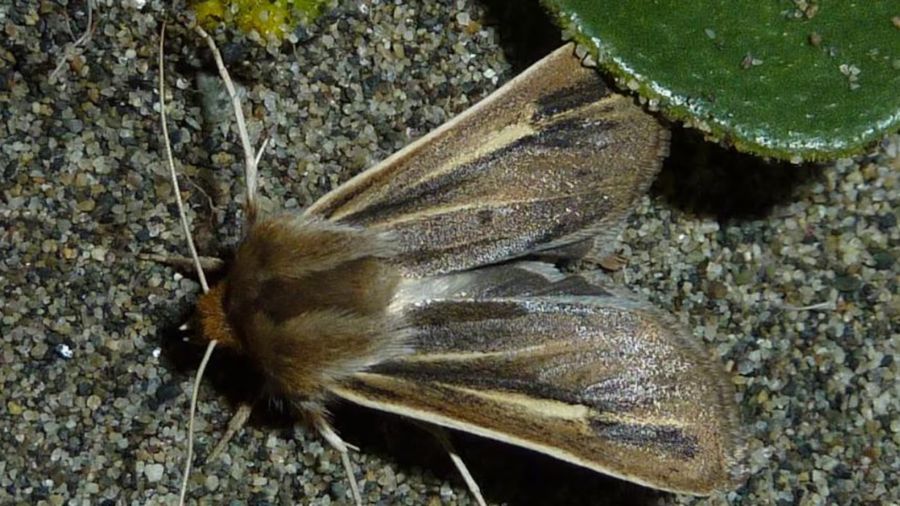
The sand-verbena moth, which is found on a few coastal beaches on Vancouver Island, British Columbia and Whidbey Island. (Photo courtesy of KIRO 7)
(Photo courtesy of KIRO 7)
The Center for Biological Diversity filed a lawsuit Wednesday against the U.S. Fish and Wildlife Service, claiming the agency unlawfully denied Endangered Species Act (ESA) protections for the sand-verbena moth, a rare species facing severe habitat threats.
The complaint argues the agency violated both the ESA and the Administrative Procedure Act (APA) when it concluded that the moth did not merit listing as threatened or endangered.
The sand-verbena moth, Copablepharon fuscum, is found on a few coastal beaches on Vancouver Island, British Columbia and Whidbey Island, with just six known populations remaining. The moth depends entirely on yellow sand-verbena (Abronia latifolia) for survival, relying on the plant for every stage of its life cycle.
“This moth’s fate is tied directly to the health of its dune habitat, which is disappearing rapidly,” said Sarah Uhlemann, an attorney for the Center for Biological Diversity. “The federal government’s refusal to protect this species contradicts the best available science and puts it at serious risk of extinction.”
Shoreline development and invasive plant species like European beachgrass have already decimated much of the moth’s historical habitat. According to the lawsuit, future risks from climate change are expected to worsen the situation.
According to projections cited in the lawsuit, sea level rise in the Salish Sea could inundate up to five of the six remaining moth habitats by 2100, potentially eradicating most populations.
“The Service itself predicted that sea level rise would devastate these populations, yet chose to ignore these long-term threats in its final decision,” Uhlemann said.
The U.S. Fish and Wildlife Service’s 2019 decision cited “uncertainty” in how habitat loss would impact the moth’s long-term survival, leading to its determination that the species did not warrant ESA protection.
The lawsuit accuses the agency of ignoring key scientific findings, including a 2018 study by John Fleckenstein that concluded the moth’s small, isolated populations were at an increased risk of being wiped out.
Additionally, the Service limited its analysis of climate change impacts to mid-century projections, rather than extending to 2100. The complaint contends this artificially shortened timeline failed to consider severe long-term threats.
The Center for Biological Diversity is asking the court to overturn the agency’s 2019 decision and order a new determination based on current science.
The lawsuit highlights the significance of Washington state in the moth’s survival. Three of the six known populations are located at Cattle Point/American Camp, Deception Pass and Fort Worden. The others are in British Columbia.
Carolyn Woods, education manager at the Port Townsend Marine Science Center, said the moth plays a key role in local ecology.
“Our educational programs introduce students to these delicate dune ecosystems. Losing the sand-verbena moth would mean losing a vital part of this habitat,” Woods said.
The Center for Biological Diversity sent a 60-day notice of intent to sue in December 2024. After the federal government failed to address the identified violations, the organization proceeded with the legal action.
The case seeks declaratory and injunctive relief. If successful, the court could compel the Service to reexamine its findings and potentially grant the sand-verbena moth protections under the ESA.
“This moth doesn’t have time for bureaucratic delays, Uhlemann said. “We need immediate action to prevent its extinction.”
KIRO 7 News has reached out to the U.S. Fish and Wildlife Service for comment.