Gas tax hikes and sneaky fees: Comparing Washington plans to fund road repairs
Mar 25, 2025, 5:50 PM | Updated: 5:52 pm

Traffic in the Seattle area. (Photo courtesy of KIRO 7)
(Photo courtesy of KIRO 7)
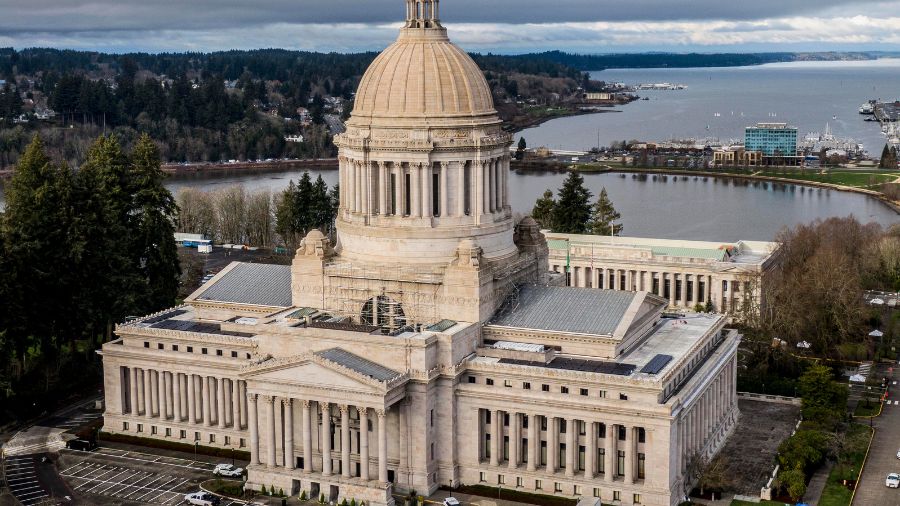
Washington lawmakers are now wrestling over competing transportation budget proposals, both of which call for increased gas taxes, new fees, and spending cuts to address a growing financial shortfall.
The state faces a $1 billion deficit over the next two years, ballooning to $8 billion over six years.
The proposed budgets from the Senate and House differ in approach, but both would require drivers to pay more at the pump and through additional fees.
Here’s a look at some of the similarities and differences.
Gas tax increases: The core of the debatebu
Both the House and Senate propose raising Washington’s already steep gas tax. The Senate plan calls for a 6-cent increase per gallon, bringing the state tax to 55.4 cents. The tax would then rise by 2% annually to adjust for inflation.
The House, meanwhile, proposes a 9-cent hike, with future increases also tied to inflation. These increases would take effect July 1, with the Senate’s plan expected to generate $1.5 billion over six years, while the House’s plan would bring in $1.8 billion.
While both chambers agree on the need for additional revenue, they take different approaches to filling the funding gap beyond the gas tax.
New fees and tax increases to generate revenue
In addition to gas tax hikes, both proposals introduce a range of new fees and tax increases.
Senate proposals:
- A $50 increase in electric vehicle registration fees.
- A new tax on luxury vehicles costing over $100,000.
- A higher rental car tax.
- A $10 surcharge on all traffic infractions.
- A new tolling proposal for the full State Route 520 corridor.
- An increase in ferry fares by 1.5% annually.
The Senate budget also proposes transferring 0.3% of sales tax collections from the general budget to transportation, adding $800 million annually starting in 2027. This move is not included in the House plan.
House proposals:
- An annual highway use fee based on a car’s fuel efficiency, with more efficient vehicles paying higher fees. This could raise $384 million over six years.
- An increase in the additional sales tax assessment on vehicles from 0.3% to 1%, projected to bring in over $1.1 billion over six years.
- A 3-cent increase on diesel fuel, starting in 2028.
- Increased registration fees based on vehicle weight for trucks and passenger vehiclesadam smith.
- A $4 additional fee per tire replacement.
- Increase in sales tax on vehicles, with a graduated tax for vehicles over $50,000, starting in 2026.
- A 1.5% annual increase in ferry fares starting in October 2025, plus a $1 surcharge for capital vessel projects.
Unlike the Senate, the House plan does not include furloughs for transportation workers to save money.
RELATED STORIES


Project delays and spending priorities
Despite new revenue streams, both proposals acknowledge that some planned projects will have to be delayed due to funding constraints. The House plan would delay $1.3 billion in projects between 2025 and 2031 that haven’t yet started.
Senate lawmakers, meanwhile, aim to shift funding for court-mandated fish passage projects (culvert replacements) to the capital budget to free up transportation dollars.
The House budget is slightly smaller, with $6.1 billion in operating expenses and $8.9 billion for capital projects, compared to the Senate’s $6.2 billion in operating costs and $10 billion for capital spending.
Both plans include about $1.3 billion from Washington’s carbon auctions under the Climate Commitment Act, funding transit, electrification projects, and other green initiatives.
The ferry system and workforce challenges
Washington’s struggling ferry system is also a major consideration. The Senate’s budget allots $845 million for new ferries and terminal maintenance, while the House plan allocates over $1.1 billion. The state expects to receive bids in May for the construction of five new hybrid-electric ferries.
The Senate plan includes 13 furlough days in 2026 for some state transportation workers (excluding ferry and highway responders) as a cost-saving measure. The House budget does not rely on furloughs.
Diverging visions for long-term transportation revenue
The House proposal also revives the long-debated idea of a road usage charge, charging drivers per mile instead of relying on the gas tax. Rep. Jake Fey, the House Transportation Committee chair, proposes an annual highway use fee instead, projected to bring in $384 million. The Senate does not include this concept in its plan.
Despite their differences, both budgets share a focus on financial stability, with the Senate setting aside $500 million in reserves and the House holding $1 billion for unexpected cost increases.
Public hearings on both budget proposals are scheduled this week, with committee votes to follow. Lawmakers will have a few weeks to negotiate a final compromise before the legislative session ends on April 27.
Matt Markovich is the KIRO Newsradio political analyst. Follow him on X.