US military shifts messaging in Africa, telling allies to prepare to stand more on their own
May 25, 2025, 7:38 AM
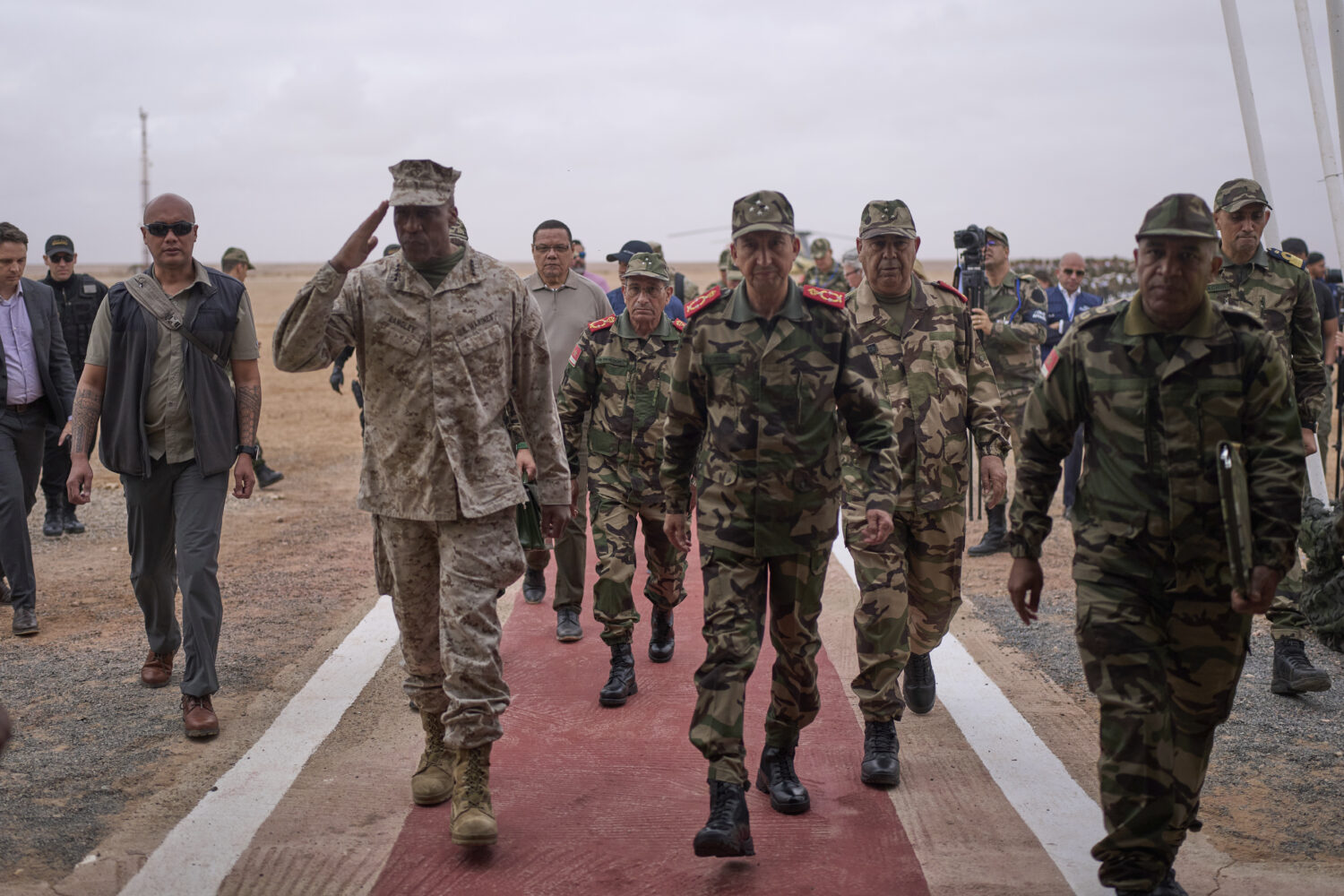
Gen. Michael Langley, USMC, Commander, U.S. Africa Command, center, and Major General Mohammed Berrid, Inspector General of Moroccan Royal Armed Forces, attend the 21st edition of the African Lion military exercise, in Tantan, south of Agadir, Morocco, Friday, May 23, 2025. (AP Photo/Mosa'ab Elshamy)
Credit: ASSOCIATED PRESS
(AP Photo/Mosa'ab Elshamy)

TAN TAN, Morocco (AP) — The U.S. military is backing off its usual talk of good governance and countering insurgencies’ underlying causes, instead leaning into a message that its fragile allies in Africa must be ready to stand more on their own.
At African Lion, its largest joint training exercise on the continent, that shift was clear: “We need to be able to get our partners to the level of independent operations,” Gen. Michael Langley said in an interview with The Associated Press.
“There needs to be some burden sharing,” Langley, the U.S. military’s top official in Africa, said on Friday, the final day of the exercise.
For four weeks, troops from more than 40 countries rehearsed how to confront threats by air, land, and sea. They flew drones, simulated close-quarters combat and launched satellite-guided rockets in the desert.
Maneuvers mirrored previous editions of African Lion, now in its 25th year. But mostly gone now is language that emphasizes ideas the U.S. once argued set it apart from Russia and China.
Messaging about the interwoven work of diplomacy and development once formed the core of Washington’s security pitch. In their place now are calls for helping allies build capacity to manage their own security, which Langley said was a priority for President Donald Trump’s Defense Department.
“We have our set priorities now — protecting the homeland. And we’re also looking for other countries to contribute to some of these global instability areas,” he said, referencing U.S. support for Sudan.
The shift comes as the U.S. military makes moves to “build a leaner, more lethal force,” including potentially cutting military leadership positions in places like Africa, where America’s rivals continue to deepen their influence.
China has launched its own expansive training program for African militaries. Russian mercenaries are recalibrating and cementing their role as security partner of choice throughout North, West and Central Africa.
In an interview a year ago, Langley emphasized what U.S. military officials have long called a “whole of government approach” to countering insurgency. Even amid setbacks, he defended the U.S. approach and said force alone couldn’t stabilize weak states and protect U.S. interests against the risk of violence spilling out.
“I’ve always professed that AFRICOM is just not a military organization,” Langley said last year. He called good governance an “enduring solution to a number of layered threats — whether it be desertification, whether it be crop failure from changing environments, or whether it be from violent extremist organizations.”
The “whole of government approach” no longer occupies the same place at the center of U.S. messaging, though Langley said holistic efforts have worked in places like Ivory Coast, where development and defense had reduced attacks by jihadi groups near its volatile northern border.
But such successes aren’t a pattern.
“I’ve seen progression and I’ve seen regression,” said Langley, who is scheduled to exit his post later this year.
The U.S. military’s new posture comes even though many African armies remain ill-equipped and insurgent groups expand.
“We see Africa as the epicenter for both al-Qaida and Islamic State,” a senior U.S. defense official said earlier this month, noting both groups had growing regional affiliates and the Islamic State group had shifted command and control to Africa. The official spoke on condition of anonymity because he wasn’t authorized to discuss the issue publicly.
Africa has rarely ranked high on the Pentagon’s list of priorities, but the U.S. has still spent hundreds of millions of dollars on security assistance and has roughly 6,500 Africa Command personnel on the continent. In some regions, the U.S. faces direct competition from Russia and China. In others, regional affiliates of al-Qaida and the IS still require direct military action, Langley said.
The messaging shift from “whole of government” to more burden-sharing comes as fears grow that rising violence could spread beyond hotspots where insurgents have expanded influence and found vacuums in which they can consolidate power.
Parts of of both East and West Africa have emerged as epicenters of violence. In 2024, more than half of the world’s terrorism victims were killed across West Africa’s Sahel, a vast desert territory ruled by military juntas, according to the Institute for Economics and Peace. The group, which compiles yearly terrorism statistics, also found Somalia accounted for 6% of all terrorism-related deaths, making it the deadliest for terrorism in Africa outside the Sahel.
Since Trump took office, the U.S. military has escalated airstrikes in Somalia, targeting IS and al-Shabab operatives. But despite air support, Somalia’s army remains far from being able to maintain security on the ground, Langley acknowledged.
“The Somali National Army is trying to find their way,” Langley said, adding that they had regained some footing after years of setbacks. “There are some things they still need on the battlefield to be very effective.”
Similarly in West Africa, the notion that states could soon have the capacity to counter such threats is a distant prospect, said Beverly Ochieng, an analyst at Control Risks, a security consulting firm. Even before Western influence began to wane in the Sahel, needed military support was limited, threats remained active, and local militaries were left without the tools to confront them.
Western powers with a presence in the Sahel have gradually scaled back their engagement, either by choice or after being pushed out by increasingly hostile governments.
“Many of them do not have very strong air forces and are not able to monitor the movement of militants, especially in areas where roads are very difficult to traverse, the infrastructure is extremely poor,” Ochieng, who specializes in the Sahel and Great Power competition in Africa, said.