Trump’s tariffs could pay for his tax cuts — but it likely wouldn’t be much of a bargain
Jun 6, 2025, 2:55 PM
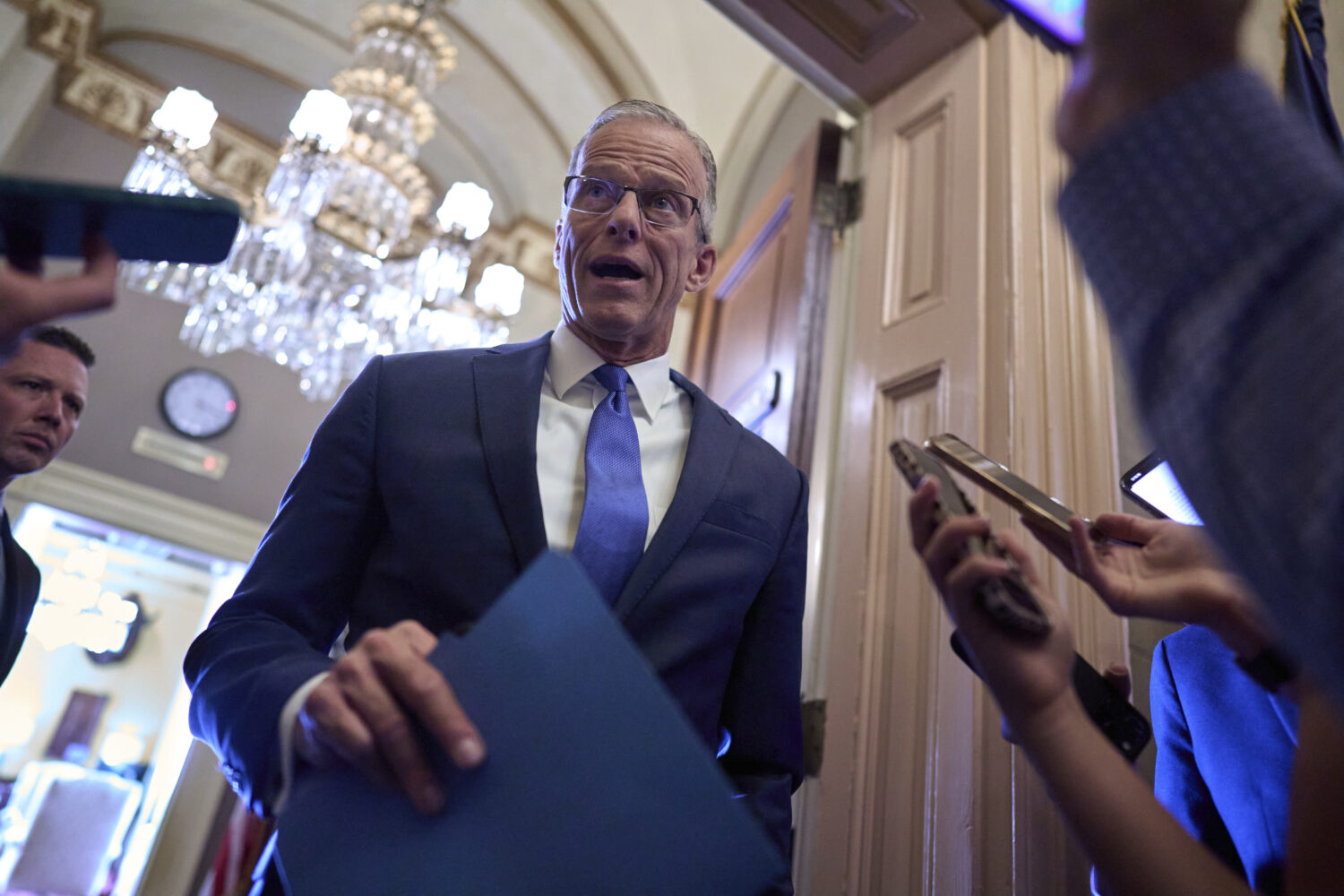
Senate Majority Leader John Thune, R-S.D., pauses in the door of his office to answer questions from reporters about his strategy to advance President Donald Trump's spending and tax bill, at the Capitol in Washington, Monday, June 2, 2025. (AP Photo/J. Scott Applewhite)
Credit: ASSOCIATED PRESS
(AP Photo/J. Scott Applewhite)

WASHINGTON (AP) —
The tax cuts in President Donald Trump’s One Big Beautiful Bill Act would likely gouge a hole in the federal budget.
The president has a patch handy, though: his sweeping import taxes — tariffs.
The Congressional Budget Office, the government’s nonpartisan arbiter of tax and spending matters, says the One Big Beautiful Bill, passed by the House last month and now under consideration in the Senate, would increase federal budget deficits by $2.4 trillion over the next decade. That is because its tax cuts would drain the government’s coffers faster than its spending cuts would save money.
By bringing in revenue for the Treasury, on the other hand, the tariffs that Trump announced through May 13 — including his so-called reciprocal levies of up to 50% on countries with which the United States has a trade deficit — would offset the budget impact of the tax-cut bill and reduce deficits over the next decade by $2.5 trillion.
So it’s basically a wash.
That’s the budget math anyway. The real answer is more complicated.
Actually using tariffs to finance a big chunk of the federal government would be a painful and perilous undertaking, budget wonks say. “It’s a very dangerous way to try to raise revenue,” said Kent Smetters of the University of Pennsylvania’s Penn Wharton Budget Model, who served in President George W. Bush’s Treasury Department.
Trump has long advocated tariffs as an economic elixir. He says they can protect American industries, bring factories back to the United States, give him leverage to win concessions over foreign governments — and raise a lot of money. He’s even suggested that they could replace the federal income tax, which now brings in about half of federal revenue.
“It’s possible we’ll do a complete tax cut,’’ he told reporters in April. “I think the tariffs will be enough to cut all of the income tax.’’
Economists and budget analysts do not share the president’s enthusiasm for using tariffs to finance the government or to replace other taxes. “It’s a really bad trade,’’ said Erica York, the Tax Foundation’s vice president of federal tax policy. “It’s perhaps the dumbest tax reform you could design.’’
For one thing, Trump’s tariffs are an unstable source of revenue. He bypassed Congress and imposed his biggest import tax hikes through executive orders. That means a future president could simply reverse them.
“Or political whims in Congress could change, and they could decide, ‘Hey, we’re going revoke this authority because we don’t think it’s a good thing that the president can just unilaterally impose a $2 trillion tax hike,’ ’’ York said.
Or the courts could kill his tariffs before Congress or future presidents do. A federal court in New York has already struck down the centerpiece of his tariff program — the reciprocal and other levies he announced on what he called “Liberation Day’’ April 2 — saying he’d overstepped his authority. An appeals court has allowed the government to keep collecting the levies while the legal challenge winds its way through the court system.
Economists also say that tariffs damage the economy. They are a tax on foreign products, paid by importers in the United States and usually passed along to their customers via higher prices. They raise costs for U.S. manufacturers that rely on imported raw materials, components and equipment, making them less competitive than foreign rivals that don’t have to pay Trump’s tariffs.
Tariffs also invite retaliatory taxes on U.S. exports by foreign countries. Indeed, the European Union this week threatened “countermeasures’’ against Trump’s unexpected move to raise his tariff on foreign steel and aluminum to 50%.
“You’re not just getting the effect of a tax on the U.S. economy,” York said. “You’re also getting the effect of foreign taxes on U.S. exports.’’
She said the tariffs will basically wipe out all economic benefits from the One Big Beautiful Bill’s tax cuts.
Smetters at the Penn Wharton Budget Model said that tariffs also isolate the United States and discourage foreigners from investing in its economy.
Foreigners see U.S. Treasurys as a super-safe investment and now own about 30% of the federal government’s debt. If they cut back, the federal government would have to pay higher interest rates on Treasury debt to attract a smaller number of potential investors domestically.
Higher borrowing costs and reduced investment would wallop the economy, making tariffs the most economically destructive tax available, Smetters said — more than twice as costly in reduced economic growth and wages as what he sees as the next-most damaging: the tax on corporate earnings.
Tariffs also hit the poor hardest. They end up being a tax on consumers, and the poor spend more of their income than wealthier people do.
Even without the tariffs, the One Big Beautiful Bill slams the poorest because it makes deep cuts to federal food programs and to Medicaid, which provides health care to low-income Americans. After the bill’s tax and spending cuts, an analysis by the Penn Wharton Budget Model found, the poorest fifth of American households earning less than $17,000 a year would see their incomes drop by $820 next year. The richest 0.1% earning more than $4.3 million a year would come out ahead by $390,070 in 2026.
“If you layer a regressive tax increase like tariffs on top of that, you make a lot of low- and middle-income households substantially worse off,’’ said the Tax Foundation’s York.
Overall, she said, tariffs are “a very unreliable source of revenue for the legal reasons, the political reasons as well as the economic reasons. They’re a very, very inefficient way to raise revenue. If you raise a dollar of a revenue with tariffs, that’s going to cause a lot more economic harm than raising revenue any other way.’’