Across the US, cities combine art, shade and education to help people beat the heat
Sep 12, 2025, 6:13 AM
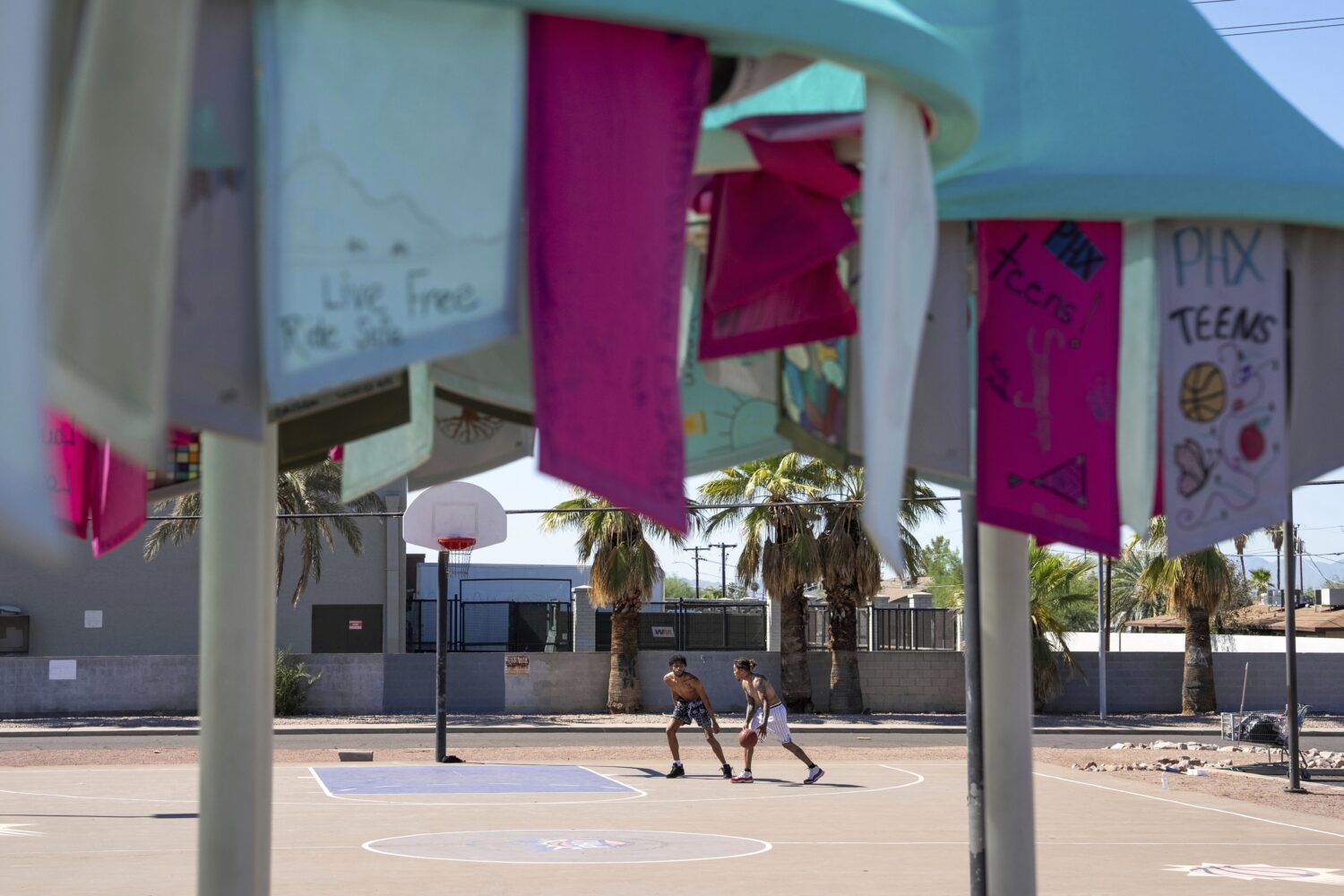
Edward Shephard, left, and Adrian Simpson play basketball near a temporary public art piece that provides shade at Sunnyslope Park in Phoenix, Saturday, Aug. 30, 2025. (AP Photo/Samantha Chow)
Credit: ASSOCIATED PRESS
(AP Photo/Samantha Chow)

LA CANADA FLINTRIDGE, Calif. (AP) — When sculptor Bobby Zokaites moved to Phoenix in the summer of 2011, walking the half mile to classes at Arizona State University in triple-digit heat felt risky. He learned to find shade along his route — resting in a stoplight’s sliver of it, dodging the sizzling sun at each opportunity.
“It was pretty crazy,” he recalled.
Those experiences influenced one of Zokaites’ latest projects: He was one of nine artists commissioned this year to bring shade to the region.
Across the U.S., cities are weaving art, science and community engagement to protect people from extreme heat and communicate its risks. As cities adapt to hotter temperatures, driven by human-caused climate change, and contend with urban heat, shade is playing a critical role. But communicating heat risks and safety can be challenging. That is where art comes in. It can engage, bring hope and even enhance how cool someone feels.
Shade “can be much more than functional,” said David Hondula, Phoenix’s director of heat response and mitigation. “It can enrich our public spaces.”
At one park in Phoenix, a large awning is held up with panels of dazzling colors. On them are painted whimsical creatures called “alebrijes” from Mexican folk art, and the structure contains a solar-powered misting system. At another park, a canopy decorated with colorful drawings uses reflective paint and an ultraviolet-resistant canvas.
These are part of Phoenix’s temporary public art pieces created with help from locals. Each was unveiled during a community event featuring information about shade and heat safety, along with free cooling towels and sunscreen.
“The more you know and the more you can recognize your own body’s response, the better you can take care of yourself,” said Carrie Brown, deputy director for the city’s office of art and culture.
These art installations are one element of the city’s plan to expand shade. Studies show that shade significantly reduces air and surface temperature and how intensely people feel heat. In a city that has averaged in the last decade more than 115 days annually with day temperatures past 100 F (38 C), cooling shade can be lifesaving.
Shade can feel even cooler when combined with beauty. One study in Phoenix, co-authored by Hondula, found that people rated aesthetically pleasing bus stops as being cooler than less beautiful ones. In another from Hong Kong, findings suggested that people had a higher heat tolerance when they perceived their environment as quiet and beautiful.
In Cambridge, Massachusetts, a place accustomed to dreary winters but not heat, a project titled “ Shade is Social Justice ” is helping the city convey heat dangers and safety with creative designs. One installation features hanging flowers that open when temperatures hit 85 F (29 C), signaling to people to cool down with water and shade, said Claudia Zarazua, the city’s art and cultural planning director.
On a recent afternoon in Phoenix, Arizona State University doctoral student Muhammad Abdullah rolled an advanced mobile weather station called MaRTy 3D+ next to a shade art installation in Cielito Park. He measured temperature, humidity, wind and radiation, then estimated what could be happening to a person’s body in both the shade and in direct sun light.
He found that moving from sun to shade dropped the mean radiant temperature from about 145 F (63 C) to 88 F (about 31 C). The change did not significantly affect core temperature, but skin temperature decreased immediately. When MaRTy3D+ returned to the sun, skin temperature rose again.
MaRTy 3D+’s ability to model and measure how different people thermoregulate is unique. It can tell researchers, for instance, the skin and core temperature as well as cardiac strain in someone who is elderly or on a specific medication, said Jennifer Vanos, an associate professor at ASU who studies heat’s impacts on the human body and how to mitigate them. This technology allows them to collect real-time data in sometimes risky situations without impacting humans. They are using their findings to make recommendations to the city.
Edith de Guzman, a cooperative extension researcher at the University of California, Los Angeles, has spent years researching how to increase shade in communities most impacted by heat. With colleagues, she has also quantified that shade can reduce up to 25% of heat-related deaths in LA and up to 66% of heat-related emergency room visits. When the opportunity emerged to curate an art exhibit about shade and who lacks access to it, she and her husband took it.
“Roots of Cool: A Celebration of Trees and Shade in a Warming World” takes visitors into the past, present and future roles of shade in LA with textiles, paintings, mixed media, interactive maps, suspended multicolored umbrellas and more. Their goal is not just to highlight the issue, but also show the general public that solutions exist, de Guzman said.
A three-part installation by artist Leslie K. Gray invites visitors to consider the past, current and future experiences of public transportation users in the city. Each features a silhouetted woman waiting at a bus stop with either no shade, a little bit or ample amounts. The bus stop signs include facts about the dangers of heat, the benefits of shade and the disparate access to it.
The exhibit ends in a room with hundreds of postcards with handwritten messages from visitors to the past, present or future. On the other side are drawings showing how they would bring much-needed shade to a bus stop.
Behind one card dated Sept. 1, a visitor wrote this message: “Dear people from the past. Take care of others among you. Take care of mother earth or we will be at fault for its destruction and ours. Sincerely — Someone (who’s) watching the effects of our actions occur.”
___
The Associated Press receives support from the Walton Family Foundation for coverage of water and environmental policy. The AP is solely responsible for all content. For all of AP’s environmental coverage, visit https://apnews.com/hub/climate-and-environment.