An uncommon program helps children displaced by flooding that devastated Alaska villages
Nov 14, 2025, 9:01 PM
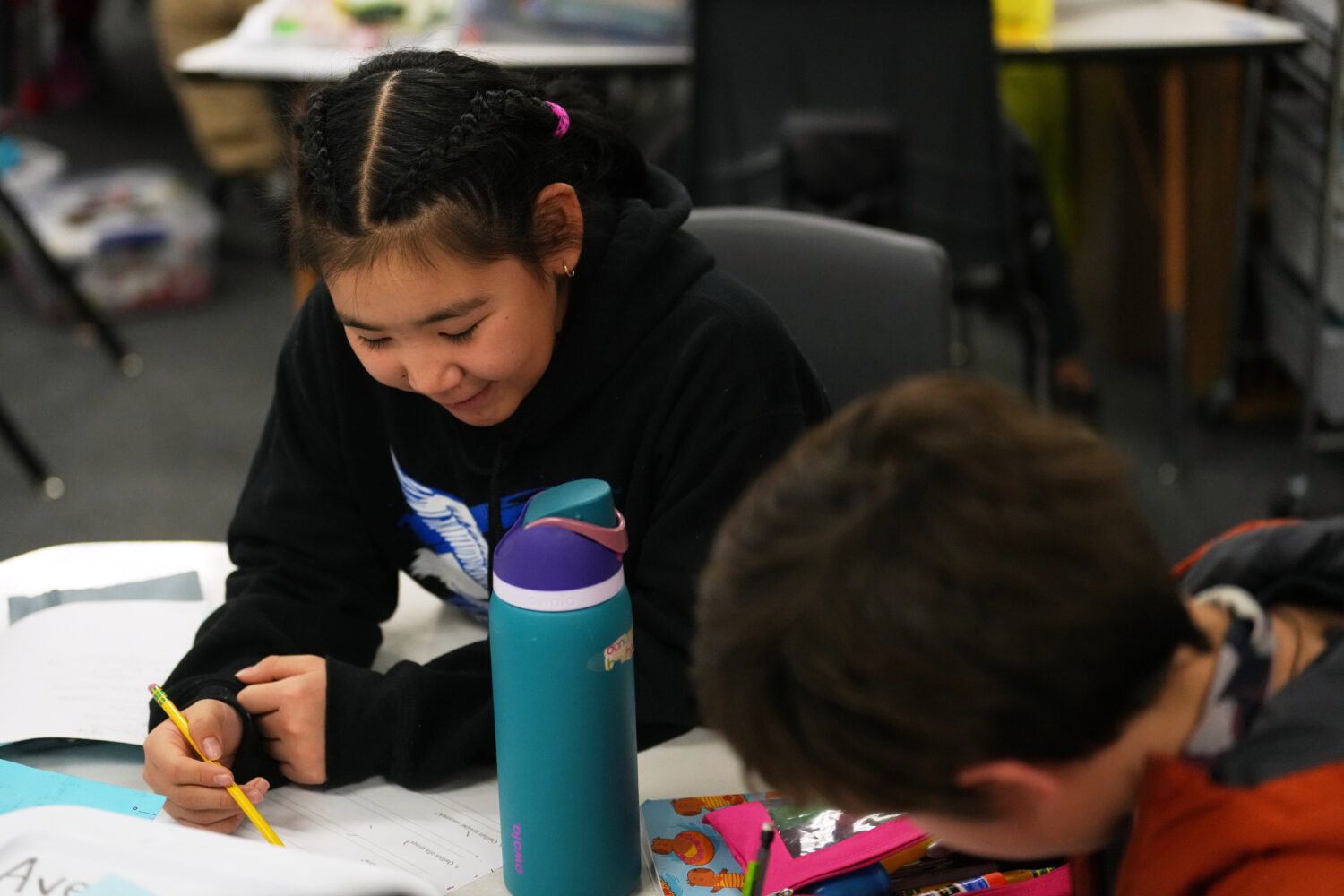
Rayann Martin, a 10-year-old displaced from the village of Kipnuk by ex-Typhoon Halong, left, talks with new classmate Lilly Loewen, 10, right, as they work in the Yup'ik language at College Gate Elementary, Thursday, Oct. 30, 2025, in Anchorage, Alaska. (AP Photo/Lindsey Wasson)
Credit: ASSOCIATED PRESS
(AP Photo/Lindsey Wasson)

ANCHORAGE, Alaska (AP) — Rayann Martin sat in a classroom hundreds of miles from her devastated Alaska Native village and held up 10 fingers when the teacher asked the pupils how old they were.
“Ten — how do you say 10 in Yup’ik?” the teacher asked.
“Qula!” the students answered in unison.
Martin and her family were among hundreds of people airlifted to Anchorage, the state’s largest city, after the remnants of Typhoon Halong inundated their small coastal villages along the Bering Sea last month, dislodging dozens of homes and floating them away — many with people inside. The floods left nearly 700 homes destroyed or heavily damaged. One person died, two remain missing.
As the residents grapple with uprooted lives very different from the traditional ones they left, some of the children are finding a measure of familiarity in a school-based immersion program that focuses on their Yup’ik language and culture — one of two such programs in the state.
“I’m learning more Yup’ik,” said Martin, who added that she’s using the language to communicate with her mother, teachers and classmates. “I usually speak more Yup’ik in villages, but mostly more English in cities.”
There are more than 100 languages spoken in the homes of Anchorage School District students. Yup’ik, which is spoken by about 10,000 people in the state, is the fifth most common. The district adopted its first language immersion program — Japanese — in 1989, and subsequently added Spanish, Mandarin Chinese, German, French and Russian.
After many requests from parents, the district obtained a federal grant and added a K-12 Yup’ik immersion program about nine years ago. The students in the first class are now eighth-graders. The program is based at College Gate Elementary and Wendler Middle School.
The principal at College Gate Elementary, Darrell Berntsen, is himself Alaska Native — Sugpiaq, from Kodiak Island, south of Anchorage. His mother was 12 years old in 1964 when the magnitude-9.2 Great Alaska Earthquake and an ensuing tsunami devastated her village of Old Harbor. He recalls her stories of joining other villagers at high ground and watching as the surge of water carried homes out to sea.
His mother and her family evacuated to a shelter in Anchorage, but returned to Kodiak Island when Old Harbor was rebuilt. Berntsen grew up living a subsistence life — “the greatest time of my life was being able to go out duck hunting, go out deer hunting,” he said — and he understands what the evacuees from Kipnuk, Kwigillingok and other damaged villages have left behind.
He has also long had an interest in preserving Alaska Native culture and languages. His ex-wife’s grandmother, Marie Smith Jones, was the last fluent speaker of Eyak, an indigenous language from south-central Alaska, when she died in 2008. His uncles had their hands slapped when they spoke their indigenous Alutiiq language at school.
As the evacuees arrived in Anchorage in the days after last month’s flooding, Berntsen greeted them at an arena where the Red Cross had set up a shelter. He invited families to enroll their children in the Yup’ik immersion program. Many of the parents showed him photos of the duck, goose, moose, seal or other traditional foods they had saved for the winter — stockpiles that washed away or spoiled in the flood.
“Listening is a big part of our culture — hearing their stories, letting them know that, ‘Hey, I live here in Anchorage, I’m running one of my schools, the Yup’ik immersion program, you guys are welcome at our school,’” Berntsen said. “Do everything we can to make them feel comfortable in the most uncomfortable situation that they’ve ever been through.”
Some 170 evacuated children have enrolled in the Anchorage School District — 71 of them in the Yup’ik immersion program. Once the smallest immersion program in the district, it’s now “booming,” said Brandon Locke, the district’s world language director.
At College Gate, pupils receive instruction in Yup’ik for half the day, including Yup’ik literacy and language as well as science and social studies. The other half is in English, which includes language arts and math classes.
Among the program’s new students is Ellyne Aliralria, a 10-year-old from Kipnuk. During the surge of floodwater the weekend of Oct. 11, she and her family were in a home that floated upriver. The high water also washed away her sister’s grave, she said.
Aliralria likes the immersion program and learning more phrases, even though the Yup’ik dialect being spoken is a bit different from the one she knows.
“I like to do all of them, but some of them are hard,” the fifth-grader said.
Also difficult is adjusting to living in a motel room in a city nearly 500 miles (800 km) from their village on the southwest coast.
“We’re homesick,” she said.
Lilly Loewen, 10, is one of many non-Yup’iks in the program. She said her parents wanted her to participate because “they thought it was really cool.”
“It is just really amazing to get to talk to people in another language other than just what I speak mostly at home,” Loewen said.
Berntsen is planning to help the new students acclimate by holding activities such as gym nights or Olympic-style events, featuring activities that mimic Alaska Native hunting and fishing techniques. One example: the seal hop, in which participants assume a plank position and shuffle across the floor to emulate how hunters sneak up on seals napping on the ice.
The Yup’ik immersion program is helping undo some of the damage Western culture did to Alaska Native language and traditions, he said. It’s also bridging the gap of two lost generations: In some cases, the children’s parents or grandparents never learned Yup’ik, but the students can now speak with their great-grandparents, Locke said.
“I took this as a great opportunity for us to give back some of what the trauma had taken from our Indigenous people,” Berntsen said.