Toy inventor Burt Meyer, who dreamed up Lite-Brite and Rock ’Em Sock ’Em Robots, dies age 99
Nov 25, 2025, 1:49 PM | Updated: 2:12 pm
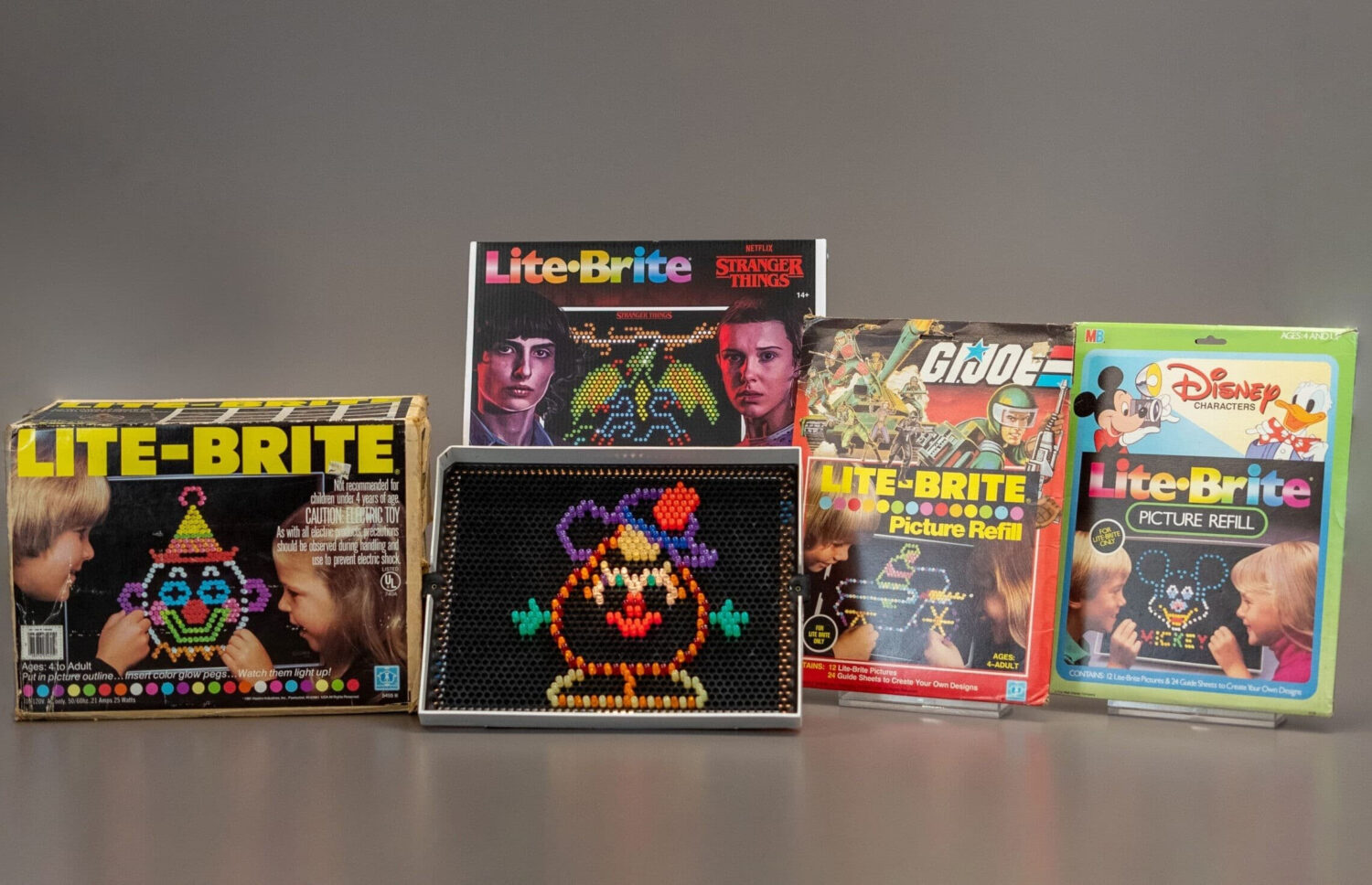
This photo provided by The Strong National Museum of Play shows Lite-Brite toys created by Burt Meyers part of the museum's collection sitting in an arrangement at The Strong National Museum of Play in Rochester, N.Y. (The Strong National Museum of Play via AP)
Credit: ASSOCIATED PRESS
(The Strong National Museum of Play via AP)

Burt Meyer, who invented toys like Rock ’Em Sock ’Em Robots, Lite-Brite and MouseTrap in the 1960s that delighted a generation of childhoods, has died. He was 99.
Meyer’s creations arrived in the postwar boom, when plastic molding and mass production transformed how American children played. That shift opened the door for more dynamic toys, and Meyer seized the moment with designs that would stay on shelves for decades.
Meyer died on Oct. 30, said Rebecca Mathis, executive director at King-Bruwaert House, a retirement community in Burr Ridge, Illinois, where he lived.
Meyer succeeded by straddling two often conflicting worlds, carrying a boundless childlike imagination alongside a pragmatic understanding of machines.
The idea for Lite-Brite came in 1966 when Meyer was walking in Manhattan with Marvin Glass, who owned one of the largest toy design companies at the time, and the two men passed a window display featuring hundreds of colored lights. Engineers at the company doubted that electic lights could be safely adapted for children, according to Tim Walsh, who interviewed Meyer for his 2005 book “Timeless Toys.”
Meyer, an employee at Marvin Glass & Associates, insisted it could.
“There’s billions of ideas out there,” Walsh wrote, “but executing them into a final creative solution is often the hard part.”
Meyer came up with a small backlit box and black paper sheets that allowed kids to create illuminated patterns. Lite-Brite was a hit, earning spots on Time Magazine’s list of 100 greatest toys and in the Strong National Museum of Play’s hall of fame. New versions are still being sold.
Meyer had a similar role with a design team that reimagined a bulky boxing arcade game for home use. The original concept stalled in development after a featherweight boxer died from a brain injury, making any toy that invoked the tragedy unmarketable, company leaders thought.
Meyer revisited the idea with a simple shift. “This is too good to pass up,” he recalled saying in a 2010 interview. “Let’s take it away from humanity, let’s make it robots. And we won’t have them fall over, we’ll have something funny happen.”
The result was Rock ’Em Sock ’Em Robots, a small game where players control the fighters’ fists by pressing buttons on joysticks. A player wins by hitting the jaw of the opposing robot, theatrically popping up the spring-loaded head.
The toy remained recognizable to later generations, appearing in the film “Toy Story 2,” and the toy company Mattel announced plans in 2021 for a live action movie adaptation.
Meyer launched his own firm, Meyer/Glass Design, in the mid-1980s. The company developed numerous best-sellers including Gooey Louie, where children picked boogers our of Louie’s nose, and the Pretty Pretty Princess board game. His son, Steve Meyer, ran the business until 2006, according to The New York Times.
Born in 1926 as Burton Carpenter Meyer, he enlisted in the Navy and served for two years as an aircraft mechanic. After retiring from toy making, he moved to Downers Grove, a suburb of Chicago, where he built small planes and could be seen deftly steering them aloft from a nearby private airfield well into his 80s.
In interviews, Meyer often drew parallels between aerospace engineering and toy design, saying both required ingenutity and teamwork.
“When you’re flying the airplane, use every resource that you have in there. That’s why we were able to turn out so many successful products,” Meyer said, crediting his success to the highly collaborative environment at Marvin Glass & Associates.
Meyer’s car had a vanity plate that said TOYKING, and by most accounts, he was. In a 2010 interview, he said he was still delighted by telling people what he did for a living, and having them respond: “Oh, I played with that!”