Sure, the newspaper informed. But as it fades, those who used it for other things must adjust, too
Dec 26, 2025, 9:44 PM
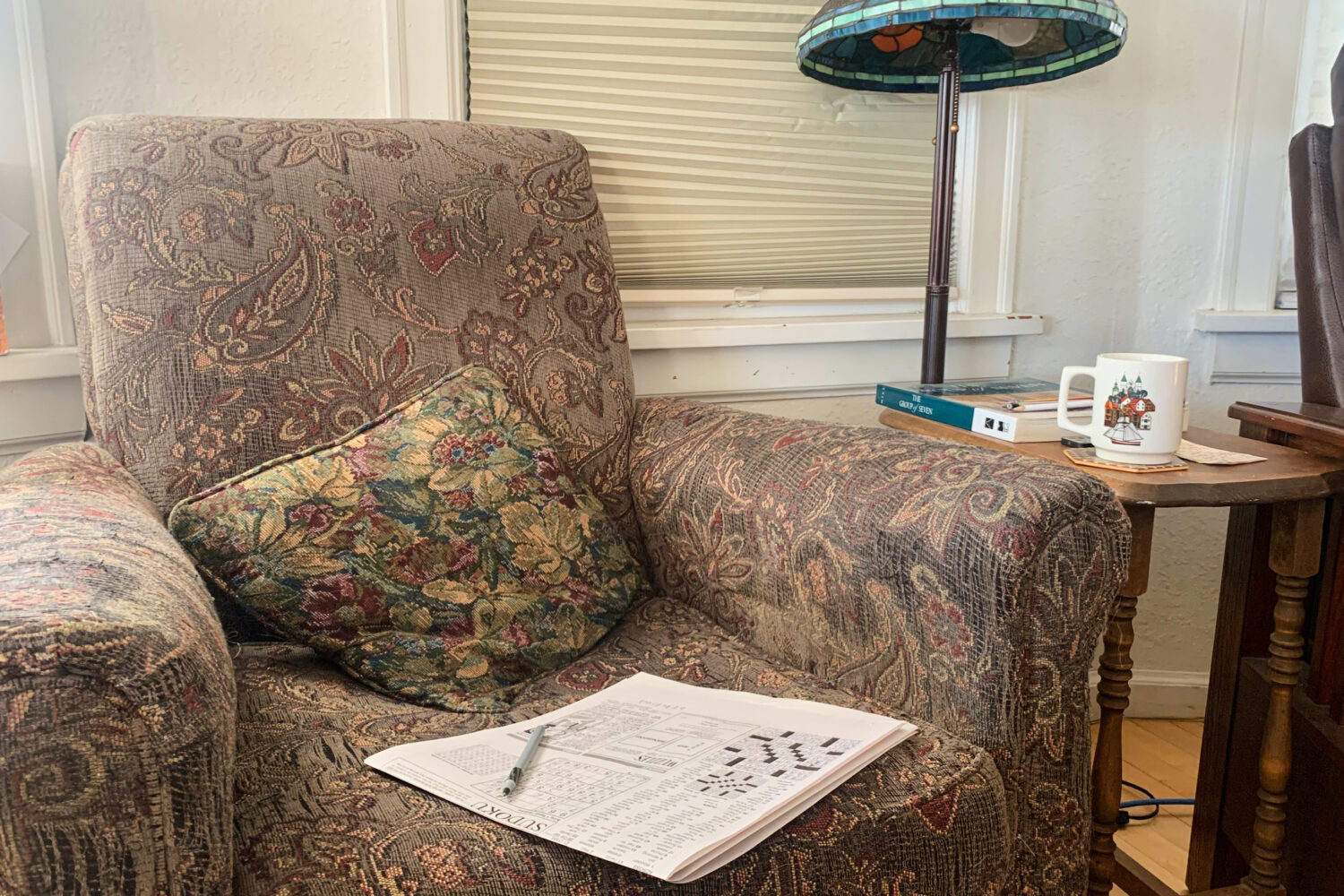
This photo provided by Colleen Elliott shows a completed Montana Standard crossword sitting on a chair in Elliott's home, Saturday, Oct. 18, 2025, in Butte, Mont. (Colleen Elliott via AP)
Credit: ASSOCIATED PRESS
(Colleen Elliott via AP)

The sun would rise over the Rockies, and Robin Gammons would run to the front porch to grab the morning paper before school.
She wanted the comics and her dad wanted sports, but the Montana Standard meant more than their daily race to grab “Calvin and Hobbes” or baseball scores. When one of the three kids made honor roll, won a basketball game or dressed a freshly slain bison for the History Club, appearing in the Standard’s pages made the achievement feel more real. Robin became an artist with a one-woman show at a downtown gallery and the front-page article went on the fridge, too. Five years later, the yellowing article is still there.
The Montana Standard slashed print circulation to three days a week two years ago, cutting back the expense of printing like 1,200 U.S. newspapers over the past two decades. About 3,500 papers closed over the same time. An average of two a week have shut this year.
That slow fade, it turns out, means more than changing news habits. It speaks directly to the newspaper’s presence in our lives — not just in terms of the information printed upon it, but in its identity as a physical object with many other uses.
“You can pass it on. You can keep it. And then, of course, there’s all the fun things,” says Diane DeBlois, one of the founders of the Ephemera Society of America, a group of scholars, researchers, dealers and collectors who focus on what they call “precious primary source information.”
“Newspapers wrapped fish. They washed windows. They appeared in outhouses,” she says. “And — free toilet paper.”
The downward lurch in the media business has changed American democracy over the last two decades — some think for better, many for worse. What’s indisputable: The gradual dwindling of the printed paper — the item that so many millions read to inform themselves and then repurposed into household workflows — has quietly altered the texture of daily life.
People used to catch up on the world, then save their precious memories, protect their floors and furniture, wrap gifts, line pet cages and light fires. In Butte, in San Antonio, Texas, in much of New Jersey and worldwide, lives without the printed paper are just a tiny bit different.
For newspaper publishers, the expense of printing is just too high in an industry that’s under strain in an online society. For ordinary people, the physical paper is joining the pay phone, the cassette tape, the answering machine, the bank check, the sound of the internal combustion engine and the ivory-white pair of women’s gloves as objects whose disappearance marks the passage of time.
“Very hard to see it while it’s happening, much easier to see things like that in even modest retrospect,” says Marilyn Nissenson, co-author of “Going Going Gone: Vanishing Americana.” “Young women were going to work and they wore them for a while and then one day they looked at them and thought, ‘This is ludicrous.’ That was a small but telling icon for a much larger social change.”
Nick Mathews thinks a lot about newspapers. Both of his parents worked at the Pekin (Illinois) Daily Times. He went on to become sports editor of the Houston Chronicle and, now, an assistant professor at the University of Missouri’s School of Journalism.
“I have fond memories of my parents using newspapers to wrap presents,” he says. “In my family, you always knew that the gift was from my parents because of what it was wrapped in.”
In Houston, he recently recalled, the Chronicle reliably sold out when the Astros, Rockets or Texas won a championship because so many people wanted the paper as a keepsake.
Four years ago, Mathews interviewed 19 people in Caroline County, Virginia, about the 2018 shuttering of the Caroline Progress, a 99-year-old weekly paper that was shuttered months before its 100th anniversary.
In “Print Imprint: The Connection Between the Physical Newspaper and the Self,” published in the Journal of Communication Inquiry, wistful Virginians remember their senior high school portrait and their daughter’s picture in a wedding dress appearing in the Progress. Plus, one told Mathews, “My fingers are too clean now. I feel sad without ink smudges.”
Flush with cash from Omahans who invested years ago with local boy Warren Buffett, Nebraska Wildlife Rehab is a well-equipped center for migratory waterfowl, wading birds, reptiles, foxes, bobcats, coyotes, mink and beaver.
“We get over 8,000 animals every year and we use that newspaper for almost all of those animals,” Executive Director Laura Stastny says.
Getting old newspapers has never been a problem in this neighborly Midwestern city. Yet Stastny frets about the electronic future.
“We do pretty well now,” she says. “If we lost that source and had to use something else or had to purchase something, that, with the available options that we have now, would cost us more than $10,000 a year easily.”
That would be nearly 1% of the budget, Stastny says, but “I’ve never been in a position to be without them, so I might be shocked with a higher dollar figure.”
Until 1974, the Omaha World-Herald printed a morning edition and two afternoon ones, including a late-afternoon Wall Street Edition with closing prices.
“Afternoon major-league baseball was still standard then, so I got to gorge on both baseball and stock market facts,” an 85-year-old Buffett told the World-Herald in 2013, By then, he had become the world’s most famous investor and the paper’s owner.
The World-Herald ended its second afternoon edition in 2016 and Buffett left the newspaper business five years ago. Fewer than 60,000 households take the paper today, according to Northwestern University’s Medill School of Journalism, down from nearly more than 190,000 in 2005, or about one per household.
Few places symbolize the move from print to digital more than Akalla, a district of Stockholm where the ST01 data center sits at a site once occupied by the factory that prints Sweden main newspaper, Kaun says.
“They have less and less machines, and instead the building is taken over more and more by this co-location data center,” she says.
Data centers use huge amounts of energy, of course, and the environmental benefit of using less printing paper is also offset by the enormous popularity of online shopping.
“You will see a decline in printed papers, but there is a huge increase in packaging,” says Cecilia Alcoreza, manager, of forest sector transformation for the World Wildlife Fund.
The Atlanta Journal-Constitution announced in August that it would stop providing a print edition at year’s end and go completely digital, making Atlanta the largest U.S. metro area without a printed daily newspaper.
The habit of following the news — of being informed about the world — can’t be divorced from the existence of print, says Anne Kaun, professor of media and communication studies at Södertörn University in Stockholm.
Children who grew up in homes with printed newspapers and magazines randomly came across news and socialized into a news-reading habit, Kaun observed. With cell phones, that doesn’t happen.
“I do think it meaningfully changes how we relate to each other, how we relate to things like the news. It is reshaping attention spans and communications,” says Sarah Wasserman, a cultural critic and assistant dean at Dartmouth College in New Hampshire who specializes in changing forms of communication.
“These things will always continue to exist in certain spheres and certain pockets and certain class niches,” she says. “But I do think they’re fading.”