Masked agents, face scans and a question: Are you a citizen? Inside Trump’s Minnesota crackdown
Jan 29, 2026, 9:09 PM
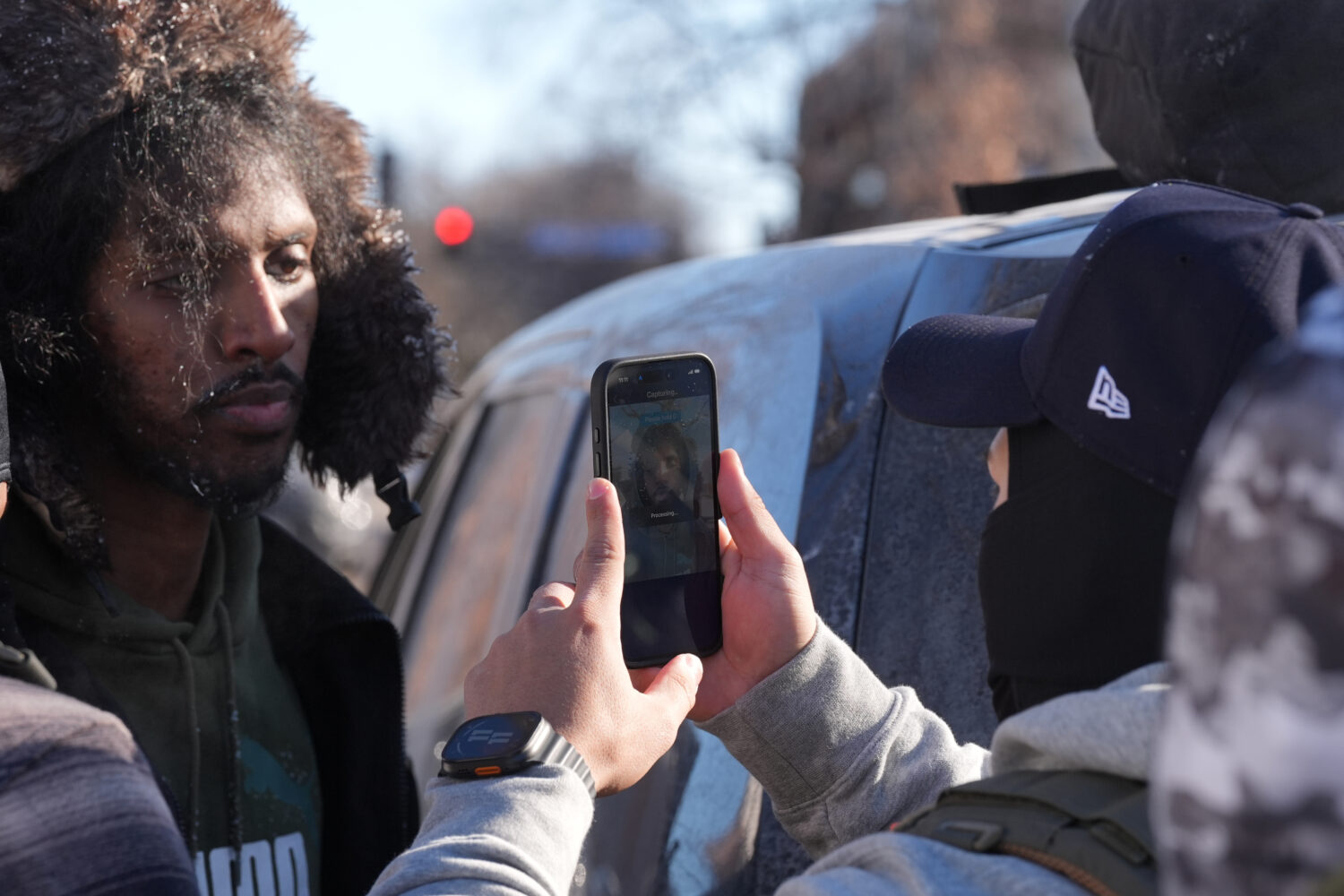
ADDS REFERENCE TO FACIAL RECOGNITION APP - Federal agents use a facial recognition app on a person detained and who later released on Tuesday, Jan. 27, 2026, in Minneapolis. (AP Photo/Adam Gray)
Credit: ASSOCIATED PRESS
(AP Photo/Adam Gray)

Luis Martinez was on his way to work on a frigid Minneapolis morning when federal agents suddenly boxed him in, forcing the SUV he was driving to a dead stop in the middle of the street.
Masked agents rapped on the window, demanding Martinez produce his ID. Then one held his cellphone inches from Martinez’s face and scanned his features, capturing the shape of his eyes, the curves of his lips, the exact quadrants of his cheeks.
All the while, the agent kept asking: Are you a U.S. citizen?
The encounter in a Minneapolis suburb this week captures the tactics on display in the Trump administration’s immigration crackdown in Minnesota, which it describes as the largest of its kind and one that has drawn national scrutiny after federal agents shot and killed two U.S. citizens this month.
Across Minnesota and other states where the Department of Homeland Security has surged personnel, officials say enforcement efforts are targeted and focused on serious offenders. But photographs, videos and internal documents paint a different picture, showing agents leaning heavily on biometric surveillance and vast, interconnected databases — highlighting how a sprawling digital surveillance apparatus has become central to the Trump administration’s immigration crackdown.
Civil liberties experts warn the expanding use of those systems risks sweeping up citizens and noncitizens alike, often with little transparency or meaningful oversight.
Over the past year, Homeland Security and other federal agencies have dramatically expanded their ability to collect, share and analyze people’s personal data, thanks to a web of agreements with local, state, federal and international agencies, plus contracts with technology companies and data brokers. The databases include immigration and travel records, facial images and information drawn from vehicle databases.
In Martinez’s case, the face scan didn’t find a match and it wasn’t until he produced his U.S. passport, which he said he carried for fear of such an encounter, that federal agents let him go.
“I had been telling people that here in Minnesota it’s like a paradise for everybody, all the cultures are free here,” he said. “But now people are running out of the state because of everything that is happening. It’s terrifying. It’s not safe anymore.”
Together with other government surveillance data and systems, federal authorities can now monitor American cities at a scale that would have been difficult to imagine just a few years ago, advocates say. Agents can identify people on the street through facial recognition, trace their movements through license-plate readers and, in some cases, use commercially available phone-location data to reconstruct daily routines and associations.
When asked by The Associated Press about its expanding use of surveillance tools, the Department of Homeland Security said it would not disclose law enforcement sensitive methods.
“Employing various forms of technology in support of investigations and law enforcement activities aids in the arrest of criminal gang members, child sex offenders, murderers, drug dealers, identity thieves and more, all while respecting civil liberties and privacy interests,” it said.
Dan Herman, a former Customs and Border Protection senior adviser in the Biden administration who now works at the Center for American Progress, said the government’s access to facial recognition, other personal data and surveillance systems poses a threat to people’s privacy rights and civil liberties without adequate checks.
“They have access to a tremendous amount of trade, travel, immigration and screening data. That’s a significant and valuable national security asset, but there’s a concern about the potential for abuse,” Herman said. “Everyone should be very concerned about the potential that this data could be weaponized for improper purposes.”
On Wednesday, DHS disclosed online that it has been using a facial recognition app, Mobile Fortify, that it said uses “trusted source photos” to compare scans of people’s faces that agents take to verify their identity. The app, which Customs and Border Protection said is made by the vendor NEC, uses facial comparison or fingerprint-matching systems.
The app was in operation for CBP and ICE before the immigration crackdown in the Los Angeles area in June, when website 404Media first reported its existence.
In interactions observed by reporters and videos posted online, federal agents are rarely seen asking for consent before holding their cellphones to people’s faces, and in some clips they continue scanning even after someone objects.
In two instances seen by an AP journalist near Columbia Heights, Minnesota, where immigration officials recently detained a 5-year-old boy and his father, masked agents held their phones a foot away from people’s faces to capture their biometric details.
The technology resembles facial recognition systems used at airports, but unlike airport screenings, where travelers are typically notified and can sometimes opt out, Martinez said he was given no choice.
According to a lawsuit filed against DHS by the state of Illinois and the city of Chicago this month, DHS has used Mobile Fortify in the field more than 100,000 times. The Department of Homeland Security told AP that Mobile Fortify supports “accurate identity and immigration-status verification during enforcement operations. It operates with a deliberately high-matching threshold,” and uses only some immigration data.
Without federal guidelines for the use of facial recognition tools, the U.S. Commission on Civil Rights warned in a September 2024 report their deployment raises concerns about accuracy, oversight, transparency, discrimination and access to justice.
Last year, the Trump administration scaled back a program to give Immigration and Customs Enforcement officials body cameras, but administration officials said some agents tied to the fatal shooting of Minneapolis ICU nurse Alex Pretti were wearing them and that footage is now being reviewed.
Gregory Bovino, who was the administration’s top Border Patrol official charged with the immigration crackdown in Minneapolis until Monday, began wearing a bodycam in response to a judge’s order late last year.
Body-camera video could help clarify events surrounding federal agents’ killing of Pretti, who was filming immigration agents with his cellphone when they shot him in the back.
Administration officials shifted their tone after i ndependent video footage emerged raising serious questions about some Trump officials’ accusations that Pretti intended to harm agents.
Homeland Security and affiliated agencies are piloting and deploying more than 100 artificial intelligence systems, including some used in law enforcement activities, according to the department’s disclosure Wednesday.
Congress last year authorized U.S. Customs and Border Protection to get more than $2.7 billion to build out border surveillance systems and add in AI and other emerging technologies.
In recent weeks, DHS requested more information from private industry on how technology companies and data providers can support their investigations and help identify people.
Meanwhile, longtime government contractor Palantir was paid $30 million to extend a contract to build a system designed to locate people flagged for deportation. On Wednesday, the Trump administration disclosed it’s using Palantir’s AI models to sift through immigration enforcement tips submitted to its tip line.
DHS has also been exploring partnerships with license-plate reader companies like Flock Safety to expand their tracking capabilities.
Rachel Levinson-Waldman, who directs the Brennan Center for Justice’s Liberty and National Security Program, said more funding for government surveillance tools changes the landscape.
“We are developing these technologies for immigrant enforcement,” she said. “Are we also going to expand it or wield it against U.S. citizens who are engaging in entirely lawful or protest activity?”
___
AP freelance photojournalist Adam Gray contributed to this report from Minneapolis.
___
Contact AP’s global investigative team at Investigative@ap.org or https://www.ap.org/tips/