Trump talks regime change in Iran after strikes, but history shows that could be very hard
Mar 1, 2026, 2:39 AM
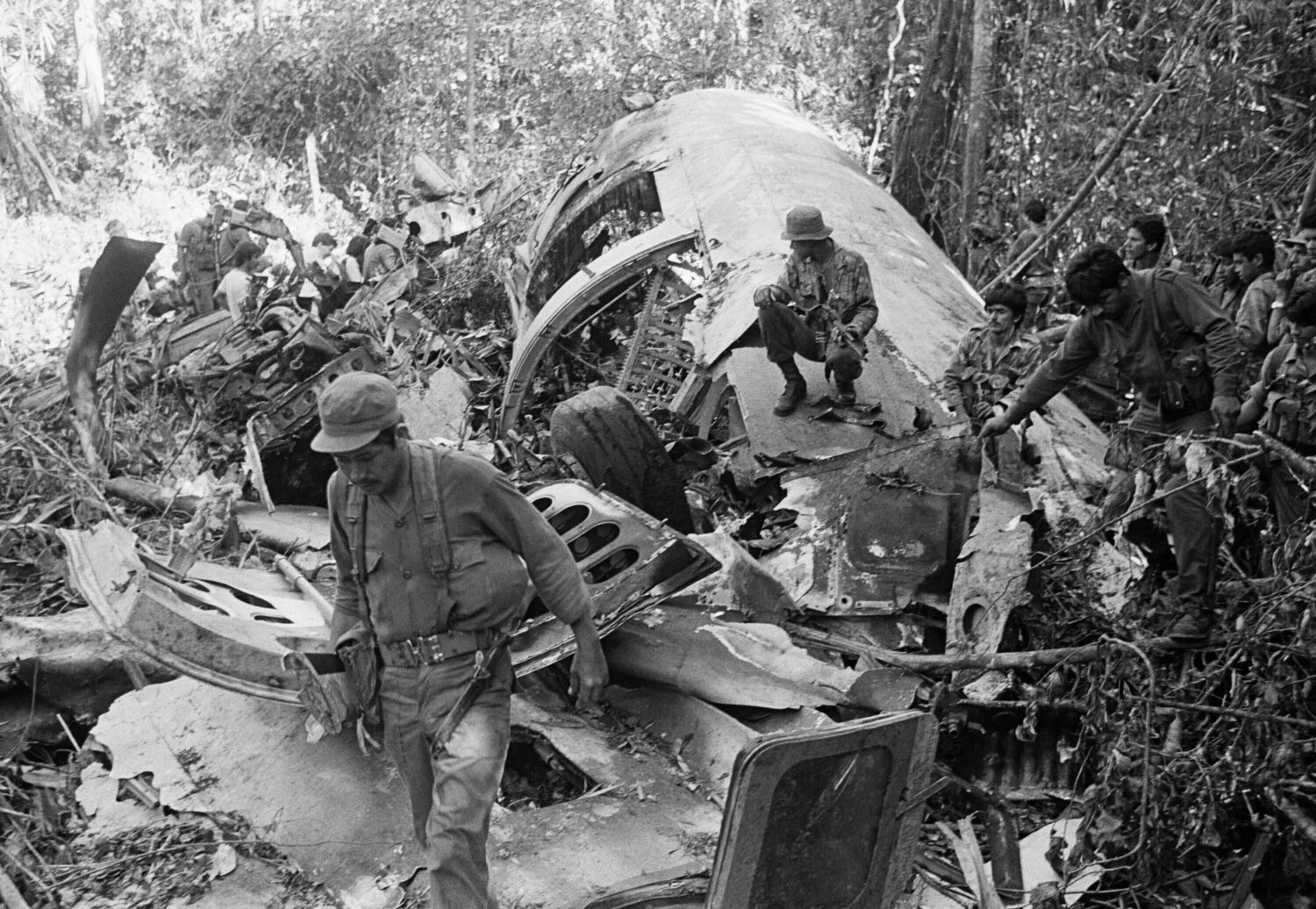
FILE - Sandinista soldiers walk amid the debris after shooting down a supply plane of the U.S.-backed rebels in Loma El Arenal, Nicaragua, on Jan. 24, 1988. (AP Photo/Mario Tapia, File)
Credit: ASSOCIATED PRESS
(AP Photo/Mario Tapia, File)

Barely an hour after the first U.S. and Israeli missiles struck Iran, President Donald Trump made clear he hoped for regime change. “Now is the time to seize control of your destiny,” he told the Iranian people in a video. “This is the moment for action. Do not let it pass.”
Doesn’t sound complicated. After all, with Iran’s fundamentally unpopular government weakened by fierce airstrikes, some of its top leaders dead or missing and Washington signaling support, how hard could it be to overthrow a repressive regime?
Possibly very hard. So says history.
Washington has a long, complicated past when it comes to regime change. There was Vietnam in the 1960s and 70s, and Panama in 1989. There was Nicaragua in the 1980s, Iraq and Afghanistan in the years after 9/11, and Venezuela just weeks ago.
There was also Iran. In 1953, the CIA helped engineer a coup that toppled Iran’s democratically elected leader and gave near-absolute power to Shah Mohammad Reza Pahlavi. But as with the shah, who was overthrown in Iran’s 1979 Islamic Revolution after decades of increasingly unpopular rule, regime change rarely goes as planned.
Attempts to usher in U.S.-friendly governments often start with clear intentions, whether hope for democracy in Iraq or backing an anti-Communist leader in Congo at the Cold War’s height. But often those intentions stumble into a political quagmire where democratic dreams turn into civil war, once-compliant dictators become embarrassments and American soldiers return home in body bags.
That history has long been a Trump talking point. “We must abandon the failed policy of nation building and regime change,” he said in 2016.
“In the end, the so-called ‘nation-builders’ wrecked far more nations than they built,” he said in a 2025 speech in Saudi Arabia, deriding U.S. efforts in Afghanistan and Iraq. The “interventionists were intervening in complex societies that they did not even understand.”
Now, after Saturday’s actions, a key question emerges: Does today’s U.S. government understand what it’s getting into?
Iran’s economy is in shambles and dissent remains strong even after a brutal January crackdown on protests left thousands of people dead and tens of thousands under arrest. Many of the nation’s key military proxies and allies — Hamas in Gaza, Hezbollah in Lebanon, the Assad government in Syria — have been weakened or eliminated. And early Sunday, Iranian state media confirmed Israel and the United States had killed Supreme Leader Ayatollah Ali Khamenei.
The United States hasn’t laid out a postwar vision and doesn’t necessarily even want a complete overthrow of the Iranian leadership. As in Venezuela, it may already have potential allies in the government willing to step into a power vacuum.
“But there’s a lot that needs to happen between now and a possible scenario along these lines,” said Jonathan Schanzer, executive director at the Foundation for Defense of Democracies, a Washington think tank that is deeply critical of the Iranian government. “There needs to be a sense that there is no salvation for the regime as such, and that they will need to work with the United States.”
In a country where the core leaders are deeply united by ideology and religion, that may be extremely difficult.
“The question to my mind right now is have we been able to penetrate the ranks of the regime that are not true believers that are more pragmatic,” Schanzer said. “Because I don’t believe that the true believers will flip.”
It’s simply too early to know if — or how much — the political winds are shifting in Tehran. The leaders who come next could turn out to be equally repressive or seen domestically as an illegitimate U.S. stooge.
“We’ll see whether elements of the regime start moving against each other,” said Phillips O’Brien, professor of strategic studies at the University of St. Andrews in Scotland. “Air power can damage a leadership,” he said. “But it can’t guarantee that you’ll bring in something new.”
In Latin America, Washington’s history of intervention in goes back a long way — to when President James Monroe claimed the hemisphere as part of the U.S. sphere of influence more than 200 years ago.
If the Monroe Doctrine began as a way to keep European countries out of the region, by the 20th century it was justifying everything from coups in Central America to the failed Bay of Pigs invasion of Cuba in 1961. Very often, historians say, that intervention led to violence, bloodshed and mass human rights violations. Therein, they say, lies a lesson.
Direct U.S. involvement has rarely “resulted in long-term democratic stability,” said Christopher Sabatini, a senior fellow for Latin America at the London think tank Chatham House. He points to Guatemala, where U.S. intervention in the 1950s led to a civil war that didn’t end for 40 years and left more than 200,000 people dead.
Or there’s Nicaragua, where backing of the Contra rebels against the Sandinista government in the 1980s contributed to a prolonged civil conflict that devastated the economy, caused tens of thousands of deaths and deepened political polarization.
While large-scale, overt U.S. involvement in the region mostly petered out after the Cold War, Trump has rekindled the legacy.
Since assuming office last year, Trump launched boat strikes against alleged drug traffickers in the Caribbean, ordered a naval blockade on Venezuelan oil exports and got involved in electoral politics in Honduras and Argentina. Then, on Jan. 3, U.S. forces captured Venezuelan strongman leader Nicolás Maduro, flying him to the U.S. to face drug and weapons charges.
What followed in Caracas may signal what the White House hopes will happen in Tehran. Many observers thought the U.S. would back María Corina Machado, who has long been the face of political resistance in Venezuela. Instead, Washington effectively sidelined her and has repeatedly shown a willingness to work with President Delcy Rodríguez, who had been Maduro’s second-in-command.
“There are those who could claim that what we did in Venezuela is not regime change,” said Schanzer, at the Foundation for Defense of Democracies. “The regime is still in place. There’s just one person that’s missing.”
___
Tim Sullivan has reported from more than 35 countries for The Associated Press since 1993. Danica Kirka in London and Eléonore Hughes in Rio de Janeiro contributed to this report.