‘Number one priority’: Democrats celebrate ‘millionaire tax’ passage while Republicans vow pushback as session closes
Mar 12, 2026, 4:20 PM

Exterior of the Washington state Capitol campus. (Photo: Julia Dallas, MyNorthwest)
(Photo: Julia Dallas, MyNorthwest)
Washington lawmakers wrapped up the final day of the 2026 legislative session Thursday, sending several major and controversial proposals to the governor’s desk while other measures died before the deadline.
Among the most closely watched bills was the state’s new 9.9% income tax on household and business incomes more than $1 million, along with legislation addressing policing policies, immigration enforcement notifications, artificial intelligence disclosures, and DUI prosecutions.
Below is a breakdown of key bills that passed and those that failed, and the reactions from leadership on both sides of the aisle on the last day of the session.
Income tax on millionaires heads to governor
After a marathon 24-hour debate in the House earlier this week, Washington’s proposed “millionaire tax” cleared its final legislative hurdle and is now headed to the governor’s desk.
The measure nearly stalled in the Senate on Wednesday when Republican Sen. Chris Gildon raised a procedural challenge, arguing amendments added by the House, particularly those related to business taxes, went beyond the scope of the original Senate bill.
Gildon argued the measure should be sent back to the House to edit those provisions — a move that could have delayed the bill beyond the session deadline and potentially forced a special legislative session.
Lt. Gov. Denny Heck, who serves as president of the Senate, spent about an hour consulting with attorneys from both parties before ultimately rejecting the challenge, allowing the bill to move forward.
Opponents fear the tax will send many of the state’s highest earners packing. At the same time, they say the tax will discourage out-of-state companies from setting up shop in Washington.
Shortly after the House approved the bill earlier this week, Starbucks founder Howard Schultz announced he plans to move to Florida, which does not have a state income tax.
“I think there will almost certainly be a legal challenge, and if the State Supreme Court cares about the state constitution, that should be the end of it. It couldn’t be more clear,” Senate Republican Leader John Braun said. “Property is everything owned, tangible and intangible. It’s hard to get to the conclusion that somehow income isn’t property, and if income is property, the Constitution doesn’t allow a graduated income tax … what the Democrats were successful in doing, I think, to the harm of our state, is prohibiting a referendum. If they really care about what the people of Washington say, putting the question to them, just like it is to the legislature, in the form of a referendum where ‘no’ gets rid of the tax and ‘yes’ keeps the tax, is the right way to do that.”
Senate Majority Leader and Democrat Jamie Pedersen said, “I would say our number one priority was to pass the ‘millionaire tax,’ and we have done that, so that will help us with all of our main priorities this year. It helps right our budget. It also helps by creating some more affordability for working families in the state, and it helps us have the resources to be able to continue pushing back against the Trump administration.”
Mask ban for police and federal agents advances
Lawmakers also approved a controversial bill, Senate Bill 5855, that prohibits police officers and federal law enforcement agents from wearing masks while on duty.
The measure now heads to the governor for signature.
Republicans strongly opposed the bill, arguing it may violate constitutional protections.
Democrats argued the legislation is about transparency and public accountability, saying people should be able to see the faces of officers, including federal immigration agents, who stop or arrest them.
“I’m excited that the bill passed the House and the Senate, and I’m looking forward to signing that,” Washington Governor Bob Ferguson said. “I think it’s outrageous that we have ICE agents and unmarked cars plucking people off our streets. That’s outrageous, and this bill addresses that.”
“That will be significantly helpful,” Pedersen added before applauding another bill that passed — regulating license plate readers to prevent federal agents from using the technology for immigration enforcement. “We will now have among the most restrictive statutes in the country on the use of those automated license plate readers, protecting the privacy of people in Washington. So that’s a significant benefit for us.”
Wins for Republicans
One significant victory for Republicans this session was the defeat of Senate Bill 6045, which sought to create a formal process allowing Washington’s agricultural workers to engage in collective bargaining with their employers.
Supporters of the bill argued it would empower farm workers and address what they described as a longstanding inequity by giving agricultural laborers the ability to unionize and negotiate working conditions, wages, and benefits.
The proposal aimed to extend collective bargaining rights that most private-sector employees already have but that agricultural workers largely do not. However, the measure failed to advance before the end of the legislative session.
Braun also pointed to a partial rollback of the state’s estate tax — the highest in the nation — from 35% to 20%. “They know this is a bad thing, and they’ve decided to undo it, take it back to a mere 20%… still the highest in the country, but better than it was for the last year,” said Sen. Braun.
Lawmakers also rejected Senate Bill 5360, a bill designed to reform the state’s environmental crime statutes by establishing a three-tiered system of criminal penalties for violations of water pollution control, clean air, and hazardous waste regulations.
“It would have been a killer for any type of construction, especially large construction,” Braun said. “The risks of building anything under that bill would have been extreme. I think it would have brought our, frankly, our limited construction in the state of Washington, to a screeching halt.”
DUI blood test backlog bill passes
Another bill aimed at speeding up DUI prosecutions also passed and now awaits the governor’s signature.
The measure would allow blood samples in DUI investigations to be tested by private laboratories instead of relying solely on the Washington State Crime Lab.
Supporters said the change is needed because the state lab is overwhelmed, sometimes taking more than a year to return test results.
Opponents argued the measure could create disparities between jurisdictions if wealthier cities and counties can afford private lab testing while smaller communities cannot.
DUI limit reduction fails
A proposal to lower Washington’s legal blood alcohol limit from 0.08% to 0.05% failed to pass this session.
The Washington Hospitality Association opposed the measure, arguing it shifted the focus away from drivers who knowingly drive drunk.
That opposition appeared to be enough to stall the proposal before it could advance.
State can decertify sheriffs and police chiefs
Senate Bill 5974, which passed the Senate 30-19, will allow Washington to decertify sheriffs and police chiefs who fail to meet professional standards.
Critics argued the bill undermines local voters by allowing a state oversight board to remove elected officials.
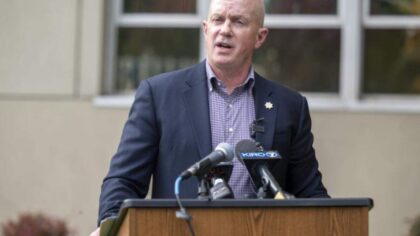
Pierce County Sheriff Keith Swank told “The John Curley Show” on KIRO Newsradio that he may resist the law.
“I’m standing up for the rights of people,” Swank said. “And if I can’t say what’s on my mind and exercise my First Amendment rights, then nobody will be able to.”
Pedersen said, “We’ve also passed really common-sense legislation that just says that the same rules that apply to line officers, sheriff’s deputies, and police officers are now going to apply to their bosses.”
AI, chatbots, and human chip implants
AI and other tech-related issues were front and center for both sides of the aisle this session.
House Bill 2225 passed, requiring chatbots to disclose if they are human or not.
Under the law, users will receive a disclosure at the beginning of a conversation informing them they are interacting with an automated system.
Lawmakers also approved a bill preventing employers from requiring workers to have microchips implanted under their skin. The bill was largely preemptive as no U.S. companies currently require workers to receive such implants.
The implants, typically small RFID devices about the size of a grain of rice, can be inserted between the thumb and index finger and are sometimes used to access buildings or devices.
According to the Carnegie Council for Ethics in International Affairs, roughly 50,000 people worldwide have implanted RFID chips.
Republican lawmakers said they will continue to focus on appropriate guardrails for the use of AI — especially when used by children — but want to temper guardrails that slow or interfere with growth across the tech industry.
“There is an attorney general priority bill that would have regulated what sort of videos TikTok, Facebook, and Instagram can show you; rather than showing you things based on what you’re interested in, it would have to show everybody the same thing. We think that was pretty unwise and needlessly restrictive,” House Republican Leader Drew Stokesbary explained. “There are a couple of other bills that kind of did the same thing. There is a data center bill that would have made it really hard to keep building data centers in Washington State, which creates a ton of jobs for us and makes us a leader in the tech world. That bill died. So I think we were pleased that some of the most anti-tech legislation was not able to cross the finish line.”
Employers required to warn workers of immigration inspections
Lawmakers also approved a bill requiring employers to notify immigrant workers about upcoming federal immigration enforcement actions.
Under the measure, businesses must warn employees if they are aware of upcoming federal I-9 inspections or other immigration enforcement activity.
Employers who fail to provide notice could face fines under the new law.
Budget compromises
There were multiple compromises made by both sides of the aisle to push through the state’s many departmental budgets. Senate Bill 6346, a major tax code change this year, initially contained funding for public defense for cities and counties, however that portion was eventually stripped out.
House Speaker Laurie Jinkins said the “millionaire tax” will help.
“What you will see in both the millionaire’s tax bill and the budget is a commitment to $200 million of the revenue that we get from that bill going to local governments,” Jinkins said. “It will go to local governments in a flexible way, rather than just listing that it must be for indigent defense. So local governments will be able to spend that money on indigent defense if they decide to do that, but they will have more flexibility than just being instructed that the money can just go for one thing, so that that will be an opportunity for local governments to decide how they prioritize, knowing that the State Supreme Court has required that we lower the ratio of cases that every attorney who’s doing indigent defense has.”
Rep. Stokesbary applauded efforts to compromise on parts of the Capital and Transportation budgets.
“The capital budget, I think, is going to do a lot of good for our communities. I think the transportation budget will as well,” Stokesbary said. “We figured out a way to allow electric vehicle makers, Rivian and Lucid, to be able to sell directly to consumers here in Washington. That’s been something we’ve been trying to navigate for a couple of years, and we finally figured out a path.”
RELATED STORIES


Looking to next session
As lawmakers look to the next legislative session, both sides named areas they will concentrate on funding and supporting. Pedersen pointed to education, housing, and health care as top priorities.
“The thing that we didn’t really have the time to tackle, from my perspective, is really education funding, and that’s big work that will be back for us next year,” Pedersen said. “We won’t have solved our housing problems between now and then, so I suspect we’ll be back to working on trying to increase housing supply and protect people in the meantime. And then I think health care is a dramatic challenge for us, given what the federal government has done in terms of destabilizing the entire health care system. So, I would say those would be right at the top of the list for next session.”
Ferguson said he plans to push for more investment in the state’s ferry system, which he highlighted in his State of the State address.
“I was disappointed by the investment in ferries,” he explained. “That was the one thing I think that I highlighted when I look back at my State of the State address … that was not in the budget. And I understand that there’s lots of competing priorities, but I really do believe we’re making progress on addressing the crisis with our ferry system, but we can only continue making progress if we continue to invest in the new ferries that we need. So I’ll definitely be coming back next session when I propose my budget with an emphasis on investments in ferries.”
Stokesbary said Republicans will focus on affordability, arguing Washington’s high cost of living can’t be blamed solely on federal policies.
“We are going to continue to be laser focused on making Washington more affordable,” Stokesbary said. “The majority party wants to blame the other Washington for tariff policies driving up prices here in Washington, but tariffs don’t explain why Washington is more expensive than pretty much every other state, and it doesn’t explain why things that are totally unconnected to tariffs, like child care, are so much more expensive here than other states and legislative Republicans are going to be laser focused for the next year and beyond at getting those price increases under control so that regular people can afford to live in our great state.”
Ferguson has until April 4 to sign bills that passed the House and Senate during this current session into law.
Follow Luke Duecy on X. Read more of his stories here. Submit news tips here.