Analysis: 1 month into war, Iran is using insurgent tactics and holding the world economy hostage
Mar 27, 2026, 8:07 AM
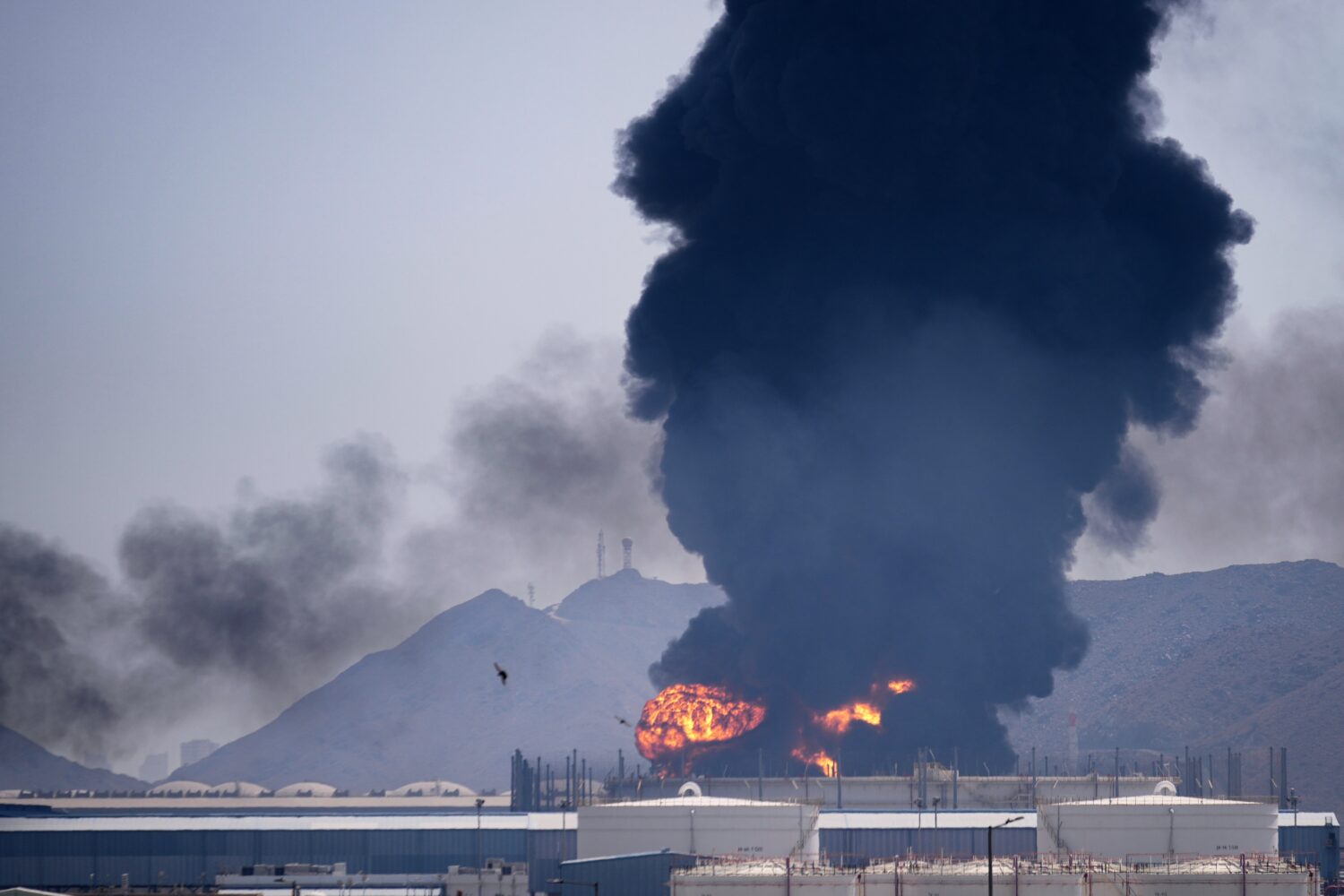
A fire and plume of smoke rise after, according to authorities. debris from an intercepted Iranian drone struck an oil facility in Fujairah, United Arab Emirates, Saturday, March 14, 2026.(AP Photo/Altaf Qadri)
Credit: ASSOCIATED PRESS
(AP Photo/Altaf Qadri)

DUBAI, United Arab Emirates (AP) — One month into their war with Iran, the United States and Israel find themselves confronting an opponent that fights more like an insurgency than a nation — using increasingly limited resources to inflict maximum pain.
Despite being battered daily by airstrikes from two of the world’s most sophisticated militaries, Iran has shown it can still torment its Gulf Arab neighbors and Israel with missiles and drones and maintain a stranglehold on the world’s economy, primarily through threats.
Tehran’s ability to control the flow of traffic — and therefore the flow of oil — through the Strait of Hormuz is its biggest strategic advantage. And, in fact, it’s a tactic that Iran’s very own proxies have adopted for years under decades of its tutelage as the leader of the self-described “Axis of Resistance.”
Meanwhile, Iran’s economy, long ago cut off from the global markets because of sanctions, is broadly insulated from the pain it is now inflicting on others.
The chokehold on the strait is causing oil prices to skyrocket, stock markets to plunge, and the cost of many basic goods to rise, putting pressure on U.S. President Donald Trump that could lead him to escalate the conflict further.
While Iran has found some success with cutting off the strait, it has its own problems lurking at home that the U.S. and Israel may be able to exploit the longer the war goes on. But its theocracy’s path to victory through insurgent-like tactics remains fairly simple — just survive.
“The Islamic Republic understands that it cannot defeat the United States militarily,” wrote Shukriya Bradost, a Mideast security analyst. “Instead, its objective is both simpler and more strategic: Survive the war long enough to claim victory.”
The Strait of Hormuz, the narrow mouth of the Persian Gulf through which a fifth of all oil and natural gas once passed, now finds itself largely devoid of traffic. The Islamic Republic allows through only the shipments it wants and at a price it dictates. Even with nearly all of its navy destroyed, Iran can hold the waterway hostage through an arsenal of missiles and drones built up over decades.
Countries in Asia, the primary customers for oil that passes through the strait, are feeling the pinch most acutely — but the market for oil is global, so drivers in Europe and the U.S. are also seeing price hikes. And since oil is so fundamental to the world economy — its cost is baked into the manufacture and transport of many goods — it’s not just gasoline prices that are rising.
That’s bad news for Trump, who was already struggling to show Americans he could bring down the cost of living ahead of midterm elections in November.
Ending the standoff is not easy. One way would be to negotiate a ceasefire — and Trump says talks are progressing, something Iran denies.
If that fails, the U.S. and Israel would either have to decide they have achieved enough and walk away from the war — or dramatically escalate the conflict to force the strait open. Trump has already ordered thousands more paratroopers and Marines into the region. And he has set a new deadline — already delayed twice — of 8 p.m. Eastern time April 6 for Iran to reopen the strait. Otherwise, he’s threatened to begin bombing power plants in Iran.
“Trump’s preference remains ‘escalate to de-escalate,’” the risk advisory Eurasia Group said in an analysis Thursday. “The U.S. is moving more ships and ground troops into the region and will be better prepared to escalate in mid-April.”
But Iran has shown itself resilient to the battering it has received thus far.
Trump on Thursday night said about 9% of Iran’s missile arsenal remains. There was no way to independently verify that figure — but even if accurate, Tehran still has ways to wreak havoc.
With its aircraft broadly destroyed and its air defenses at their weakest, Iran still maintains a vast network of air and sea bases, many built up decades ago.
It also has more recently built underground bases, which along with missile launchers disguised as commercial trucks, allow it to hide its launch sites until the last minute. Keeping mobile launchers on the move can protect them from airstrikes.
That strategy, known as “shoot and scoot,” is a mainstay of many insurgent groups, including Yemen’s Houthi rebels. The Iran-backed group itself successfully disrupted international shipping, in the Red Sea. Shiite militias in Iraq, also backed by Iran, used similar tactics against U.S. troops there. Both have survived if not thrived while being repeatedly targeted.
Iran’s geography and terrain — a mountainous nation about the size of America’s largest state, Alaska — also give it the space and features to hide like an insurgent force.
But problems still lurk under the surface for Iran as well.
Both American and the Israeli leaders have said they hope Iran’s people, who challenged the country’s theocracy in nationwide protests in January, would take over their government.
There have been no signs of any such uprising — and, for now, many Iranians are sheltering from airstrikes.
Iran’s public also remembers the government’s bloody crackdown earlier this year that saw thousands killed and tens of thousands detained. The Revolutionary Guard’s all-volunteer Basij force, which was key to that crackdown, remains active despite repeatedly being targeted in the war, with social media videos showing their armed fighters roaming streets, blaring propaganda from loudspeakers.
In a sign that Iran is feeling the pressure on its forces, Guard official Rahim Nade-Ali said it has begun to recruit children as young as 12 for the Basij. He described it as responding to public demand — but it is also a way to fill out its ranks as its checkpoints come under attack.
Questions also remain about Iran’s leadership. Mojtaba Khamenei hasn’t been seen publicly since becoming Iran’s new supreme leader, with U.S. officials saying he’s been wounded in the war. The Guard and other military units appear to be operating without any central command. And any ceasefire deal that doesn’t give the Guard and hard-liners what they want could fracture the country’s political leadership.
But Trump’s military pressure might not be having the desired effect.
“Washington seems to believe that an overwhelming display of military power will force the Iranians to the negotiating table,” the New York-based Soufan Center said in an analysis Friday. “But … the U.S. can’t expect to gain in peace what it was not able to take in war.”
___
EDITOR’S NOTE — Jon Gambrell, news director for the Gulf and Iran for The Associated Press, has reported from each of the Gulf Cooperation Council countries, Iran and other locations across the Mideast and the wider world since joining AP in 2006.