They scour the Mexican cartel lands for the missing — and for closure
Apr 14, 2026, 10:02 PM
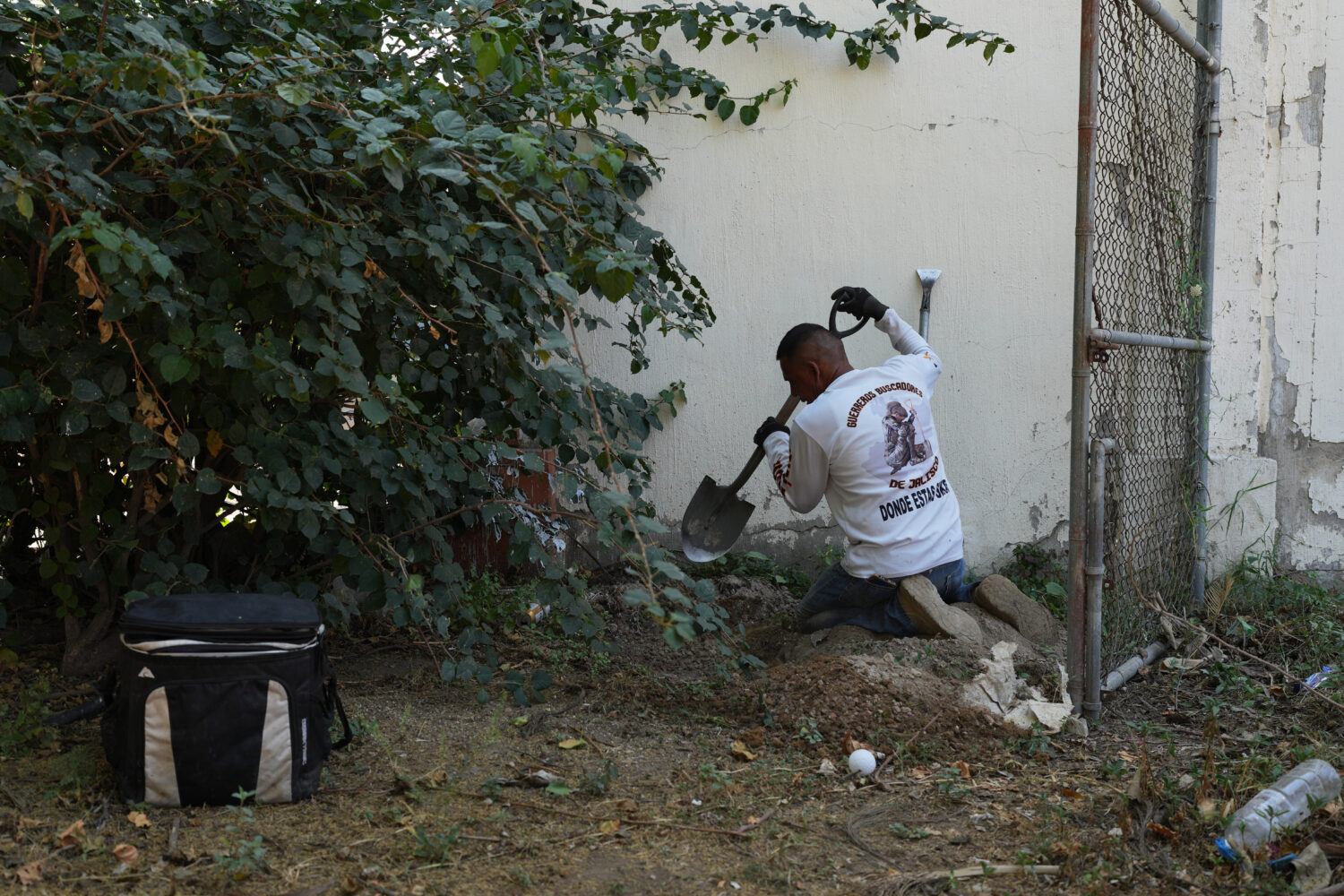
Raul Servin, whose son disappeared eight years prior, inspects an area where the Guerreros Buscadores group of serarchers suspects bodies may be buried, in Tlajomulco de Zuniga, on the outskirts of Guadalajara, Mexico, Tuesday, March 24, 2026. (AP Photo/Eduardo Verdugo)
Credit: ASSOCIATED PRESS
(AP Photo/Eduardo Verdugo)

GUADALAJARA, México (AP) — For hours under the blistering sun, Raúl Servín shovels and digs his way through days filled with pain, hope and usually frustration. He is looking for his son, gone eight years now — and for “ all the other missing people ” in Mexico as well.
Every Tuesday, Servín loads a van with picks, shovels, water and lunches. He commends himself to God. He picks up his three teammates for the day. Then they venture forth into areas where the ground beneath their feet may sometimes hide the bodies of the missing — the victims of foul play in a Mexican state rife with drug cartel violence.
They call themselves the Guerreros Buscadores — the “Searching Warriors.” There is much to search for, and dozens of groups like theirs do: More than 130,000 people have been reported missing since 2006, according to official records.
On a recent day, these Guerreros agreed to be shadowed by an Associated Press photojournalist to see what they do — and why it matters. They set out to cover several locations on the outskirts of Guadalajara, the capital of the Mexican state of Jalisco and a World Cup host city.
Servín and the three women go alone, the only semblance of an authority a “panic button” held by Servín that connects to a federal network to protect rights activists.
It is perilous work in a perilous environment. Mexico is neither at war nor under a military dictatorship, yet thousands of people disappear every year amid cartel violence. Clandestine graves are discovered on a semiregular basis; more than 70,000 unidentified remains have piled up in morgues and cemeteries.
The previous administration recognized the magnitude of the problem and launched official search commissions, but high levels of impunity and inaction persist. The current government has said missing information for one-third of those disappeared makes it impossible to look for them at all. Families remain the main driving force behind the searches and the findings.
The group heads to several locations based on anonymous tips received on the Guerreros Buscadores website. These often come from people who heard screams or gunshots or who saw something but fear going to the authorities.
On their previous outing, they dug down more than a yard (meter) at four locations. Nothing. Sometimes they find bloodstains or shell casings. They check every tip anyway. Says Servín: “There cannot be room for doubt.”
He receives a call. An informant says there is a body buried in a residential area. The information seems reliable, so they change their plans.
Arches mark the entrance to the residential complex identified by the informant. It sits next to a commuter train line on the outskirts of Guadalajara, a city plastered with fliers of missing people. Jalisco state, a stronghold of the Jalisco New Generation Cartel, is an epicenter of disappearances.
Mexican President Claudia Sheinbaum visited the area following the violence that erupted in February over the killing of the cartel’s leader. She insisted that security for the World Cup would be guaranteed.
The search collectives want to take advantage of the world’s focus on Mexico to draw attention to their reality. “I love soccer,” Servín says, “but that’s not going to stop me from going out to search.”
Caps and scarves shield the searchers from the sun. Each wears a personalized T-shirt with a photo of their loved one. Servín’s reads “Searcher Dad.”
They begin digging in a small dirt area at one residential corner. They dig and dig some more. Nothing.
Then, after hours of no progress, Servín steps outside the apartment complex and walks between the wall and the tracks. The ground is soft. “I saw a hole with small rocks; it was strange.”
Years ago, his heart would have raced. Now he says, “I don’t get nervous anymore.”
He kneels and grips his shovel. A train passes. First he sees part of a skull. He begins to dig out the soil with his shovel and hands.
“We’ve got a positive!” he shouts.
Servín shows his colleagues the head, holding it with the utmost delicacy. They decide to keep digging to look for the full body. A bag of bones appears. Then a shoe. Then a pelvis. They carefully place each outside the pit.
The women’s voices mingle like lullabies. “Hi baby, you’re going home soon.” “Your family is waiting for you.” One lights a candle at the edge of the pit.
To someone unfamiliar with violent environments, the scene might seem macabre. To those who witness it, it’s an act of tremendous tenderness and solidarity carried out by people who were re-victimized by the authorities for years. In 2021, a prosecutor handed a woman the remains of her relative in a trash bag. A photo of her with a vacant stare over the huge black bag at her feet went viral.
Criminals often hide their victims because if there’s no body, there’s no crime. Nearly 20,000 missing people have been found dead since 2010. So finding a body can be dangerous.
Servín activates his panic button that many searches carry and talks to federal officials on the line. Since 2010, at least 36 searchers have been killed, according to civil society organizations. The latest was in mid-March. Then he phones the police.
One of the women prepares to go live on Facebook. The phone zooms in to show the details of the shoe, of the jawbone missing a tooth. Any detail might help. One woman hopes that the “little person” will soon be with loved ones. They pray.
Servín begins answering questions online. He’s no expert, but his experience tells him the body might have been buried about 18 months ago. It cannot be his son, but hope is never entirely lost; two weeks ago, a mother found her son after seven years of searching. He thanks God that there are remains for DNA testing.
When the Guerreros find bodies “in pieces,” Servín feels like crying.
“What hits us hardest is to think that our children might be in those conditions.”
But he also feels good. Because he knows there are answers there.
——
Verza reported from Mexico City.