Indigenous Amazon groups urge the UN to curb organized crime, not militarize territories
May 11, 2026, 7:01 AM
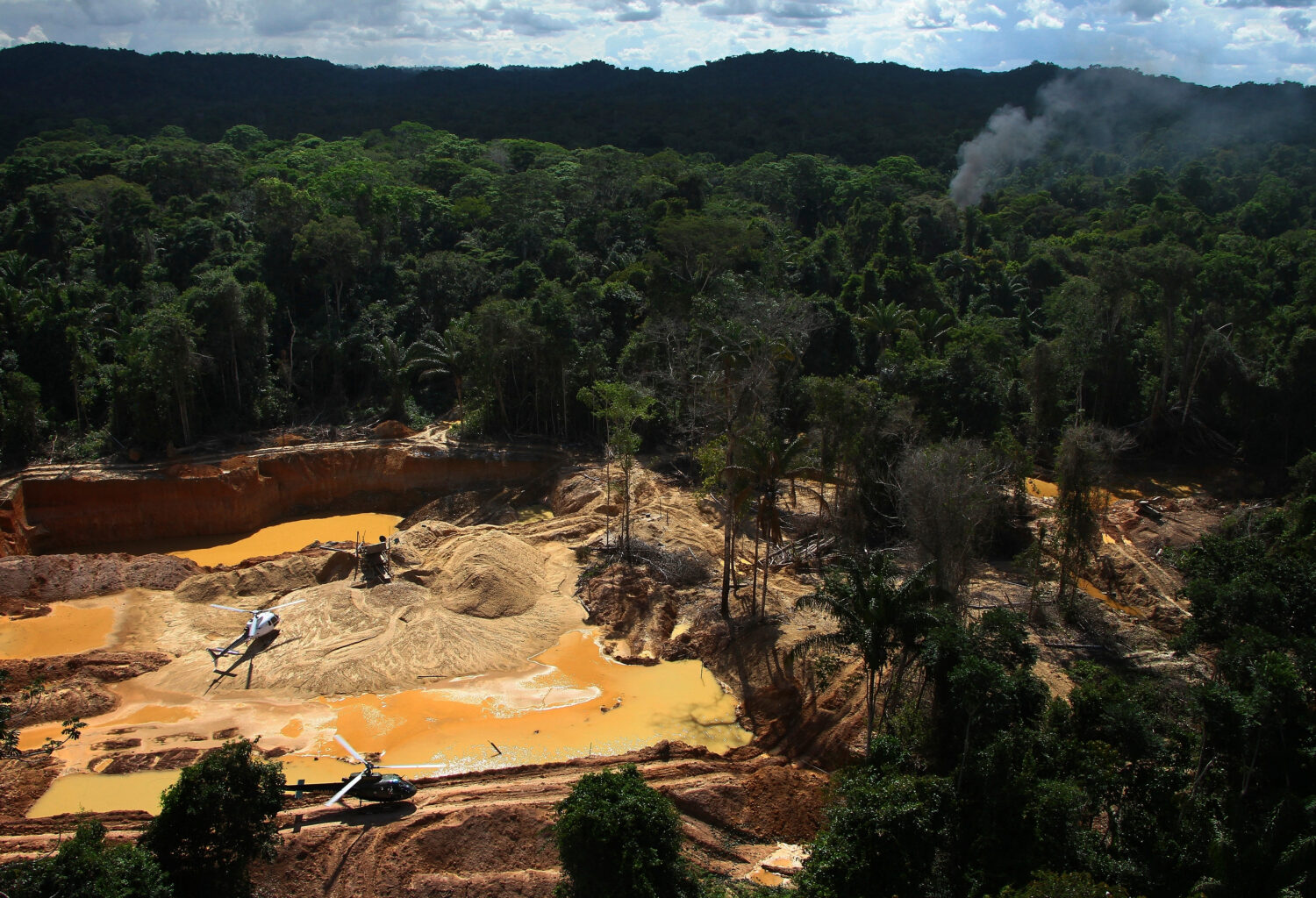
FILE - Helicopters are visible at an illegal mining camp during an operation by Brazil's environmental agency aimed at combating illegal mining in Yanomami Indigenous territory, Roraima state, Brazil, Feb. 11, 2023. (AP Photo/Edmar Barros, File)
Credit: ASSOCIATED PRESS
(AP Photo/Edmar Barros, File)

BOGOTA, Colombia (AP) — Indigenous organizations from across the Amazon and Latin America will send a letter Monday to the United Nations warning that organized crime — including illegal mining, drug trafficking and logging — is driving violence and accelerating environmental destruction in rainforest communities. However, they urged governments to avoid heavily militarized responses in Indigenous territories.
The letter, addressed to U.N. member states and agencies including the U.N. Office on Drugs and Crime and the U.N. Permanent Forum on Indigenous Issues, says criminal networks are expanding across parts of the Amazon and other Indigenous lands in Latin America, threatening communities, ecosystems and local governance.
Signatories of the letter say the expansion of organized crime is undermining Indigenous governance systems and threatening communities that have long acted as stewards of some of the world’s most biodiverse ecosystems.
The appeal comes as Indigenous communities across the Amazon increasingly find themselves caught between expanding criminal networks and state security operations. In recent years, illegal gold mining, logging and drug trafficking have spread deeper into remote rainforest regions in countries including Brazil, Peru, Colombia and Ecuador, bringing violence, mercury contamination and deforestation.
International rights groups and U.N. experts have raised concerns about rising attacks on Indigenous leaders and environmental defenders linked to disputes over land, natural resources and illicit economies across the Amazon. Global Witness says at least 2,253 land and environmental defenders have been killed or disappeared globally between 2012 and 2024, with Latin America accounting for the vast majority of cases.
In Peru, five men are on trial over the 2023 killing of Indigenous defender Quinto Inuma Alvarado, who had repeatedly denounced illegal logging and drug trafficking in his territory. Rights groups say most similar killings in the region go unpunished.
Raphael Hoetmer, Western Amazon Program Director at Amazon Watch, an environmental and Indigenous rights advocacy group, said the letter reflects a growing sense of urgency among Indigenous organizations as these threats expand.
“More and more Indigenous Peoples are experiencing the violence and impacts of illicit economies in their territories, so it is higher on the agenda,” he told The Associated Press in a written response. “Even four years ago this was not a central topic for most of our partners, but now it is one of the central topics for the wide majority.”
Hoetmer said the expansion of organized crime is increasingly shaping life across large parts of the Amazon.
“The expansion and control of organized crime and violent conflict is taking over more and more of the Amazon, becoming a risk to their ways of living and to the global climate,” he said.
The letter warns that these dynamics are not only driving environmental destruction but also weakening Indigenous governance and territorial control.
Illegal gold mining in particular has become a major driver of deforestation and mercury contamination across parts of the Amazon, while armed groups and trafficking networks have sought control over strategic river routes and Indigenous lands.
“Drug trafficking in the Amazon often connects with illegal mining, logging and land grabbing — a criminal ecosystem where environmental degradation disproportionately impacts local populations and Indigenous people,” said United Nations Office on Drugs and Crime Deputy Director of Operations Jeremy Douglas in written comments to AP.
“Pushing back requires territorial protection, prioritizing environmental crimes, and cooperation against transnational organized crime networks active across the Amazon,” he added.
At the time of sending the comments, the U.N. agency said it had not yet seen the Indigenous organizations’ letter and that the response should not be interpreted as an endorsement of its contents. UNODC said its offices in Latin America are working with Indigenous communities and national authorities to strengthen territorial protection and combat environmental crimes tied to organized criminal networks.
The AP also contacted the U.N. Permanent Forum on Indigenous Issues for comment, but did not receive a reply by the time of publication.
The document was signed by major Indigenous organizations including the Coordinator of Indigenous Organizations of the Amazon River Basin, known as COICA, Brazil’s Indigenous umbrella organization APIB, Peru’s AIDESEP and Ecuador’s CONAIE, along with dozens of regional Indigenous federations and international advocacy groups.
Ercilia Castañeda, vice president of Ecuador’s largest Indigenous organization, the Confederation of Indigenous Nationalities of Ecuador, or CONAIE, said governments have increasingly responded to organized crime and illegal mining with militarization that has failed to resolve the crisis in many Indigenous territories.
“Militarization has not provided answers,” she said.
Instead, she said, some communities have faced displacement, fear and psychological harm.
“It has affected their relationship with the land, with the water, with sacred sites, with their spiritual life,” she said. “We are talking about a deterioration of the identity and life of Indigenous peoples.”
Herlín Odicio, vice president of Organización Regional AIDESEP Ucayali, or ORAU, an Indigenous organization representing communities in Peru’s Amazon region of Ucayali, said organized crime groups have increasingly adapted how they operate in Indigenous territories.
“Organized crime in Indigenous territories has changed its strategies significantly,” he said in a call with AP. “They no longer make direct threats. Now they use other strategies.”
Odicio said that criminal groups are increasingly embedding themselves in local political structures and campaigns to maintain influence and continue operating in Indigenous territories.
He said the expansion of organized crime has deeply affected Indigenous communities, where poverty and the absence of state services leave many vulnerable to recruitment into illegal activities.
“They recruit young people to work as ‘mochileros,’” he said, referring to people used to transport drugs or supplies through remote areas. “Then, in the end, when they no longer want them or do not want to pay them, they kill them.”
Odicio also warned of growing sexual exploitation of Indigenous girls in communities and border areas affected by criminal groups, some as young as 13 and 14, he said.
In the letter, organizations say that government responses focused primarily on military force risk worsening conditions for Indigenous communities if they fail to recognize Indigenous territorial rights and systems of self-governance.
“In light of this situation, it is essential that responses to organized crime and illicit economies do not translate into new processes of militarization, criminalization, or the subordination of Indigenous governance systems,” the letter says.
The letter calls on the U.N. Permanent Forum on Indigenous Issues to conduct a dedicated study on organized crime and illicit economies in Indigenous territories and urged U.N. agencies to include Indigenous perspectives in anti-crime and anti-corruption policies.
“We are talking about a deterioration of the identity and life of Indigenous peoples,” Castañeda said.
___
The Associated Press’ climate and environmental coverage receives financial support from multiple private foundations. AP is solely responsible for all content. Find AP’s standards for working with philanthropies, a list of supporters and funded coverage areas at AP.org.