Analysis: Trump embraces ‘Great Equivocator’ role sending mixed signals that vex markets and allies
Jul 1, 2026, 9:01 PM
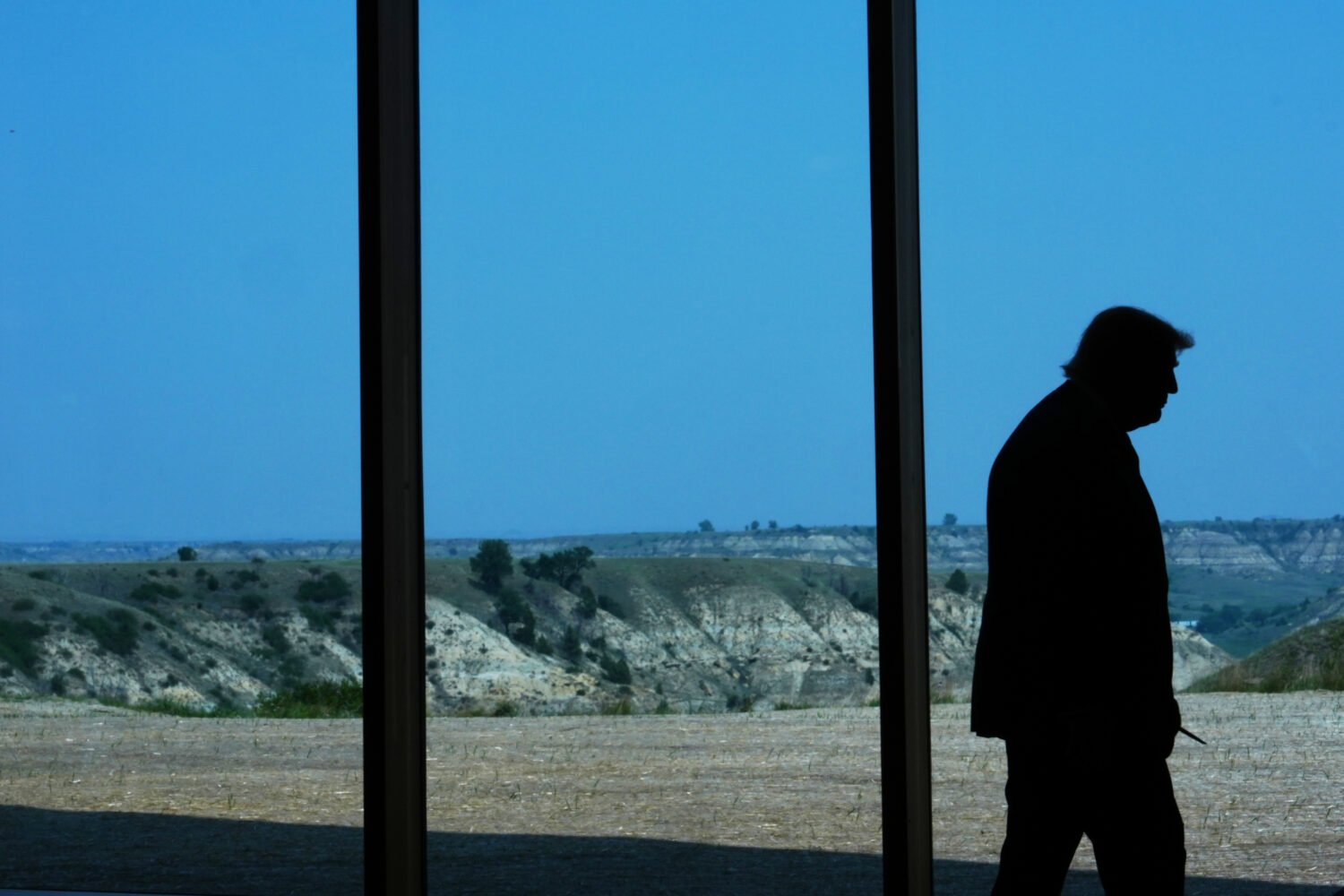
President Donald Trump departs after presenting Theodore Roosevelt's Medal of Honor that was in the Roosevelt Room at the White House House, to be kept on display at the Theodore Roosevelt Presidential Library, in Medora, N.D., Wednesday, July 1, 2026. (AP Photo/Julia Demaree Nikhinson)
Credit: AP Photo/Julia Demaree Nikhinson
(AP Photo/Julia Demaree Nikhinson)

WASHINGTON (AP) — When the U.S. and Iran reached a tentative agreement to end the war, President Donald Trump managed to both trumpet the deal and raise questions about its viability, all in the same answer.
“It’s a very strong deal,” he said. “Nobody knows what it is. But it’s very strong.”
It was the kind of mixed signal the president frequently sends: He’ll seem to commit to one side of a major issue, then the opposite — only to subsequently suggest he’s not actually decided and may not be wed one way or the other.
Just as Ronald Reagan was the “Great Communicator” and George W. Bush declared himself “The Decider,” Trump increasingly seems comfortable as the “Great Equivocator,” oscillating between contradictions in what he says on one subject or multiple times in a single online post.
Taking so many positions means the president can’t be fully wrong while letting the public fix on different, albeit often conflicting, statements that can reinforce their own beliefs. It differs from Trump’s propensity for falsehoods, which can be part of a concentrated effort to cloud the facts for his own political benefit.
“Trump is, generally, all over the map,” said Daniel Immerwahr, a historian at Northwestern University and author of “How to Hide an Empire: A History of the Greater United States.” “His friends forgive him, and his enemies hate it.”
White House spokesperson Kush Desai dismissed questions about the president’s shifting positions as an “asinine obsession with splitting hairs.”
“President Trump’s results speak for themselves,” Desai said, noting the ceasefire agreement, a resulting decline in energy prices and administration efforts to lower prescription drug prices among the “many other victories for the American people.”
Aides from Trump’s first administration say the president likes to lean on the business concept of “optionality,” or staying flexible enough to have always multiple choices available. That allows him to shift abruptly as the politics or his personal needs change.
Deepak Malhotra, a Harvard Business School professor and author of “Negotiating the Impossible,” finds that implausible.
“Business leaders and politicians have always sought to create option value whenever possible. But they wouldn’t go about it by taking incoherent, or mutually inconsistent, positions on major issues,” he said. “That erodes credibility.”
Still, Trump’s style can make him a feared negotiator since no one knows his next move. It recalls President Richard Nixon’s “madman” theory of foreign relations, in which he sought to gain an upper hand by spreading uncertainty about his personal volatility.
Trump has mostly abandoned any pretense of the United States playing its traditional role as leader of a rules-based global order. That could damage the country’s international reputation, but it also gives Trump a freer hand, Immerwahr said.
Most presidents “are interested in systemic power, the whole chessboard,” Immerwahr said. Trump, meanwhile, is “interested in what’s in front of his face.”
“That’s not just a pathology of his, that’s his worldview,” Immerwahr said. “That is a strategy.”
While politicians typically try to avoid accusations of waffling, Trump has long been unafraid to contradict himself — refusing to be pinned down even when it unsettles financial markets or sparks consternation among fellow Republicans ahead of November’s midterm elections.
On Iran, Trump indicated that two top objectives were to remove Tehran’s stockpile of enriched uranium and eliminate its ability to fire ballistic missiles. More recently, however, he has suggested Iran should be able to keep both, citing the need for fairness among regional powers.
“You’re not letting them have it for purposes of electricity and things like that,” he said in June of the enriched uranium. “You have to use a little common sense.”
Of Tehran’s missiles, the president now says, “They have to have some because other people have some.”
Malhotra said Trump “has become accustomed to people not holding him accountable for outcomes because he is typically able to change the subject or declare victory regardless.”
“We are now witnessing what happens when someone like that realizes there are limits to how much you can spin reality,” he said. “You start to promise everything and nothing, and you get fixated on making excuses for yesterday rather than strategizing for tomorrow.”
Desai countered that the ceasefire agreement amounted to “the Art of the Deal in practice.”
Trump also frequently offered conflicting statements about the war itself. He claimed repeatedly that it was already won even as fighting escalated. He downplayed the war as “a little excursion” and “not a big thing,” while pointing to it as the reason he couldn’t do other things, like attend his son’s wedding in the Bahamas.
“I think there’s a point where he goes into default sales mode for whatever he’s trying to sell,” said Thomas Wright, a former special assistant to President Joe Biden and senior director for strategic planning at his administration’s National Security Council. “And he’ll say, with great conviction, points that will sometimes be in contradiction to each other.”
Cuba, Trump has said, is “ready to fall” without U.S. military intervention. while also suggesting that the quick-strike U.S. operation to remove Venezuelan President Nicolás Maduro could be a model for the island’s communist government.
“Sometimes you have to use it,” Trump said of the military during a March investment forum. “And Cuba is next, by the way.” On Wednesday, in a North Dakota speech he was even more explicit saying of Cuba: “After many, many decades, it’s coming our way.”
After spending years slamming Biden for rising inflation, Trump said recently, “I love the inflation,” as prices rose under his own watch during the Iran war.
Even when it comes to seeking a third presidential term, Trump has toggled between teasing another run and hinting that he’s only joking — or maybe not.
Reagan, known for his keen storytelling and ability to project warmth, got his moniker from a background in radio and movie and television acting. Bush declared himself the ultimate arbiter at a low moment of the Iraq War when asked about firing Defense Secretary Donald Rumsfeld.
Trump doesn’t struggle to communicate. As a developer in 1980s New York, the future president was so obsessed with managing his image that he used fake names to call reporters and pose as his own spokesperson.
Now, he talks constantly to the media and is the unquestioned decision maker at the White House, where aides often have to scramble to make their own past and present statements coincide with the boss’ latest about-face.
Trump nonetheless talks in circles as a matter of course.
“We like everybody really in the room. I don’t like a few people, but that’s OK,” the president said recently following an occasionally heated lunch with Senate Republicans.
Daniel Ames, a professor at Columbia Business School whose research focuses on social judgment and behavior, said Trump may be driven by showmanship.
“We could look at President Trump’s behavior through the lens of content production and managing for viewership,” Ames said. “Constant twists and cliffhangers may seem like attractive levers for engagement, leaving viewers wondering and having to tune back in to find out ‘What will I do?’”
But Wright, now a senior fellow at the Brookings Institution, said Trump’s ever-changing sentiments also mean he can fully support something, then shift his position without warning — leaving even close allies squeezed. For instance, Israeli Prime Minister Benjamin Netanyahu has been politically weakened by the Iran war’s major objectives going unfulfilled.
“It’s a little bit like riding the tiger,” Wright said. “You might sometimes get him to move in your direction. But, when all is said and done, one might wonder if it was better just to leave the tiger alone.”
___
Will Weissert has covered the White House for The Associated Press since 2022, after covering politics, the drug war and immigration in Texas, Cuba, Mexico and Guatemala since 2000.