WSU researchers create electronic skin that could help prosthetics feel touch
Aug 21, 2026, 9:52 AM
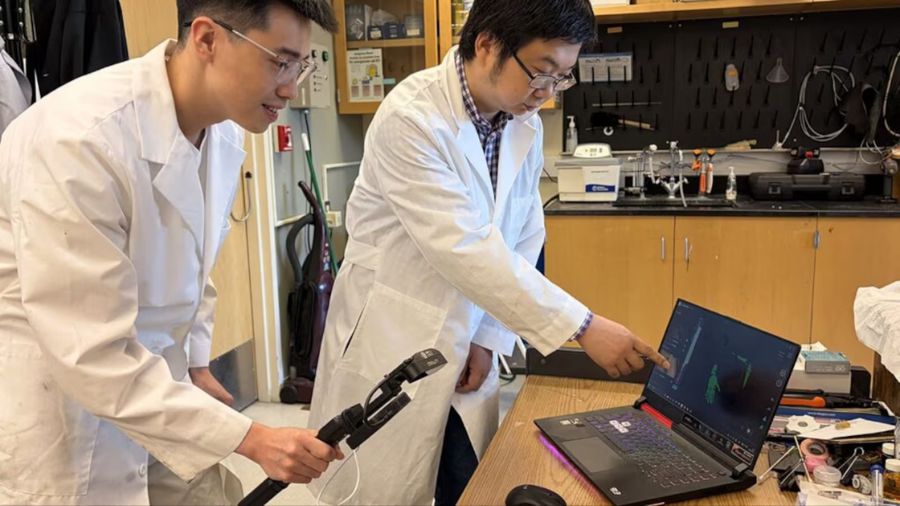
Hongyi Shen, left, a graduate student in the School of Mechanical and Materials Engineering, and Professor Kaiyan Qiu helped lead a project that developed an electronic skin that can detect pressure and temperature. (Photo: Sravanthi Yalamanchili, WSU)
(Photo: Sravanthi Yalamanchili, WSU)
Researchers at Washington State University (WSU) have developed an electronic skin for prosthetics that can sense both pressure and temperature, a breakthrough that could one day help amputees regain a sense of touch.
WSU researchers published their work in the journal Cell Reports Physical Science earlier this week.
The technology can detect sensations at a resolution up to 10 times finer than sensors used in many commercial products today.
The customizable “e-skin” is designed to fit the unique shape of a prosthetic limb while providing seamless coverage across curved surfaces. Using a scan-model-print process, researchers create sensor arrays tailored to each prosthetic’s geometry.
“The scanner basically scans the prosthetic and then, based on the geometry, we map our sensors,” said Kaiyan Qiu, an assistant professor in WSU’s School of Mechanical and Materials Engineering and a corresponding author on the study.
According to researchers, the sensor modules measure both pressure and temperature and can identify surface textures and material properties. Unlike many existing e-skins, the modules snap together without adhesives, making them easier to assemble and potentially less expensive to produce.
Researchers say current electronic skins are often costly, cover limited areas, and can struggle to provide accurate sensing when customized to fit individual users. The new system aims to improve both comfort and performance.
The team is now working on technology that would convert the e-skin’s sensing signals into stimulation for nearby nerves, allowing users to actually feel what their prosthetic is touching.
“This work lays a crucial foundation for a full bionic skin with both sensing and haptic stimulation functions on prosthetics,” said Hongyi Shen, a WSU graduate student and lead author of the study.
Researchers have also submitted an invention disclosure as they continue developing the technology. They hope the device will eventually help amputees perform everyday tasks more easily and naturally.