Untested in court, Trump’s new tariffs on Canada raise legal questions
Aug 28, 2026, 9:51 PM
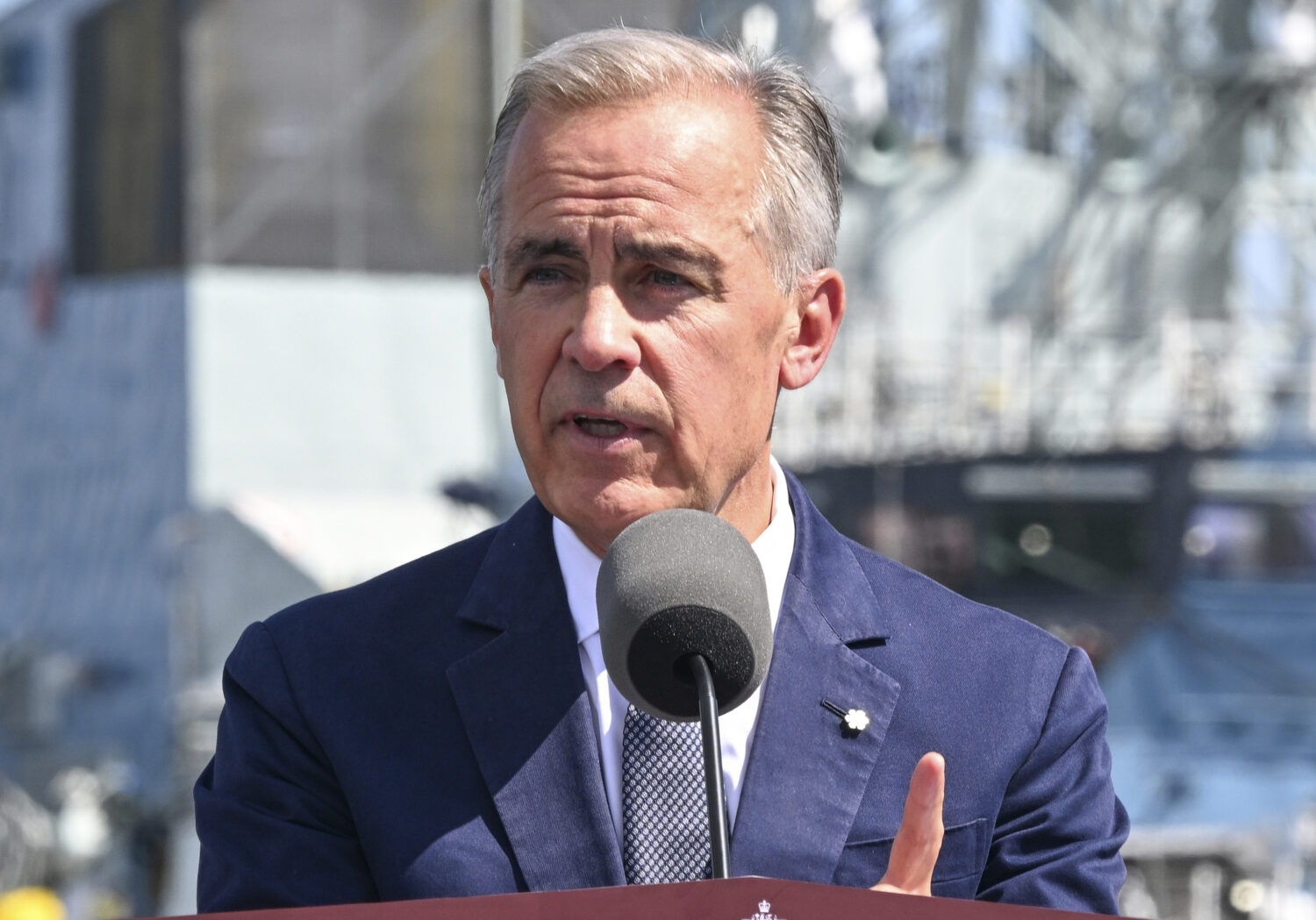
Canadian Prime Minister Mark Carney speaks at the Davie shipyard in Levis, Quebec on Monday, Aug. 24, 2026. (Jacques Boissinot/The Canadian Press via AP)
Credit: Jacques Boissinot/The Canadian Press via AP
(Jacques Boissinot/The Canadian Press via AP)

WASHINGTON (AP) — In firing up a trade war with Canada, President Donald Trump turned to a 96-year-old statute so obscure that many trade lawyers didn’t even know it was still on the books.
A week ago, Trump invoked Section 338 of the Tariff Act of 1930 to slap a 50% tax on $20 billion worth of Canadian imports. The move prompted dollar-for-dollar retaliation from Ottawa and strained already-tense relations between the neighbors and longtime allies.
The president’s Section 338 tariff authority has never been used, let alone tested in court. “This law is literally a blank canvas because it’s never been litigated,’’ said Ryan Majerus, a partner at King & Spalding and a former U.S. trade official.
So it’s unclear whether Trump’s latest Canada tariffs could survive a legal challenge, and some lawyers argue that the Depression-era law has been rendered obsolete by more recent trade laws.
To sanction Canada for allegedly discriminating against U.S. dairy, auto and alcoholic beverage exports this summer, the Trump administration reached back to the Great Depression.
The 1930 tariff legislation is known as the Smoot-Hawley Act after its congressional sponsors. With the U.S. and world economies in collapse, Congress raised tariffs on hundreds of imports in an attempt to protect American farmers and manufacturers.
The tariffs are notorious among economists and historians for shutting down world commerce and making the Great Depression worse. (Trump, who proudly calls himself “Tariff Man,’’ has a different view, arguing that the Smoot-Hawley levies simply came too late to rescue the American economy.)
In addition to raising tariffs themselves, lawmakers in 1930 gave the president new power to impose them himself: Section 338 authorizes presidential tariffs of up to 50% on imports from countries that have discriminated against U.S. businesses.
Before Trump, no president had actually used the statute.
“Until Trump’s second term, few trade lawyers were aware that Section 338 remained on the books or understood what it did,” legal scholars Peter Harrell and Jennifer Hillman of Georgetown University wrote earlier this month in the libertarian magazine Reason. They cite State Department records to show that the U.S. considered using Section 338 in trade disputes – against Spain in 1932 and against newly Communist China in 1949 – but never did. After the Depression, U.S. policy focused more on using negotiations — rather than sanctions — to open foreign markets.
So Section 338 sat moldering in the law books.
As the years went by, the United States passed new trade laws. Some of them ceded to the president tariff power, which the U.S. Constitution originally granted to Congress. But the new laws also limited the president’s authority to certain circumstances — including dealing with national security threats and foreign currency crises — and required the government to carry out investigations and meet other procedural requirements beforehand.
“There is a very strong argument that (Section 338) was superseded,’’ said Sara Albrecht, CEO of the Liberty Justice Center, a libertarian advocacy group that represented businesses that successfully challenged the earlier Trump tariffs with the Supreme Court.
If Congress wanted the president to retain Section 338 power, Albrecht asks, why did lawmakers pass the Trade Expansion Act of 1962, which allowed for national security tariffs? And the Trade Act of 1974, which gives the president power to go after other countries’ unfair trade practices?
Legal experts see other weaknesses in the Section 338 tariffs.
Harrell and Hillman, for instance, write in Reason that Section 338 only authorizes tariffs that “offset’’ the harm that a foreign country’s trade practices do to American companies. But in targeting Canada, they note, the Trump administration made no attempt to calculate the dollar amount of damage arising from discrimination against U.S. farmers, automakers and marketers of alcoholic beverages. And the U.S. went after Canadian imports unconnected to those trouble spots, including hockey sticks and cement.
Harrell and Hillman also say that Canada’s protection of its dairy market does not single out U.S. farmers for discrimination; the rules apply to many other Canadian trading partners as well.
Moreover, the United States agreed to the Canadian system – in which Canada imposes stiff tariffs on dairy imports that exceed a quota — in a North America trade pact Trump himself negotiated with Canada and Mexico in his first term. Harrell and Hillman write that it is “incongruous, to say the least, for the United States to denounce as discriminatory the very terms it agreed to.’’
But John Veroneau, former general counsel for the U.S. Trade Representative, said the Section 338 tariffs are straightforward: They are justified when another country discriminates against U.S. imports by taxing them more than it taxes imports from other countries.
And in a “perverse irony,’’ Veroneau said, Canada did just that when it responded to tariffs Trump imposed on Canadian products last year with its own retaliatory tariffs on U.S. imports. “Courts will rightly feel obliged in the face of any challenge (to decide): Are the statutory requirements met or are they not met, however ludicrous the broader context might be,’’ said Veroneau, adjunct professor at the University of Maine Law School.
Trump’s other tools to impose his protectionist agenda have already floundered in court. The Supreme Court in February threw out his boldest gambit: invoking a 1977 national security law to hit almost every country on Earth last year with double-digit tariffs.
When Trump tried to replace the revenue lost to the Supreme Court defeat with a new set of tariffs, a specialized trade court in New York rejected those, too – though the government was allowed to continue collecting the import taxes while the case works its way through the court system.
No one has filed a lawsuit challenging the Section 338 tariffs. The Liberty Justice Center has been looking for businesses willing to sue the government over the levies.
“I haven’t had a lot of response from plaintiffs,’’ Albrecht said. “Anytime you want to sue the government, it’s a hard proposition.’’
The Section 338 tariffs on Canada are also far smaller – just 5% of Canadian imports — than Trump’s 2025 worldwide tariffs, meaning that fewer companies have to pay them and can claim to have been injured by them.
There’s also a chance, Albrecht said, that the two countries will resume the talks they broke off Aug. 21 and reach a compromise to end a standoff neither country wants. “I’m hopeful that somebody blinks, that they come to some agreement and it all goes away,’’ she said.