Scientists hope deeper-rooted soybeans can withstand climate extremes and store more carbon
Sep 18, 2026, 6:01 AM
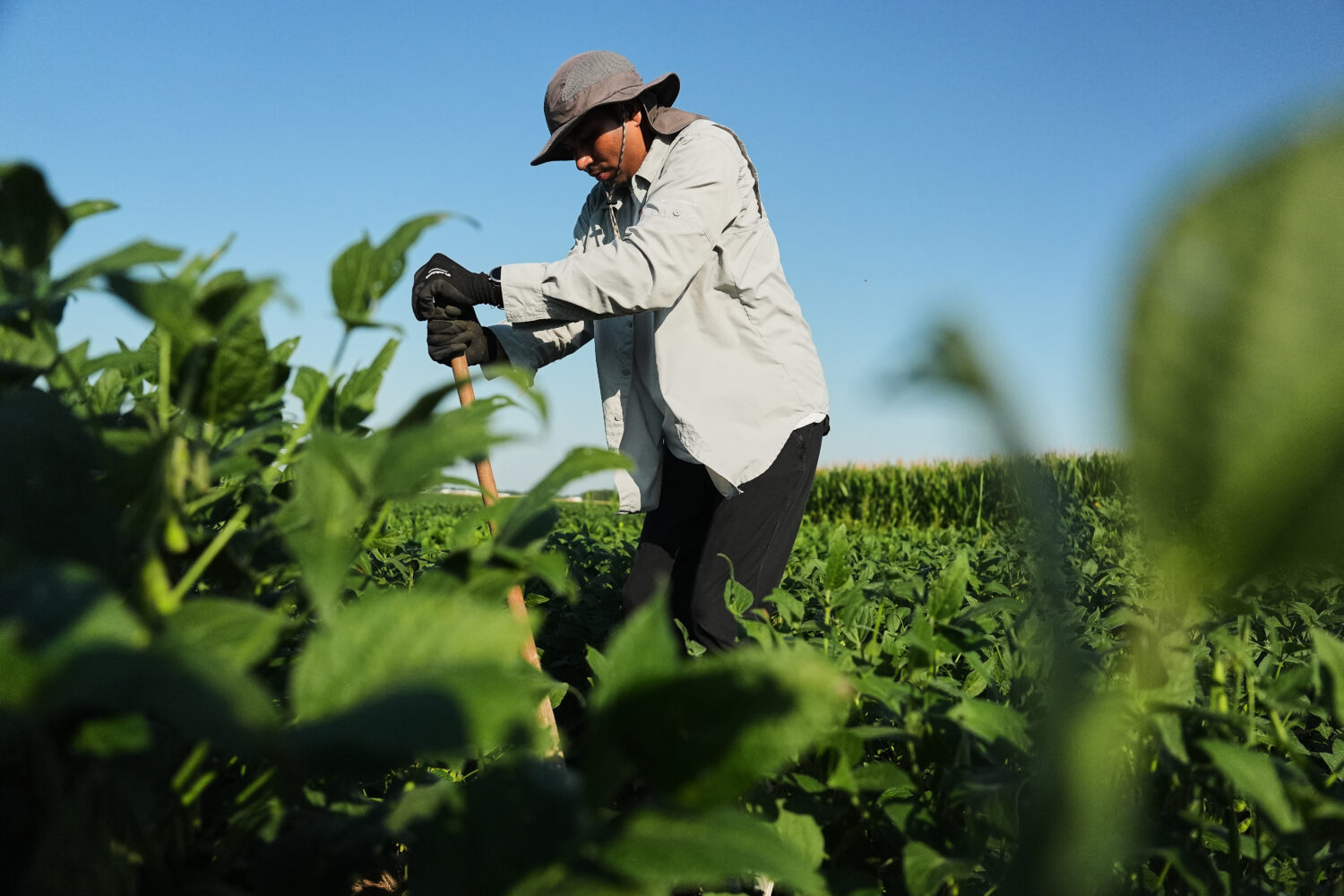
Ashish Rajurkar, a research scientist at the Salk Institute, digs out root samples from genetically-engineered soybeans Tuesday, Sept. 1, 2026, at a research field in Urbana, Ill. (AP Photo/Joshua A. Bickel)
Credit: AP Photo/Joshua A. Bickel
(AP Photo/Joshua A. Bickel)

CHAMPAIGN, Ill. (AP) — Research scientist Ashish Rajurkar kneels in the dirt, lifting a large clod of soil tangled around a soybean plant. He knocks away pieces of earth from the plant’s roots, which slope straight down instead of out to the side like typical soybean plants.
Researchers hope roots like these could help crops withstand some effects of climate change while also drawing more carbon from the atmosphere and storing it underground. Carbon dioxide released by burning fossil fuels traps heat in the atmosphere, driving human-caused climate change.
For years, scientists have explored ways to remove some of that carbon from the atmosphere, including through direct air capture, changes to ocean chemistry so seawater can absorb more carbon, and reforestation. Now, researchers at the Salk Institute for Biological Studies are testing whether deeper root systems could become another tool.
But scientists still need to show how much additional carbon those roots can store under real farming conditions, how long the carbon would remain underground and whether the crops can maintain yields.
An $18 million grant from the Bezos Earth Fund will help Salk researchers test those questions in the field by measuring how resilient these plants are to drought and other climate stressors, how much carbon they can store and for how long, and how to get the plants onto farms at scale.
Wolfgang Busch, director of the institute’s Harnessing Plants Initiative, said the issue is pressing.
“We are actually steering in a direction that is very concerning,” he said. “It will become harder to grow enough food for enough people.”
Over the last six years, Salk scientists uncovered the genetic information of hundreds of versions of common row crop plants such as soybeans and sorghum from around the world, creating an “encyclopedia” of plant genomes, said Todd Michael, a research professor at the institute.
After identifying 347 genes related to carbon storage and root growth, scientists were able to edit the plants’ DNA and create ones with roots that penetrate the soil further down.
“We wanted to leverage the natural variation of a given plant,” Michael said. “We just have to be able to make the right crosses to bring in those genetics.”
During droughts, they hope the roots will allow plants to access water below the top layer of soil while also storing carbon farther underground, where it may be less vulnerable to being released when farmers till their fields.
Researchers are also trying to boost carbon storage by growing larger root systems so more carbon-rich plant material is left in the soil, and by increasing suberin, a cork-like substance in roots that contains carbon and decomposes more slowly than many other plant tissues.
Researchers hypothesize that more steeply shaped root systems may also allow farmers to plant more crops in a smaller area, potentially increasing yield.
Salk scientists think longer, bigger roots could also absorb more nitrogen and other fertilizer runoff, which can cause algae blooms and lead to low-oxygen environments that kill marine life.
Based on earlier lab results, Salk researchers estimate one hectare (2.5 acres) of deeper- and bigger-rooted soybean plants could store an additional metric ton of carbon dioxide per year. How long that carbon stays stored depends on how deep the roots can grow and the surrounding environment in the soil. Initial results from the field are expected this fall, Busch said.
At one of these field sites at the University of Illinois Urbana-Champaign, Salk is growing deep-rooted soybean plants under a canopy that can open and close to control the amount of rainfall plants receive, testing how the plants perform in drought conditions. Using underground cameras and sensing equipment, research partners at the university can track the amount of carbon in the soil and view the root structure’s growth in real-time.
But there is still uncertainty about how these plants will perform outside a lab. Salk researchers hope data collection at the site in Illinois, along with ones in Missouri, Kansas and Iowa, will provide accurate estimates of carbon storage and crop yield.
Because most plant breeders haven’t focused on root systems in the past, “we don’t really know what the real trade-off is,” Busch said. “You have to test it in the field.”
Busch acknowledges that getting new seed technology into farmers’ fields can be difficult. Having a crop that has clear benefits to farmers and large seed companies is key to getting it adopted rapidly. He noted that companies and farmers adopted herbicide-resistant crops in less than a decade once the technology was introduced.
“Historically it’s clear, if you have a technology that is interesting to a big seed company, it will go out there very, very fast,” he said.
And large-scale adoption on farm fields will be required to have the kind of carbon-reduction impact Salk scientists want. A 2025 study that Busch co-authored modeled that about a gigaton of carbon dioxide per year could be removed from the atmosphere by 2040 if deeper-rooted soybean, corn, cotton and canola crops were adopted in countries where genetically-modified crops are already grown.
Adoption could be rapid because deeper-rooted crops could be planted on current farm fields using existing agricultural infrastructure and land, according to the study.
But Busch also notes that crop and seed development can take years. Ambitious solutions, he said, require fast funding.
“It’s a race against time,” he said of climate change. “We are racing against limiting the damage and crossing tipping points, where it’s much harder to return from.”
___
The Associated Press’ climate and environmental coverage receives financial support from multiple private foundations. AP is solely responsible for all content. Find AP’s standards for working with philanthropies, a list of supporters and funded coverage areas at AP.org.
___
Follow Annika Hammerschlag on Instagram @ahammergram and Joshua A. Bickel on Instagram, Bluesky and X @joshuabickel.