A quarter century later, the legacy of the US-led invasion of Afghanistan endures
Oct 8, 2026, 12:39 AM
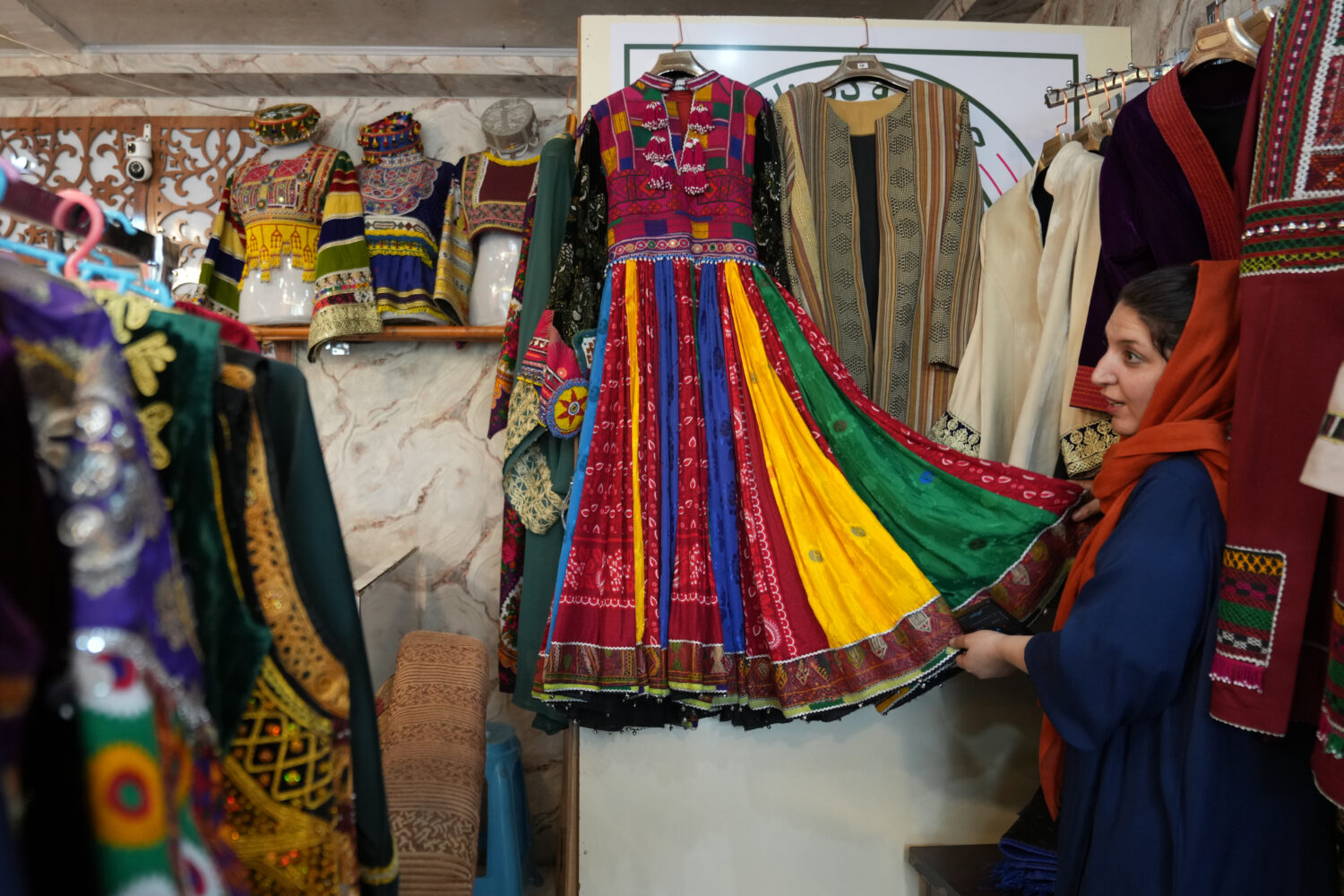
Tahmina Mangal displays a traditional Afghan dress at her clothing shop in Kabul, Afghanistan, Sunday, Oct. 4, 2026. (AP Photo/Siddiqullah Alizai)
Credit: AP Photo/Siddiqullah Alizai
(AP Photo/Siddiqullah Alizai)

KABUL, Afghanistan (AP) — Dr. Nigar Nangrahari was on a night shift in a Kabul hospital when the U.S.-led invasion of Afghanistan began 25 years ago — an event that would shape her and her country’s future for decades to come.
As she walked home the next morning, Nangrahari saw Kabul residents taking revenge on members of the Taliban, whose harsh, repressive rule had seen public stonings, limb amputations of alleged criminals and women obliterated from public life.
“Along the way, I saw ordinary people killing anyone they caught who was a Taliban member. I witnessed with my own eyes the people of Kabul capturing and killing Taliban fighters. Some had climbed trees to hide,” she said.
Afraid of what was to come, Nangrahari and her family stayed home for about a month. Eventually, she was called back to the hospital and returned to work as an obstetrician-gynecologist. She no longer had to wear a burqa in the street.
“They granted us freedom — but not the kind that Afghans could truly benefit from,” said Nangrahari, 58.
Afghanistan is a deeply conservative Muslim society, and the U.S. culture that came with the American presence in the country often rankled some segments of society.
“Afghans should neither be completely unrestricted nor subjected to the kind of severe constraints imposed by the Taliban,” she said. “There needs to be a moderate balance.”
Under U.S. President George W. Bush, the American-led coalition launched Operation Enduring Freedom with the stated goal of dismantling al-Qaida, the terrorist organization whose leader, Osama bin Laden, had orchestrated the Sept. 11 attacks in the United States from his base in Afghanistan.
The invasion was to mark the start of a 20-year war that cost tens of thousands of Afghan lives, along with thousands of coalition service members, U.S. contractors, aid workers and journalists.
The legacy of that war, and of the successive U.S.-supported Afghan governments during that time, endures today.
“Their stated goals were to bring good governance to Afghanistan and to combat narcotics and terrorism,” said Muin Gul Chamkanai, a former doctor who now heads a humanitarian organization, the Shkula Charitable Foundation, and also works as a political analyst. “The reality turned out to be the exact opposite.”
At a massive cost, both financial and in lives, the American presence brought certain freedoms, particularly for the media and in women’s education and employment opportunities. But pervasive corruption and often heavy-handed military tactics soon bred deep resentment.
Sitting at home on Oct. 7, 2001, Chamkanai switched on his television. The sight of his country being invaded enraged him.
“Had I been struck by their bombs, I would have considered martyrdom far preferable. I was not afraid,” he said. “I wanted to fight against them in Afghanistan using both the pen and the gun.”
Now, 25 years after the invasion and five years after the chaotic U.S. withdrawal from the country, the Taliban are firmly back in control of Afghanistan. Although not quite as extreme as their previous government, when they ruled the country from 1996-2001, they have reinstated many draconian restrictions, particularly on women and girls.
Security has improved without question since the Taliban seized power in August 2021. Gone are the endless devastating bombings and attacks, the vast majority of them carried out by the Taliban themselves during the two-decade-long war.
“After a long and arduous struggle, jihad and great sacrifices, Afghans succeeded in liberating their country,” deputy government spokesman Hamdullah Fitrat said in a statement on the 25th anniversary of the invasion. “This struggle demonstrated that Afghans will never submit to foreign occupation or external coercion.”
He said that Oct. 7, 2001, was “a dark day in the country’s history that resulted in thousands of Afghans being martyred, wounded, imprisoned, displaced and left homeless.”
But for a generation who grew up under U.S.-supported governments, the loss of personal freedoms, especially for women, who face restrictions on everything from what they wear to where they can go, has been a brutal blow.
After the Taliban took over, “gradually … restrictions were imposed, and the normal life we had known was taken away. Things became very difficult for us,” said Tahmina Mangal, a 33-year-old woman who saw her hopes of continuing her studies dashed by the shuttering of high schools and universities for girls and women.
“The burden is immense. It weighs heavily on my own spirits and psyche,” she said.
Now, Tahmina owns and runs a store selling traditional Afghan clothing for women. Although women face multiple restrictions and are barred from most jobs, the Ministry of Commerce does issue business licenses to women, she said. She viewed that as the only avenue open to her.
But with women barred from education and participation in any form of governance, she worries deeply about the future.
“If this situation persists, Afghanistan’s future is perilous,” Tahmina said. “Without women pursuing their studies or receiving an education, we will lack doctors, teachers and literate women, including mothers capable of raising healthy children for society. I view Afghanistan’s future as bleak and dire if this trend continues.”
For Nangrahari, although the Taliban government’s emphasis on improving infrastructure in the country is welcome, its emphasis on religious education for boys, and its ban on higher education for girls, “sets Afghanistan back by a century.” Afghanistan already is among the world’s poorest countries.
“Roads have been improved and high-rise buildings constructed. Indeed, infrastructure is the foundation of the economy, and we acknowledge all of this,” Nangrahari said. “But a society lacking education is zero.”
Still, sitting in her clothing shop in Kabul, Tahmina said that women shouldn’t give up hope, and should continue pursuing their studies, even if it is only online.
“Governments inevitably come and go, collapses happen, and no government lasts forever,” she said. “I always say: ‘Remain hopeful for the future. Study, pursue professional training alongside your regular schooling, and seek higher education.’”