Man accused of stabbing King County deputy posts bail as state weighs new release rules
Nov 11, 2026, 9:06 AM
King County Sheriff’s deputies want answers about why a man accused of stabbing a deputy was allowed to post bail for far less than prosecutors requested and was back on the streets less than 24 hours after his first court appearance.
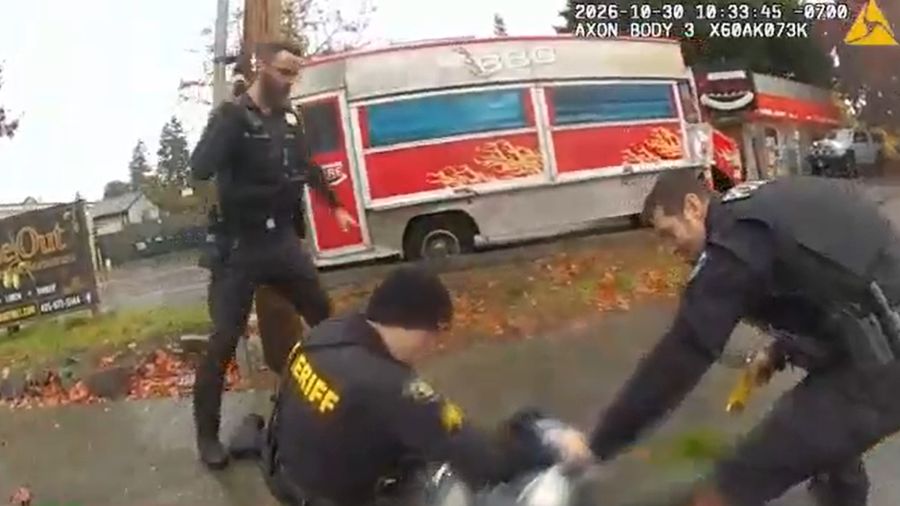
Daniel McCullough was arrested Oct. 30 after an encounter with deputies in a Shoreline parking lot.
The incident started with a dispute over a bus McCullough had parked at Thriftway Market on Ballinger Way, according to a probable cause statement. The store manager told him the bus needed to be moved or it would be towed.
Investigators said McCullough became increasingly angry, threatened to kill the manager and then threatened to kill responding police officers.
“He threatened to slit the throat of the store manager […] He also screamed at another employee, ‘This is what’s going to happen. If he calls 911. I kill him, I kill the police, they kill me, everybody dies today,'” court documents said.
When deputies moved in to arrest him, McCullough allegedly ran. A probable cause statement said he pulled a knife from his sleeve as a deputy chased him.
A deputy tackled McCullough and suffered a three-to-five-inch cut to his upper arm. Investigators said body camera video shows McCullough holding the knife in a position consistent with preparing to stab the deputy.
“Daniel was able to hit my left upper arm and bicep with the blade of the knife, causing me pain in the upper left arm and bicep,” the deputy said in a probable cause statement. “As we fell to the ground, I yelled ‘knife’ and saw the knife bounce away. I could not see where the knife landed and did not know if it was still within reach of Daniel. Daniel was also continuing to move his hand, which had previously held the knife, in a similar motion he had just used to cut me, as if trying to continue to stab me with the knife.”
McCullough’s first court appearance was Oct. 31. Prosecutors asked the judge to set bail at $75,000 and find probable cause for felony harassment and second-degree assault.
The judge instead set bail at $25,000. McCullough posted bond and was released that Saturday.
McCullough denied threatening the store manager or attempting to stab the deputy, according to the probable cause statement. He said the deputy was cut during the struggle when they fell on the knife.
The 35-year-old suspect has since been charged with second-degree assault and felony harassment.
RELATED STORIES



Washington Supreme Court weighs changes to bail rules
The questions surrounding McCullough’s release come as the Washington Supreme Court considers whether to make it easier for criminal defendants to get out of jail before trial.
Justices heard sharply divided arguments Tuesday over proposed changes that would make it harder for judges to impose monetary bail when the concern is whether someone will show up for court.
The proposal would cap appearance-related bail at $200 for most misdemeanor cases, excluding domestic violence and DUI offenses. It would also create a strong presumption allowing defendants to post a refundable 10% deposit directly with the court, rather than paying a nonrefundable fee to a bail bond company.
Supporters, including public defenders, argue the current system keeps people behind bars simply because they cannot afford bail, even when they’re presumed innocent.
“For people with money, bail is a condition of release. For people without money, it becomes an order of pretrial detention,” Katie Hurley with the King County Department of Public Defense told justices.
Professor Megan Stevenson, a law professor at the University of Virginia, added, “It’s one thing to do this to somebody who has been adjudicated guilty as punishment for their crime, but it’s another thing to do this to someone who has not yet been proven guilty, someone who is presumed innocent in the eyes of the law.”
Alan Knoll, a veteran and youth advocate who has also been incarcerated, testified in support of the new rules.
“I met hundreds of people who plead guilty just to get released,” Knoll explained. “When the bail is set at an amount they cannot afford, they often decide to plead guilty to serve a few days or weeks in jail in lieu of fighting their case.”
But prosecutors, judges, and crime victim advocates warned the changes could make it harder to ensure defendants show up for court and could undermine public safety.
Importantly, judges would retain their authority to impose bail based on public-safety concerns.
“The fact is there’s no free lunch. If you commit a crime, there’s going to be repercussions for it. You’re going to be inconvenienced for it,” Jefferson County prosecuting attorney James Kennedy said. “Some individuals are going to be held under these court rules, and if they feel coerced, maybe they do, maybe they don’t, but I have a duty to protect the public.”
Paulette, the grandmother of a domestic violence victim, told the justices her granddaughter’s boyfriend was arrested several times and ended back out on the streets every time — defying court orders and conditions of his release, including cutting off his GPS ankle monitor.
“Days later, he lured her to his car under the pretense of talking. He forced her inside, drove at high speeds through Tacoma, beat her while driving, and threatened to kill her. She threw herself out of the moving car to escape,” Paulette testified. “This is what happens when court orders are violated, and no one acts.”
The proposal has generated nearly 900 written public comments.
The Supreme Court did not make a decision Tuesday. Its Rules Committee will review the testimony and public comments before recommending next steps to the full court.
Follow Luke Duecy on X. Read more of his stories here. Submit news tips here.