1982 Bigfoot investigation: Forest Service releases records of suspected Sasquatch hoax in WA
Nov 20, 2026, 5:00 PM
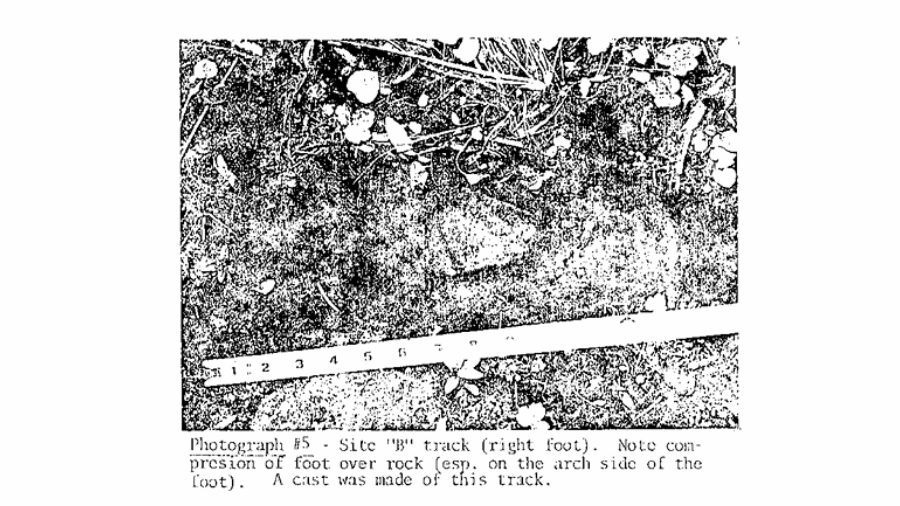
A track believed to possibly be from Bigfoot is measured next to a ruler. (Photo courtesy of 1982 Bigfoot Tracks Investigation)
(Photo courtesy of 1982 Bigfoot Tracks Investigation)
The legend of Bigfoot has another chapter in Washington history, thanks to newly released government records.
The U.S. Forest Service has published documents from a June 17, 1982, investigation into suspected Bigfoot tracks discovered in the Mill Creek watershed in Washington.
Near Low Ridge, they found six distinct footprints stretching approximately 25 feet along a muddy trail. Two measured about 15 inches long. An elk had also stepped on the heel of one print.
At a bog beside Low Creek Trail, investigators found approximately 18 prints extending about 40 feet toward thick vegetation.
The team made two plaster casts at each location.
But investigators weren’t convinced they had discovered evidence of Sasquatch.
Instead, one experienced tracker with the U.S. Border Patrol believed someone had manufactured the footprints.
Forest Service wildlife biologist Rodney Johnson noted that the prints didn’t behave the way he expected genuine tracks to behave.
“It is my opinion that the tracks observed at site “A” and site “B” along Low Creek were made by something other than a 300-pound-plus, two-footed being,” Johnson said.
RELATED STORIES


Odd details raised doubts about Bigfoot footprints
Details that stood out: Investigators’ boots sank deeper into the mud than the alleged Bigfoot footprints. The footprints appeared and disappeared along the trail without any tracks leading to or away from them.
Johnson also questioned why the stride remained approximately four feet long on both gentle and steep terrain. He expected the distance between steps to change with the slope.
“If the tracks were faked, someone went to a great deal of trouble and detail. The “print” marks on the foot would have to be very hard to duplicate,” Johnson said in the report. “They appear very natural. I would almost suspect a cast made of an actual foot would have had to be used to make the ‘fake’ feet. If this were the case, though, the other creases in the foot should have shown.”
Those observations raised doubts about whether the tracks were authentic.
The release provides a look at how investigators approached Bigfoot reports more than four decades ago, including the physical evidence they examined and the reasons they questioned its authenticity.
The legendary, large, hairy creature, also called Sasquatch, is said to roam the forests of the Pacific Northwest and other parts of North America.
Despite decades of reported sightings, photographs, and alleged footprints, scientists have found no credible evidence that the creature exists.
Follow Luke Duecy on X. Read more of his stories here. Submit news tips here.