Are distracted walking laws misguided?
Aug 4, 2017, 1:34 PM | Updated: 4:17 pm
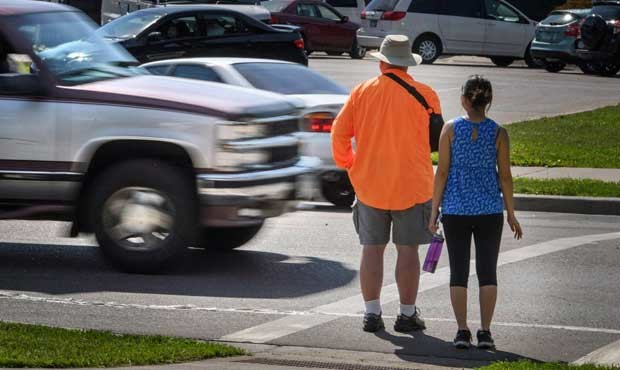
A new distracted walking law would make it illegal to check a mobile device while crossing a street or highway (AP.)
(AP.)
Would you ever accept a $35 ticket for checking your phone while crossing the street? How about a $99 distracted walking ticket?
Those are the fines listed in Honolulu’s new distracted walking law, which bans any use of a cellphone while walking through a pedestrian crosswalk. While it may be intended to reduce car-pedestrian collisions, for City Lab’s Laura Bliss, the new law is ignoring a bigger problem: the unfair burden placed on pedestrians to avoid traffic accidents.
RELATED: Pedestrians continue their oblivious stroll as drivers hit with tougher laws
“As a policy that’s aimed to protect that population, this seems a bit misguided,” Bliss said on KIRO Radio’s Seattle’s Morning News.
“The city councilman who had the idea for it was inspired by a group of teenagers who seemed to be distracted by their phones,” she said. “Then more broadly, there’s just very little evidence that banning behaviors that society frowns upon works. And add to that, too, this policy shares with others like it that have been attempted across the country a tendency to sort of blame pedestrians rather than drivers in the event of pedestrian-car collisions. Ultimately, it is the driver navigating the car.”
Honolulu is the first major city to pass distracted walking legislation; though after passing its new distracted driving law, it is conceivable that Seattle may one day follow suit. The law, which is set to go into effect in October, makes it illegal for a pedestrian to view any mobile electronic device while crossing a street or highway. The law fines violators up to $35 for a first offense, up to $75 for a second offense, and up to $99 for a third offense if cited during the same year.
A distracted walking law may feel like a bad idea to some people – especially young people – who rely more on their mobile devices than older generations. On the other hand, Seattle drivers (who now have to follow a hands-free device mandate) might feel it is only fair that pedestrians are also held accountable on the roads.
Bliss agrees that everyone should be responsible for their own safety on shared streets. But she reminds critics that, outside of cities like Seattle, there is an unfair amount of blame placed on pedestrians.
“I do think it’s worth contemplating the way that our streets are designed more broadly outside of pro-cycling, pro-walking cities like Seattle,” she said. “… there is a sort of greater priority given to the driver and, in many cases, less room for error on the part of the pedestrian. So, I do think it’s worth trying to balance traffic safety policy a little bit more so that pedestrians are safer on the road as well.”
Follow @http://twitter.com/Mynorthwest