
Seattle housing committee makes misleading attacks against drivers
Jul 10, 2015, 11:33 AM | Updated: 1:09 pm
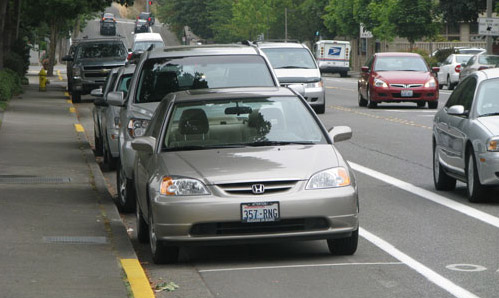
The city is preparing to recommend the reduction of off-street parking requirements for residential development and charging more for street-parking permits. (File photo)
(File photo)

Driving is going to get much harder in Seattle, courtesy of Mayor Ed Murray’s housing committee.
They’re preparing to recommend the reduction of off-street parking requirements for residential development and charging more for street-parking permits.
I predicted this would happen in April, after the Seattle Department of Transportation told housing activists that parking is what’s causing the so-called housing affordability crisis. SDOT disingenuously argued that parking costs developers a lot of money, which then contributes to high rent.
In a leaked early draft of their recommendations, the Housing Affordability and Livability Advisory Committee (HALA) argues that parking quotas “…can dramatically constrain the supply of new dwellings built,” because they take up space that could otherwise be used for housing, that also “prevent some smaller properties from being developed altogether.”
They literally took the SDOT talking points, which was the plan from the beginning.
Related: City’s parking solutions somehow forget about cars
Of course, there are flaws in their arguments, but let’s start with that fact that parks take up space on lots that could be used for housing (as well as preventing smaller properties from being developed). Will the committee recommend we get rid of parks? Light rail expansion is literally kicking people out of their homes to lay down tracks. Should we stop?
Despite SDOT and HALA claims, parking does not significantly drive up costs of rent. Like a gym, a mini-movie theater, a rooftop deck, etc., parking is an amenity that creates demand from renters (a lack of parking is why I wouldn’t rent from a developer and I’m not alone). SDOT claims a parking spot can technically cost $50,000 because it takes the space of a housing unit that could bring in significant rent over time. Great! I could fit about 10 cars in my apartment’s gym, making that gym cost $500,000 (and we don’t even have barbells!). Yet they’re not recommending we get rid of gyms.
And like SDOT, HALA pretends parking isn’t even an issue. In April, SDOT laughingly said the City of Seattle has an “over-supply” of parking (they said this a few weeks after city workers were caught illegally parking because they couldn’t find spots). HALA, too, claims “research shows that throughout Seattle, multifamily buildings continue to have excess parking
capacity.”
That’s a disgusting and purposeful misreading of the data. As I said in April:
By not requiring developments to build enough parking spots, they have to price it high enough to convince some residents not to ask for spots. So they jack the prices up. Some people with cars will refuse to pay and then fight for street parking (and if you have ever around driven Capitol Hill or South Lake Union after work hours, it’s a vicious fight looking for street parking).
Now, because the pricing scheme for these apartment parking spots has to be high enough to scare some people away, you will have some empty stalls — it’s inevitable. You don’t want a full parking lot because you don’t want to tell a paying resident who expects parking and is willing to pay, that they don’t get a spot.
Remarkably, the Times reports, “[t]he draft report recommends the city reduce parking requirements for new, multifamily buildings outside the densest neighborhoods when they are near transit or services.”
Related: Seattle leaders should stop pretending they care about families
These activists actually think taking a bus when you have a 7 and 9 year old is something that’s doable. They actually think it’s convenient getting to your job in West Seattle on a bus from Magnolia.
Do you see how these activists all work together? It’s remarkable — the city hates cars, but they have a lot of drivers, including people who can’t afford to live in the city.
Understand that this is part of the plan to continue to go after drivers. To blame parking for rising housing costs is not just a blatant lie, it’s not even a good one.
Next week, we’ll get into what the rising cost is actually to blame for (or of course, you can listen to my show weeknights from 7 p.m.-10 p.m. on KIRO Radio 97.3 FM).

-
 Tune in to Seattle Red AM 770 weekdays at 3-7pm to The Jason Rantz Show.





