
Seattle dept. falsely called protest ‘constitutionally protected’
May 8, 2018, 6:58 AM | Updated: 12:17 pm
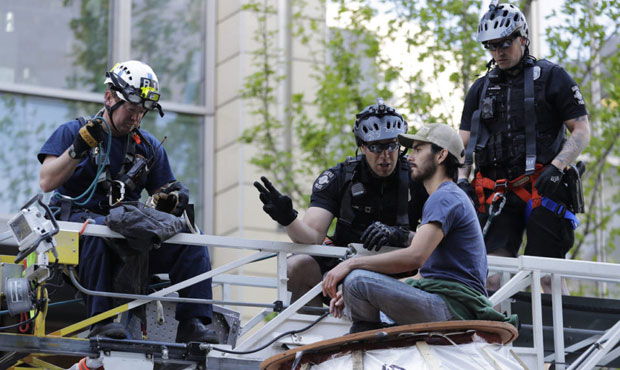
Seattle Police officers talk with a protester sitting on top of a teepee on Second Ave. in downtown Seattle as they utilize a fire department ladder truck, Monday. (AP Photo/Ted S. Warren)
(AP Photo/Ted S. Warren)

Moments after the Seattle Police Department issued dispersal orders to the environmental activists protesting Chase Bank on Second Avenue in Downtown Seattle, the Seattle Special Events Office claimed the protest was a “spontaneous constitutionally protected free speech activity.”
When I pushed them on that claim, they almost immediately walked it back.
At 11:50 a.m. on Monday, the Seattle Police Department tweeted that “Officers have issued a dispersal order to demonstrators still at the scene.” They’d end up arresting 14 people.
But at 12:13 p.m., Chris Swenson with the Seattle Special Events Office claimed the protest was protected. When a colleague at our sister station, KIRO Radio, asked if a permit had been granted, Swenson emailed back: “No Special Event Permit was applied for or granted for today’s spontaneous constitutionally protected free speech activity in downtown Seattle.”
RELATED: 14 people arrested in protest
That didn’t seem right. I had done the research after the last time a similar protest snarled traffic and the SPD, at the time, incorrectly stated it was a protected protest. I wrote at the time:
“The City of Seattle could place reasonable restrictions on where, when and how protests unfold. Time, place, and manner restrictions are permissible, though they cannot be content-based. Meaning, it’s reasonable to make arrests — or ask the protesters to move to sidewalks — when their permit-less protests occur in the middle of a busy intersection during a morning commute.”
I emailed Swenson to justify the position the protest was constitutionally protected and, within two emails, they clarified the statement. Swenson wrote, in part:
“Our previous statement was not an assessment of whether the activity taking place is constitutional, but rather was only meant to state that this type of event would normally fall into the category of a constitutionally protected event. Although this type of march would normally fall into that category, not all behavior is constitutional.
Under Supreme Court precedent, the Police Department may issue an order of dispersal if there is a ‘clear and present danger of riot, disorder, interference with traffic upon the public streets, or other immediate threat to public safety, peace, or order, appears.’ If a clear and present danger exists, police must 1) give a valid order, 2) to disperse, and 3) provide a reasonable opportunity to comply.”
So, in other words, the SPD had every right to remove these protesters illegally occupying a public street, without a permit, interfering with traffic.
Why is any of this important? I’m highly suspicious that Swenson corrected the original statement to KIRO Radio or any other outlet incorrectly told the protest was lawful. When you tell a media outlet that the city believes a protest to be constitutional, it may change the narrative presented by the outlet. If they treat the event as constitutional, when it is not, it can lead not just to confusion but a more sympathetic view of protesters that ends up demonizing the police for doing their job.
Perhaps the Seattle Special Events Office should choose its words more carefully.
Follow @https://twitter.com/jasonrantz

-
 Tune in to Seattle Red AM 770 weekdays at 3-7pm to The Jason Rantz Show.






