Organized retail theft is closing stores in vulnerable Seattle neighborhoods, King County prosecutors warn
Jul 6, 2026, 10:27 AM
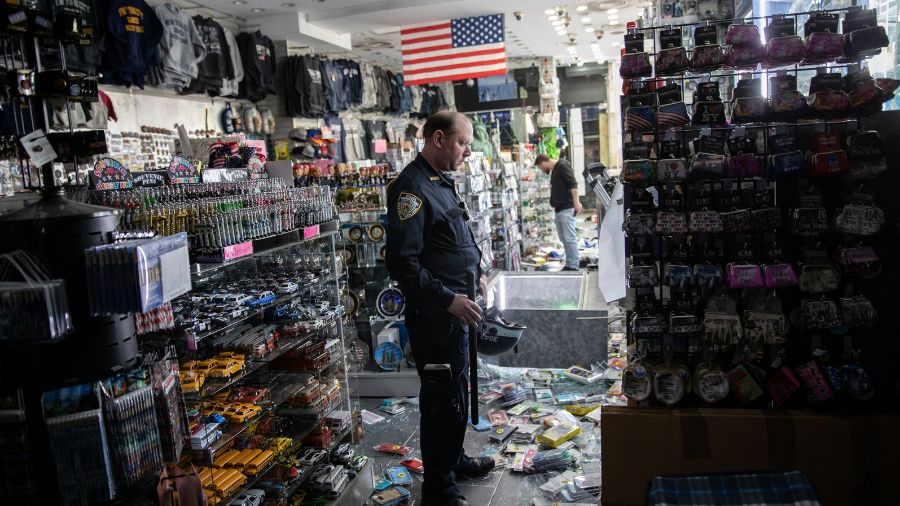
A police officer stands guard in a looted souvenir and electronics shop. (Photo: John Moore, Getty Images)
(Photo: John Moore, Getty Images)

The King County Prosecuting Attorney’s Office is charging organized retail theft cases daily, but said it needs significantly more staff and funding to keep pace with the volume of crimes driving some stores out of vulnerable neighborhoods.
Casey McNerthney of the King County Prosecuting Attorney’s Office said prosecutors handle cases that escalate beyond simple misdemeanor shoplifting — commercial burglaries, felony thefts, and organized retail crime rings that repeatedly target the same businesses.
“The key is once you’ve been trespassed, even if you steal a Snickers bar, that is a different guideline,” McNerthney said. “Or if you have a weapon, which we see far too often, that’s when the cases come to us.”
The office has a single senior deputy prosecutor, Stephanie Sato, dedicated full-time to organized retail crime. McNerthney called her work essential but said the caseload far exceeds what one person can manage.
“We could have 12 people just like her and still have enough work, and so we really need that funding,” McNerthney said.
Sato attends multiple monthly coordination meetings, including an East Side gathering where retailers and law enforcement discuss trends, the Washington Attorney General’s Task Force, and a group called WA ORCA — the Washington Organized Retail Crimes Association. Those sessions help investigators connect suspects across multiple stores and jurisdictions.
“When you have somebody who’s caught at one store, maybe a Target, odds are they might not have stolen only from Target,” McNerthney said. “They might have hit other businesses.”
Better documentation from retailers can make or break a case, prosecutors say
Sato urged business owners to take specific steps to help prosecutors build felony cases: Document the date, time, and physical descriptions of suspects; capture surveillance stills of them entering, exiting, and concealing merchandise; and compile itemized lists of stolen goods with values.
“If we can get a still shot of them walking in the door, a still shot of them walking out of the door from the surveillance, and then the actual taking or concealing of the item, that’s really helpful,” Sato said.
She also stressed the importance of filing a police report after every incident, even when business owners feel overwhelmed.
“We’ve seen in court business owners, and employees say, ‘Well, this has happened three or four times,’ and then understandably you have defense saying, ‘Well, you can’t prove that,'” McNerthney said. “So if you have that record where you can call the police,” it strengthens the prosecution’s case.
McNerthney acknowledged that small business owners, often operating with just a few employees, find the documentation burden exhausting. But Sato has made herself available to help, offering to visit businesses and train staff on how to respond.
“Say you’re at a strip mall, and all the small businesses are getting victimized by this one person — I can just come to that strip mall or speak with each of the retailers as to coordination and how to respond to that,” Sato said.
RELATED STORIES


Leaders within the office describe the resource gap as a public safety crisis
Patrick Hinds, chief of the office’s Retail Crimes and Wage Theft Division, framed the resource gap as a public safety crisis.
“We can’t prosecute a case without having enough prosecutors with enough paralegals and support staff to prosecute the defendants who commit these crimes,” Hinds said. “We also rely on our law enforcement partners having sufficient resources for officers to respond, for detectives to investigate, and for all of that to be packaged up and sent” to prosecutors.
The office characterized organized retail crime as both a public safety and a racial equity and social justice issue, noting that store closures driven by repeated theft disproportionately harm economically disadvantaged, immigrant, and BIPOC communities.
McNerthney pointed to the closure of the Fred Meyer in Seattle’s Lake City neighborhood as an example of the consequences.
“You don’t want to see the neighborhoods that really need easy access to a grocery store not have one because of these repeat thefts,” McNerthney said.
The office said it plans to continue requesting additional positions in upcoming county budget cycles and invited the public to review its budget proposals.
Manda Factor is the host of “Seattle’s Morning News” on KIRO Newsradio. Follow Manda on X and email her here.