After a reference to Trump’s impeachments is removed from a history museum, complex questions echo
Aug 1, 2025, 9:10 PM
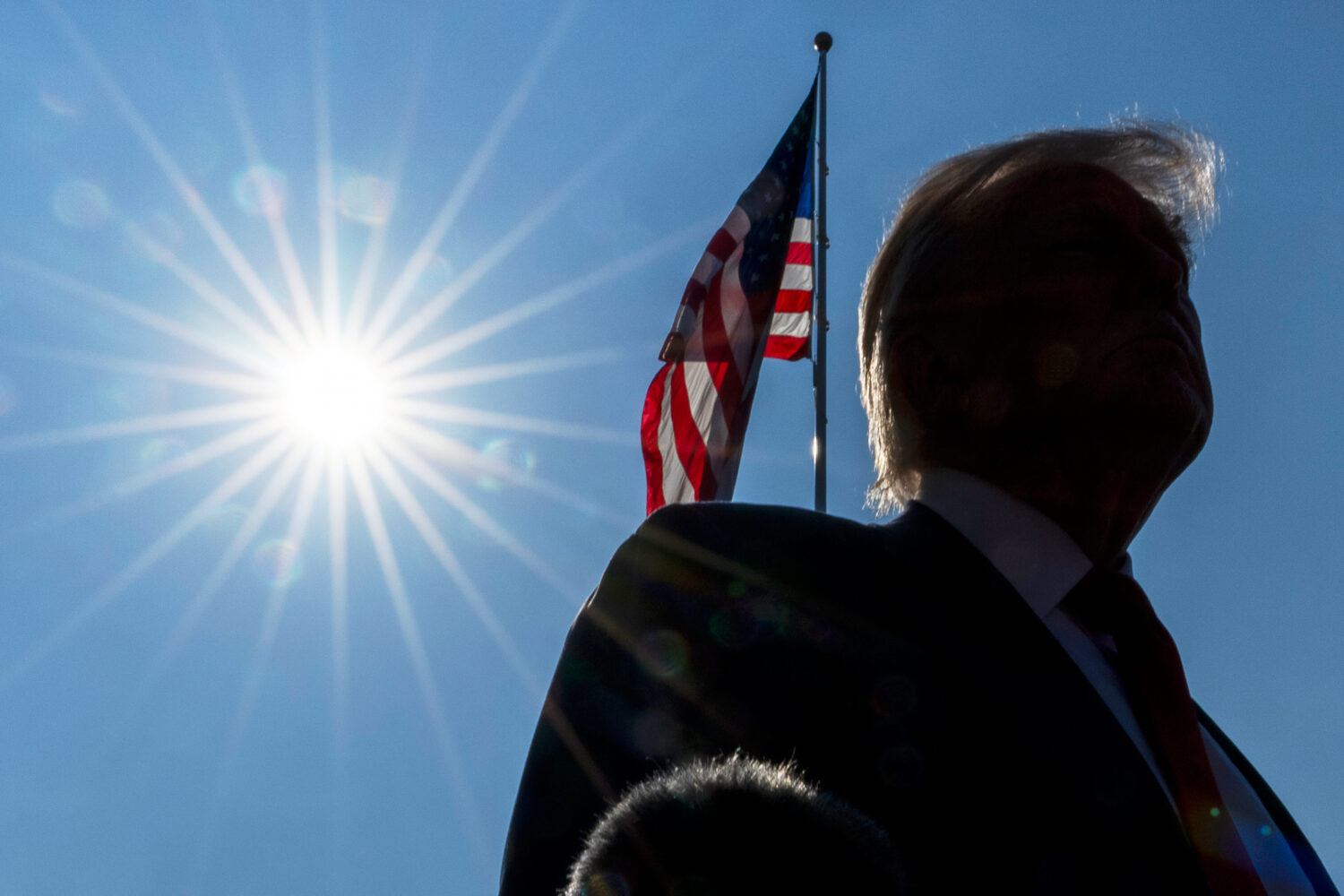
President Donald Trump speaks with reporters before departing on Marine One from the South Lawn of the White House, Friday, July 25, 2025, in Washington. The President is traveling to Scotland. (AP Photo/Alex Brandon)
Credit: ASSOCIATED PRESS
(AP Photo/Alex Brandon)

NEW YORK (AP) — It would seem the most straightforward of notions: A thing takes place, and it goes into the history books or is added to museum exhibits. But whether something even gets remembered and how — particularly when it comes to the history of a country and its leader — is often the furthest thing from simple.
The latest example of that came Friday, when the Smithsonian Institution said it had removed a reference to the 2019 and 2021 impeachments of President Donald Trump from a panel in an exhibition about the American presidency. Trump has pressed institutions and agencies under federal oversight, often through the pressure of funding, to focus on the country’s achievements and progress and away from things he terms “divisive.”
A Smithsonian spokesperson said the removal of the reference, which had been installed as part of a temporary addition in 2021, came after a review of “legacy content recently” and the exhibit eventually “will include all impeachments.” There was no time frame given for when; exhibition renovations can be time- and money-consuming endeavors.
In a statement that did not directly address the impeachment references, White House spokesperson Davis Ingle said: “We are fully supportive of updating displays to highlight American greatness.”
But is history intended to highlight or to document — to report what happened, or to serve a desired narrative? The answer, as with most things about the past, can be intensely complex.
The Smithsonian’s move comes in the wake of Trump administration actions like removing the name of a gay rights activist from a Navy ship, pushing for Republican supporters in Congress to defund the Corporation for Public Broadcasting and getting rid of the leadership at the Kennedy Center.
“Based on what we have been seeing, this is part of a broader effort by the president to influence and shape how history is depicted at museums, national parks, and schools,” said Julian E. Zelizer, a professor of history and public affairs at Princeton University. “Not only is he pushing a specific narrative of the United States but, in this case, trying to influence how Americans learn about his own role in history.”
It’s not a new struggle, in the world generally and the political world particularly. There is power in being able to shape how things are remembered, if they are remembered at all — who was there, who took part, who was responsible, what happened to lead up to that point in history. And the human beings who run things have often extended their authority to the stories told about them.
In China, for example, references to the June 1989 crackdown on pro-democracy demonstrators in Beijing’s Tiananmen Square are forbidden and meticulously regulated by the ruling Communist Party government. In Soviet-era Russia, officials who ran afoul of leaders like Josef Stalin disappeared not only from the government itself but from photographs and history books where they once appeared.
Jason Stanley, an expert on authoritarianism, said controlling what and how people learn of their past has long been used as a vital tool to maintain power. Stanley has made his views about the Trump administration clear; he recently left Yale University to join the University of Toronto, citing concerns over the U.S. political situation.
“If they don’t control the historical narrative,” he said, “then they can’t create the kind of fake history that props up their politics.”
In the United States, presidents and their families have always used their power to shape history and calibrate their own images. Jackie Kennedy insisted on cuts in William Manchester’s book on her husband’s 1963 assassination, “The Death of a President.” Ronald Reagan and his wife got a cable TV channel to release a carefully calibrated documentary about him. Those around Franklin D. Roosevelt, including journalists of the era, took pains to mask the impact that paralysis had on his body and his mobility.
Trump, though, has taken it to a more intense level — a sitting president encouraging an atmosphere where institutions can feel compelled to choose between him and the truth — whether he calls for it directly or not.
“We are constantly trying to position ourselves in history as citizens, as citizens of the country, citizens of the world,” said Robin Wagner-Pacifici, professor emerita of sociology at the New School for Social Research. “So part of these exhibits and monuments are also about situating us in time. And without it, it’s very hard for us to situate ourselves in history because it seems like we just kind of burst forth from the Earth.”
Timothy Naftali, director of the Richard M. Nixon Presidential Library and Museum from 2007 to 2011, presided over its overhaul to offer a more objective presentation of Watergate — one not beholden to the president’s loyalists. In an interview Friday, he said he was “concerned and disappointed” about the Smithsonian decision. Naftali, now a senior researcher at Columbia University, said museum directors “should have red lines” and that he considered removing the Trump panel to be one of them.
While it might seem inconsequential for someone in power to care about a museum’s offerings, Wagner-Pacifici says Trump’s outlook on history and his role in it — earlier this year, he said the Smithsonian had “come under the influence of a divisive, race-centered ideology” — shows how important those matters are to people in authority.
“You might say about that person, whoever that person is, their power is so immense and their legitimacy is so stable and so sort of monumental that why would they bother with things like this … why would they bother to waste their energy and effort on that?” Wagner-Pacifici said. Her conclusion: “The legitimacy of those in power has to be reconstituted constantly. They can never rest on their laurels.”
___