AP Exclusive: The school choice scholarship boom benefits kids already in private school
Jun 16, 2026, 2:05 AM
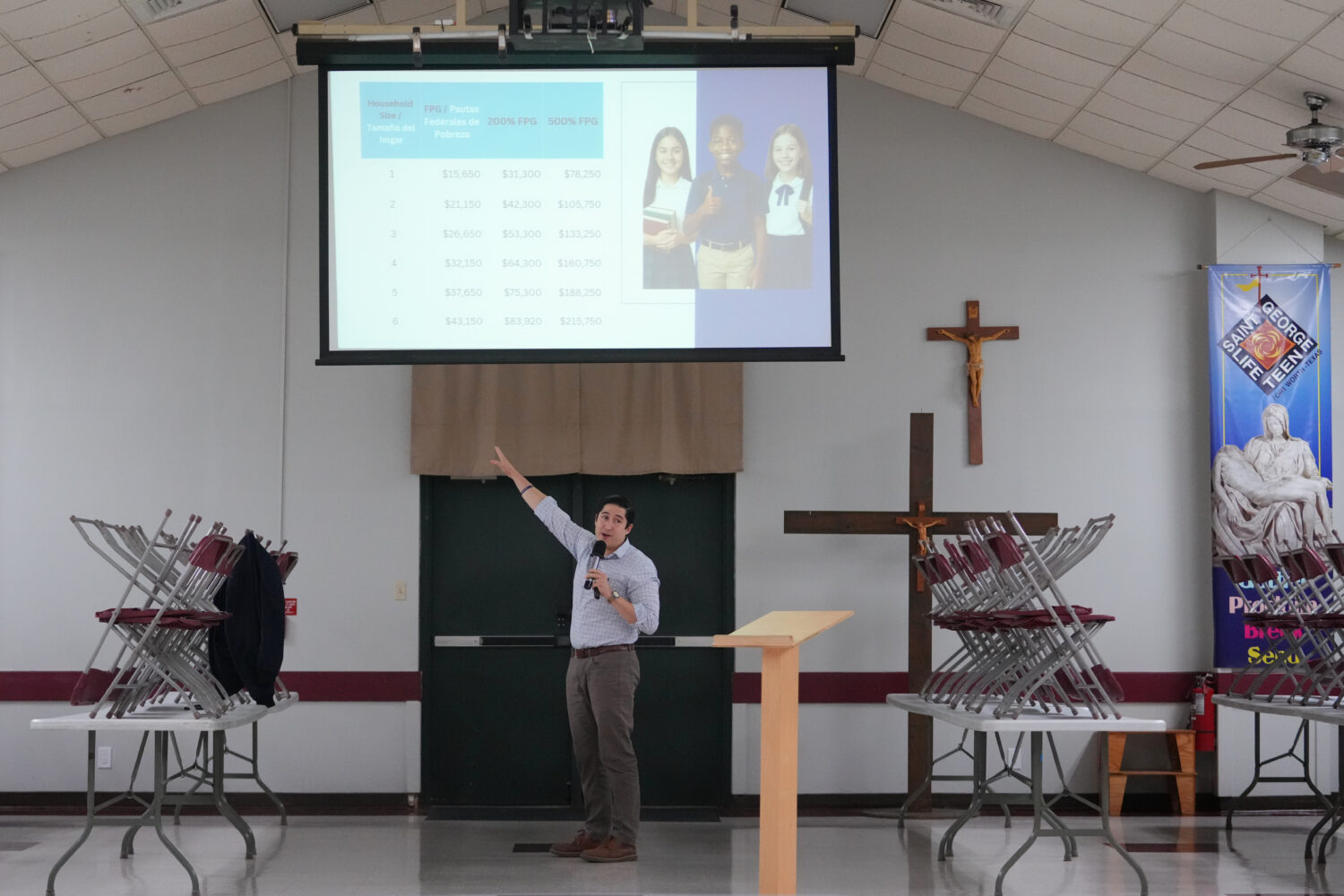
Oscar Ortiz, representing the the Catholic Diocese of Fort Worth, speaks at St. George Catholic School during a session with parents on Texas’ private school voucher program, Wednesday, Jan. 21, 2026, in Fort Worth, Texas. (AP Photo/Julio Cortez)
Credit: AP Photo/Julio Cortez
(AP Photo/Julio Cortez)

FORT WORTH, Texas (AP) — The Catholic school tour ended, and Maria Contreras felt an overwhelming desire to enroll her 7-year-old. But first, a difficult question for the principal.
The second grader has trouble focusing. He doesn’t listen to teachers and runs around the classroom, she explained. Could he be expelled?
More families across the country are experimenting with private school as states — and soon the federal government — use taxpayer-supported scholarships to encourage them to leave public school. Soon, half of all American schoolkids will be able to apply for state money to finance a private education, and many states will offer the scholarships even to families with high incomes.
In theory, these programs are supposed to give children an educational opportunity they wouldn’t otherwise have. In reality, students already in private or home school are most likely to benefit, an analysis by The Associated Press shows.
The reasons are complicated. In some cases, public school families don’t know about these scholarship programs, known as vouchers or education savings accounts. They may lack transportation to get their kids to private school. Some worry their child won’t survive in a more strict disciplinary environment. Sometimes, as in Texas, the latest state to join the already $10.5 billion private school choice movement, the law is written to benefit families who know how to navigate complicated education systems.
Contreras and her husband had grown up Catholic in Mexico. They moved to Texas, he found a job as a welder, and eventually they got green cards. They were relatively happy sending their three older children to Fort Worth public schools.
But their youngest son, Ian, presented different challenges. He was reading far below grade level.
Contreras asked Ian’s teacher in the fall to test him for a learning disability, not knowing there was a legally mandated process for requesting an evaluation.
For months, no one tested her son.
She wasn’t alone. Students at her son’s elementary school, where nearly all students are economically disadvantaged and the majority are still learning English, have been diagnosed with learning disabilities at a surprisingly low rate. Only 4% qualify for special education services, compared with 14% districtwide.
Contreras had no idea then, but without the testing, she would have few options for paying for a new school for Ian.
Contreras learned about the opportunity for private school scholarships at church, of all places. During announcements at Mass, a man asked in Spanish if anyone wanted $10,000 to attend Catholic school. Ian raised his hand.
Texas’ monumental program launches this fall, offering around $1 billion of public money to help families with private school or homeschooling expenses. The program funds education savings accounts — a type of scholarship that goes beyond just tuition, giving families money for everything from textbooks and music lessons to transportation and tech.
Republican-led states such as Indiana, Florida and Arizona have long offered taxpayer-funded scholarships for students attending private school or studying at home. But the movement to privatize education has surged under President Donald Trump, who has capitalized on growing skepticism of public schools.
For years, Texas had resisted launching a voucher program, as Democrats and rural Republicans blocked efforts they feared would divert money from public schools. Gov. Greg Abbott, a Republican, fast-tracked the creation of Texas Education Freedom Accounts last year with an assist from Trump. The president himself called GOP lawmakers to urge them to pass this part of his education agenda.
To get the votes, Texas Republicans abandoned a provision that would have awarded 80% of Freedom Accounts in the first year to students leaving public schools.
Without such a provision, evidence from other states is clear: The majority of scholarships will be used by students already in private or home schools.
Last year in Alabama, for example, former public school students made up only 13% of scholarship recipients, an AP analysis shows. Fewer than half of public school students in Alabama who were offered a scholarship used it, compared with 94% of kids who were already attending private schools.
Alabama plans to remove any income limits to its scholarship program next year, joining states like Arizona that offer scholarships to all. In Arizona, the AP analysis shows, use of the scholarships is nearly three times higher in high-income ZIP codes than in low-income neighborhoods.
In the end, the Texas legislation prioritized students from any type of school who have documented disabilities, plus their siblings. Those students, as long as their families earn less than $165,000 for a family of four, would be first in line when Texas awarded its Freedom Account scholarships this spring.
Next, the state prioritized lower-income children, whose families earn less than $66,000 for a family of four.
Ian would be in the third group, virtually at the end of the line, since his parents earn around $70,000 a year.
To catapult to the front, Ian would need to have a documented disability — a growing trend in state voucher programs. Today, nine states have taxpayer-funded scholarships to help students with special needs attend private school or learn at home.
But leaving the public school system is risky for many of these students, and special education advocates have long warned against it. Private schools aren’t legally required to admit students with special needs. Contreras was surprised to learn private schools also aren’t obligated to offer services to help kids with disabilities, as public schools are.
Despite decades of research on school choice, academic scholarship hasn’t kept pace with states targeting vouchers to students with disabilities. How those students are faring academically in traditional private schools is unknown.
Educators at Saint Rita Catholic School appeared unfazed when, in the middle of her tour, Contreras interrupted their description of the third grade reading list to disclose how much trouble Ian has sitting still.
“Sometimes a kid would rather be seen as active than not understanding,” replied Principal Kindra Johnston, a former counselor who brings her golden retriever to work each day. “I can teach him how to regulate himself. How to have purpose.”
Having a smaller class and a teacher who knows how to reach him could help, she added.
The school currently enrolls students with learning disabilities, including dyslexia, dysgraphia, attention-deficit / hyperactivity disorder, and borderline intellectual function, she told a reporter.
There’s no public information showing how many students with disabilities attend private schools in Texas. Representatives of the Diocese of Fort Worth say they have encouraged Catholic school students to apply for the scholarship money so schools can pay for more special education therapies students need.
Contreras left the tour of Saint Rita wanting to enroll her son immediately. But she soon realized: Without the voucher, she can’t afford the $7,000 tuition.
With her daughter’s help, she formally requested a special education evaluation at her son’s public school.
Under Texas law, the district has 15 school days to respond and then 45 school days to evaluate after a parent files their request for disability testing. If evaluators find a disability and decide it’s affecting a child’s ability to learn, the school is legally obligated to make a plan and provide services to help.
But by the time the Texas voucher application was due, the Fort Worth school district still hadn’t tested Ian. Contreras had made the request too late.
Texas started notifying families in April whether they would get the voucher. According to information released so far, the approved applicants don’t mirror the state population. Only 43% recently attended public school. While more than half of Texas public school students are Latino, only a little over a quarter of voucher recipients are.
At the same time, three-fourths of the roughly 95,000 Freedom Accounts awarded as of May went to low-income kids. The share of approved applicants with disabilities, 28%, was double the share in the public school system.
Ian’s group has been placed on the waitlist.
In April, right before the school’s deadline to respond about the disability testing, and shortly after The Associated Press asked the district about Ian’s evaluation, his school contacted Contreras to arrange testing for attention-deficit/hyperactivity disorder. Contreras was surprised to learn the process started with a survey to be completed by a parent and Ian’s teacher, plus a visit to his pediatrician.
On the last day of school, Contreras finally got answers. Ian was diagnosed with ADHD. The school agreed to seat him near the teacher and give him extra teaching on difficult concepts.
But he currently doesn’t qualify for specialized services for his disability. He won’t receive priority status for this round of vouchers.
It’s possible Ian could benefit from leaving his public school and attending Saint Rita this fall.
Chances are, he won’t receive any financial help from the state to do it.
____
The Associated Press’ education coverage receives financial support from multiple private foundations. AP is solely responsible for all content. Find AP’s standards for working with philanthropies, a list of supporters and funded coverage areas at AP.org.