Bald eagle’s new status as the official US bird brings pride and hope to many Native Americans
Jul 13, 2025, 4:21 AM
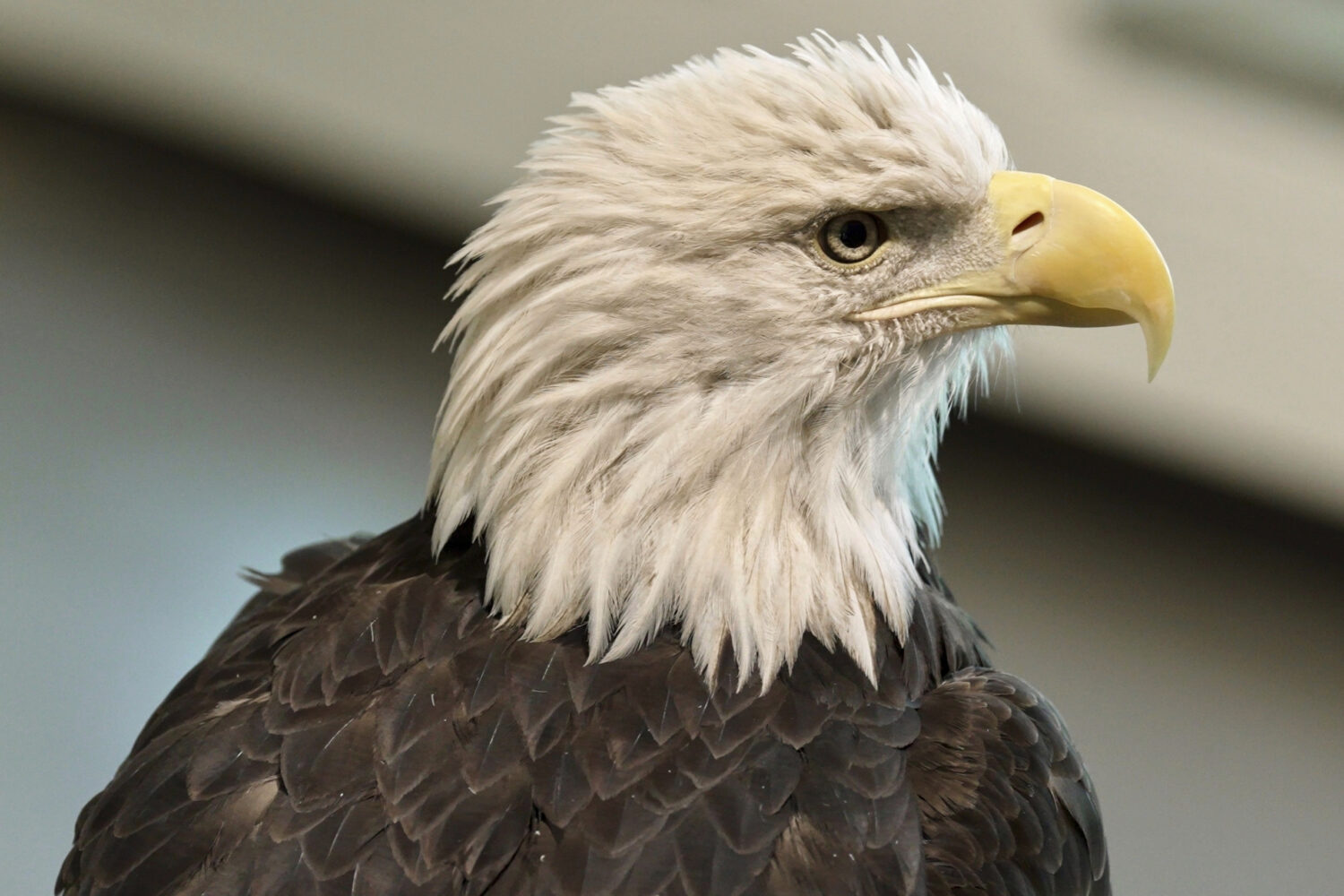
Angel, a 26-year-old bald eagle from Wisconsin that was too gravely injured to be returned to the wild, serves as "ambassador" to visitors at the National Eagle Center in Wabasha, Minn., on Wednesday, July 9, 2025. (AP Photo/Mark Vancleave)
Credit: ASSOCIATED PRESS
(AP Photo/Mark Vancleave)

PRAIRIE ISLAND INDIAN COMMUNITY, Minn. (AP) — Some Native Americans traditionally bestow bald eagle feathers at ceremonies to mark achievements, such as graduations, and as a form of reverence for the bird they hold sacred as a messenger to the Creator.
This year, many are doing so with elevated pride and hope. The bald eagle is now the official bird of the United States, nearly 250 years after it was first used as a symbol of the newly founded nation that’s deeply polarized politically today.
“The eagle is finally getting the respect it deserves. Maybe when the nation looks at the eagle that way, maybe there will be less division,” said Jim Thunder Hawk. He’s the Dakota culture and language manager for the Prairie Island Indian Community, a small Mdewakanton Sioux band on the banks of the Mississippi River in Minnesota.
This wide, unruffled stretch of water framed by wooded bluffs is prime bald eagle territory. The size of Minnesota’s population of the majestic, white-head-and-tail birds that are exclusive to North America is second only to that of Alaska.
The legislation that made the eagle official came from members of Minnesota’s Congressional delegation. The federal act recognizes the eagles’ centrality in most Indigenous peoples’ “spiritual lives and sacred belief systems,” and a replica of it is on display at the National Eagle Center in Wabasha, Minnesota, 40 miles (65 kilometers) downriver from the Prairie Island community, which partners with the center in eagle care.
“If you grew up in the United States, eagles were a part of your everyday life,” said Tiffany Ploehn, who as the center’s avian care director supervises its four resident bald eagles. “Everyone has some sort of connection.”
A bald eagle, its wings and talons spread wide, has graced the Great Seal of the United States since 1782, and appears on passport covers, the $1 bill, military insignia, and myriad different images in pop culture.
But a prolific collector of eagle memorabilia based in Wabasha realized recently that, while the United States had an official animal (the bison) and flower (the rose), the eagle was getting no formal credit. Several Minnesota legislators sponsored a bill to remedy that and then-President Joe Biden’s signature made it official in December.
With their massive wingspan and stern curved beak, bald eagles are widely used as symbols of strength and power. In reality, they spend 95% of their day perched high in trees, though when they hunt they can spot a rabbit 3 miles (5 kilometers) away, Ploehn said.
For many Native Americans, the soaring eagle represents far more; it delivers their prayers to the Creator and even intercedes on their behalf.
“My grandma told me that we honor eagles because they saved the Ojibwe people when the Creator wanted to turn on them. The eagle, he can fly high, so he went to speak with the Creator to make things right,” said Sadie Erickson, who is Ojibwe and Mdewakanton Sioux.
Erickson and a dozen other high school graduates received a bald eagle feather at an early July celebration by the riverbank at Prairie Island.
Thunder Hawk said a prayer in the Dakota language urging the high school graduates and graduates receiving higher education degrees to “always remember who you are and where you come from.”
Then they lined up and a relative tied a feather — traditionally on the left side, the heart’s side — as tribal members sang and drummed to celebrate them.
“It just feels like I went through a new step of life,” said Jayvionna Buck.
Growing up on Prairie Island, she recalled her mother excitedly pointing out every eagle.
“She would genuinely just yell at me, ‘Eagle!’ But it’s just a special occurrence for us to see,” Buck said. “We love seeing it, and normally when we do, we just offer tobacco to show our respects.”
Some Native Americans honor the eagle by taking it as their ceremonial name. Derek Walking Eagle, whose Lakota name is “Eagle Thunder,” celebrated the graduates wearing a woven medallion representing the bird.
To him, eagles are like relatives that connect him to his future and afterlife.
“Being able to carry on to the spirit world … that’s who guides you. It’s the eagle,” Walking Eagle said.
That deep respect attaches to the feathers, too.
“It’s the highest respect you can bestow on a person, from your family and from your people, from your tribe,” Thunder Hawk said. “We teach the person receiving the feather that they have to honor and respect the eagle. And we tell them why.”
In many Native cultures, killing an eagle is “blasphemous,” he said. It is also a federal offense.
Historically, Sioux warriors would lure an eagle with rabbit or other food, pluck a few feathers and release it, said Thunder Hawk, who grew up in South Dakota.
Today, there’s a nationwide program that legally distributes eagle feathers and parts exclusively to tribal members, though it’s very backlogged. U.S. wildlife and tribal officials worry that killings and illegal trafficking of eagles for their feathers is on the rise, especially in the West.
In Minnesota, eagles are most often harmed by road accidents and eating poison – results of shrinking wildlife habitat that brings them in closer contact with humans, said Lori Arent, interim director of the University of Minnesota’s Raptor Center.
The center treats about 200 injured bald eagles each year. Of those they can save, most are eventually released back into the wild. Permanently disabled birds that lose an eye or whose wings are too badly fractured to fly are cared for there or at other educational institutions like the Wabasha eagle center.
The official designation could help more Americans understand how their behaviors inadvertently harm eagles, Arent said. Littering by a highway, for instance, attracts rodents that lure eagles, which then can be struck by vehicles. Fishing or hunting with tackles and ammunition containing lead exposes the eagles eating those fish or deer remains to fatal metal poisoning.
Humans have lost the ability to coexist in harmony with the natural world, Thunder Hawk said, voicing a concern shared by Indigenous people from the Chilean Andes to the U.S.-Mexico borderlands.
He hopes more people might now approach the eagle with the same reverence he was taught. It’s what leads him to offer sage or dried red willow bark every time he spots one as a “thank you for allowing me to see you and for you to hear my prayers and my thoughts.”
Erickson, the new graduate, shares that optimism.
“I feel like that kind of shows that we’re strong and united as a country,” she said by the Mississippi, her new feather nestled in her hair.
___
Associated Press religion coverage receives support through the AP’s collaboration with The Conversation US, with funding from Lilly Endowment Inc. The AP is solely responsible for this content.