Some anglers praise forward-facing sonar, others say high-tech fishing ruins a day at the lake
Jun 14, 2026, 9:03 PM
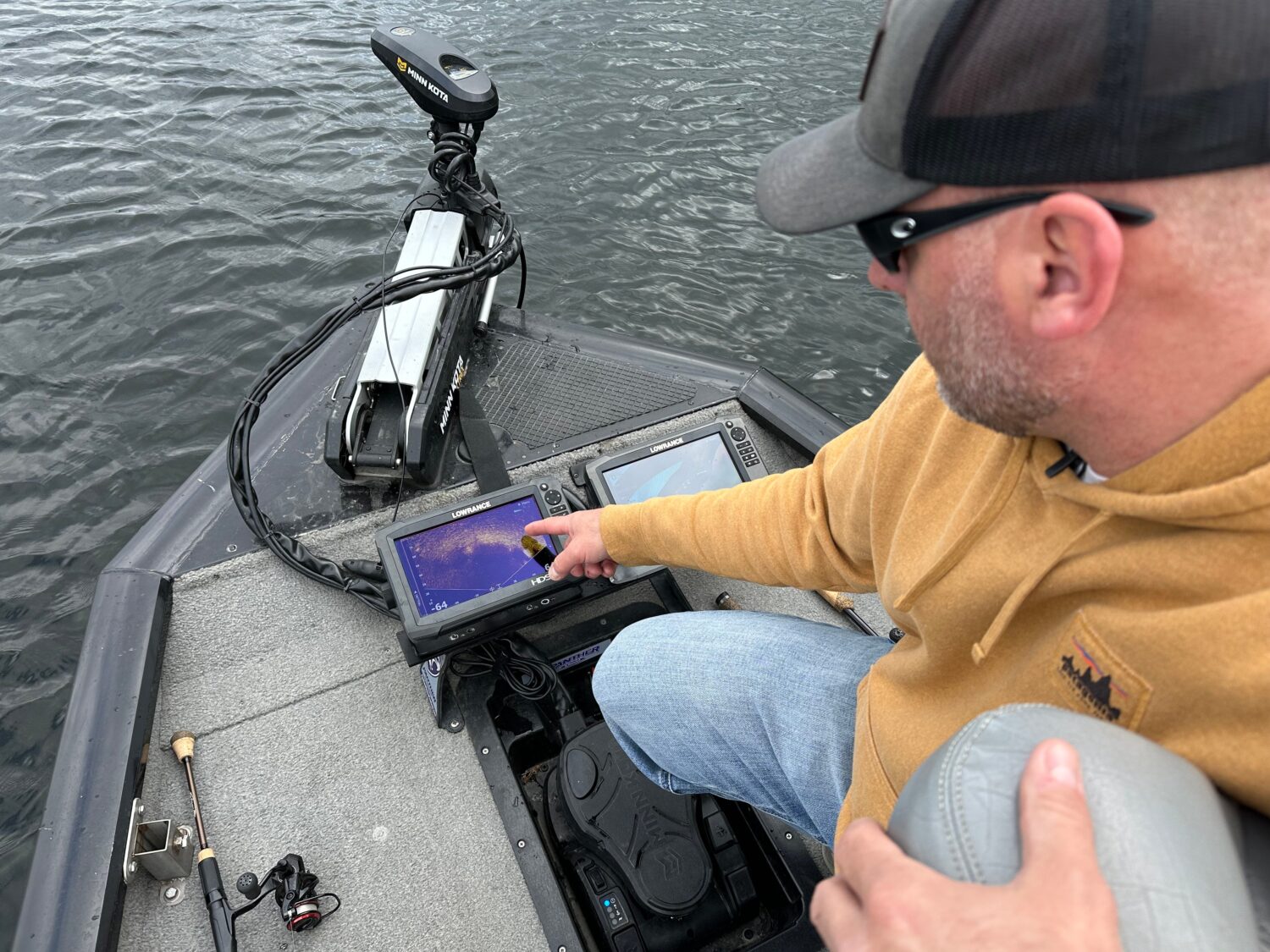
Terry Rehm points out a fish on his forward looking sonar system Saturday, May 23, 2026 in Nowthen, Minn. (AP Photo/Mark Vancleave)
Credit: AP Photo/Mark Vancleave
(AP Photo/Mark Vancleave)

BISMARCK, N.D. (AP) — Ah, the serenity of fishing.
Just an angler, a fishing pole and maybe thousands of dollars worth of sonar equipment offering an exact image of what that walleye or bass is doing in the watery depths below.
It’s called forward-facing sonar, and the hot-selling products are not only helping anglers increase their catch, they are raising questions about why people go fishing in the first place and whether fish populations can survive the new technology.
“You’ve got people that are concerned about what’s going to happen to the sport of fishing,” said Gary Korsgaden, who has written about the sport for decades.
Fish-finding sonar is typically mounted on the bow or back of a boat, sending out sound frequencies that are converted into a picture on a screen based on the time it takes the pings to hit the bottom and return. Earlier products would show where fish were located, but advancements now enable anglers to see images of fish in real time.
“With forward-facing sonar, you can attach it to a trolling motor and you can look around the water under you and you could find exactly, pinpoint where that fish exactly is at any given time,” said Dave Dunn, a sales executive at Garmin, a company that manufactures the equipment.
Dunn notes the equipment, which costs about $2,500 for a full setup, enables anglers to even see their lures and cast directly to fish. It does have a learning curve.
For Minnesota angler Terry Rehm, the new technology is invaluable. Rehm said he doesn’t get a lot of lake time due to his work and kids’ schedules and forward-facing sonar ensures he makes good use of his time plying the waters.
“It’s just nice to be able to hone in on them a little quicker and find them quicker and catch more fish when I’m out here,” he said.
Tens of millions of people fish recreationally each year, making it one of the nation’s top activities.
But people fish for different reasons and those who care most about the tranquility and beauty of being on a lake can find it puzzling that other anglers eagerly hunch over their screens, watching as fish swim by below.
Still, the use of the technology is growing dramatically, with surveys in Minnesota finding about 30% of anglers now use forward-facing sonar. Surveys of anglers on several Minnesota lakes found the user rate as high as 63% on one lake last fall, Walleye Alliance spokesperson Nate Blasing said.
Much of the debate around forward-facing sonar plays out on social media, but also podcasts, online fishing forums, trade shows and tournaments.
“It’s much like politics now. It tends to get personal. You can agree to disagree,” Blasing said.
Criticisms and reactions go back and forth on social media, said Korsgaden, the fishing writer. He said tournament anglers have banned him from their Facebook pages for even raising the topic.
“I think the unfortunate reality is fishing has gotten to be more about, shall we say, success or numbers or quantity, that type of thing, instead of the actual enjoyment of the engagement and making decisions on your own,” Korsgaden said.
Even as anglers say the equipment helps ensure they will actually catch fish, some studies indicate it hasn’t led to overfishing.
Wisconsin researchers conducted a controlled experiment last year with two teams of anglers fishing for smallmouth bass, one with forward-facing sonar, the other without. Halfway through the summer, the teams switched.
The team without the technology had higher catch rates, though the team using it caught slightly longer fish, said Greg Sass, fisheries research team leader with the Wisconsin Department of Natural Resources’ Office of Applied Science. The sonar users searched more for fish before even fishing, while the other team spent more time actively fishing.
Sass said he is reluctant to apply the study to all fish species and water bodies, but the findings “would be counterintuitive to what I’m hearing in the bait shops or from other people that are on both sides of the fence with technology,” he said. More studies are ahead, including for the muskie, a prized predator fish.
Eric Sanft, a fisheries specialist for the Minnesota Department of Natural Resources, said an analysis of lakes across the state didn’t find “negative impacts” from the use of forward-facing sonar in fishing.
Surveys by wildlife officers in Minnesota found people using forward-facing sonar ended up catching similar numbers and variety of fish as anglers who cast their lines the old-fashioned way.
“To some degree, it can get scapegoated a little bit, and people’s perceptions of what other people are doing is often different than what the reality is,” said Marc Bacigalupi, a regional fisheries supervisor for the Minnesota Department of Natural Resources.
The department has proposed reducing the daily walleye limit from six fish to four, partially because of advancements in fish-finding technology, among other factors such as a boom in ice fishing, attention on hot spots from social media and lower limits in surrounding states.
For Daren Schneider, a lifelong angler from Bismarck, North Dakota, forward-facing sonar has changed everything he thought he knew about fishing.
When seeking walleye, for example, he thought you needed to catch them on or near the lake bottom, but after watching on sonar, he found “they do all kinds of things that you never thought a walleye would do.”
The technology has enhanced his understanding of fish and his enjoyment of fishing, Schneider said.
“Fishing isn’t necessarily about catching fish and getting your limit or whatever,” he said. “It’s about being out there and making memories, and if it’s making memories with forward-facing sonar, why is that such a bad thing?”