Whether `stringing’ or `looping,’ tobacco is the tie that binds many North Carolina farm families
Oct 20, 2026, 9:01 PM
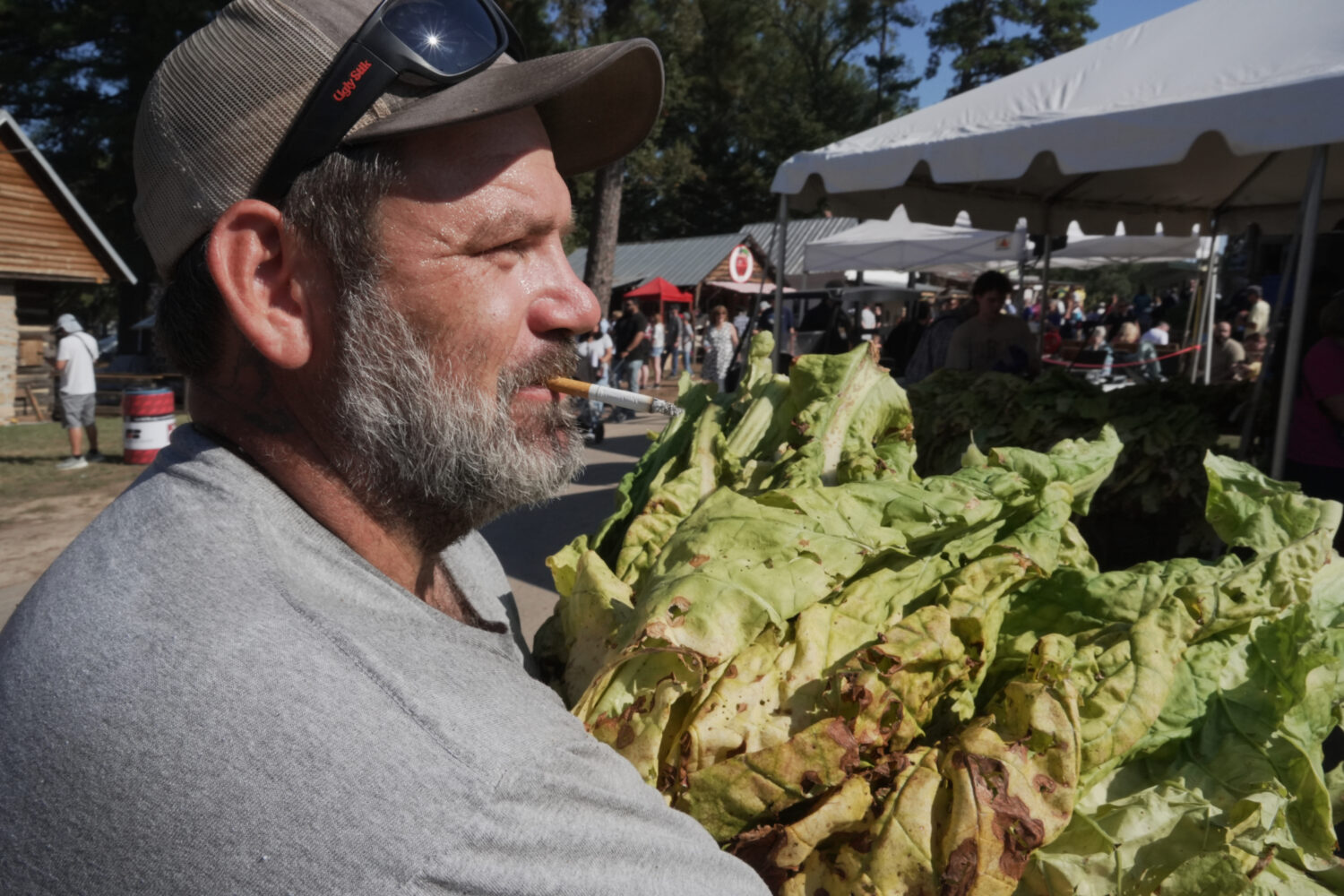
Josh Ramsey, an employee at the Oxford Tobacco Research Station, smokes a cigarette as he carries a bundle of tobacco leaves for the annual tobacco stringing contest at the State Fair in Raleigh, N.C., on Friday, Oct. 16, 2026. (AP Photo/Allen G. Breed)
Credit: AP Photo/Allen G. Breed
(AP Photo/Allen G. Breed)

RALEIGH, N.C. (AP) — When Sophie Sunday told her schoolmates she was taking off halfway through the school day, they couldn’t wait to find out why.
“`I’m going to loop tobacco at the fair,’” the seventh grader told them. “And they’re, like, `What?’ They don’t have a clue.”
To be fair, most people don’t.
At 12, Sophie was the youngest contestant in the North Carolina State Fair’s annual tobacco stringing contest, which pays homage to a way of life that was already largely past when her parents were kids.
Traditionally, tobacco was harvested by hand, hung in a log barn and cured to a golden-brown with a wood fire that had to be stoked day and night. But before it could go into the barn, the green tobacco had to be strung on long wooden sticks.
What you called this practice depended on what part of the state you lived in. Because the fairgrounds are in the capital, Raleigh, they call it a stringing contest.
“Where I grew up, in the middle of the state, we call it stringing,” said Pat Short, superintendent of the fair’s Heritage Circle. “But down east, in the eastern part of the state, they call it looping tobacco.”
Today, North Carolina’s flue-cured tobacco crop is harvested mostly by machine and packed tightly into natural gas-heated metal bulk barns that look more like shipping containers.
It’s a different world from when 97-year-old Ruth Coats, the oldest contestant, worked her family’s tobacco near the Virginia border. Once the state’s largest cash crop, tobacco was the beating heart of many family farms. Tobacco “allotments” — the rights to grow it — were hereditary.
“It was good, hard work, but it made you much stronger,” she said with a giggle. “A lot of memories of my family and friends.”
Although North Carolina remains the nation’s No. 1 tobacco producer, the leaf has fallen to the state’s third most valuable cash crop, behind corn and soybeans. Growers produced more than 248 million pounds (112,490,907 kilograms) last year, valued at nearly $546 million, according to the U.S Department of Agriculture. Most tobacco ends up in smoking products.
“When we were growing up, if people had anywhere from 6 to 10 acres of tobacco, they could actually raise enough money to raise their family,” said Ken Jones, Sophie’s grandfather. “But now, most of the guys contract (with tobacco companies) 400 to 600 acres (162 to 243 hectares) of tobacco at one time.”
On Friday, teams with names like The Tie Masters, the Mule Stringers and 89 & Twine battled it out in a white tent as temperatures reached 90 degrees Fahrenheit (32 Celsius).
With a “ready set and go” from Short, a pair of “handers” gathered clumps of yellow-green leaves from a table and passed them to the stringer, who wrapped twine around the stems of the leaves, then the stick.
When they’d strung at least 36 bundles, they wrapped the twine around the stick’s end and tore it off.
The fastest teams can tie a stick in under a minute.
Peggy Medlin remembers being so fast as a teenager that her boss let the other two loopers go.
“And I made $6 for looping 600 sticks,” the 89-year-old recalled with a grin.
But it’s not just about speed. Before presenting a stick to the judges, a worker gave each a couple of good shakes to make sure no leaves fell out.
“Because in the curing process, that would be a bad thing if it caused it to catch on fire,” explained Andrea Ashby, director of public affairs for the state Department of Agriculture and Consumer Services.
A dozen teams competed this year. Sophie was one of three generations of her family vying for the $250 first prize.
Sandy Jones grew up on a southeastern North Carolina farm and learned to loop from her mother. She taught her own daughter, Annie, when she was about 5, and her granddaughter when she was about the same age.
Jones’ squad, the defending champion Maple Hill Loopers, included her husband, Ken, and son-in-law Mike Sunday. Sophie, mom Annie and her great-aunt comprised The 3 Suckers — a play on the small side shoots that can stunt the growth of healthy leaves.
The Maple Hill Loopers were edged out by The Benson Nites, which finished with a time of just under one minute and four seconds.
The Suckers didn’t place, but that didn’t matter to Sophie.
“I think of it as tradition,” she said.
Short said the tobacco strung at the fair — which was grown at the nearby Oxford Tobacco Research Station — will be sold to a contractor and likely go into cigarettes. Sophie confessed to being a bit conflicted about tobacco, a plant that has killed untold humans, but is also showing promise in vaccine production and other pharmaceutical research.
“Every single year I go, I’m like, `Why do we do this? It’s, like, bad for people,’” she said. “But the leaves can also get used for, like, different things, not just smoking.”
And when she has kids of her own, she’s going to teach them how to loop.
“It makes my heart smile,” her grandmother said.