Family thankful for revolutionary gene sequencing technology at Seattle Children’s
Jun 1, 2016, 11:37 AM | Updated: 11:42 am

Seattle Children's Dr. Jimmy Bennett holds a slide where patient samples are placed in preparation for gene sequencing. (Colleen O'Brien/KIRO Radio)
(Colleen O'Brien/KIRO Radio)
Kaylyn Milligan’s life was forever changed because of genetics. From a young age, she planned out her life as a wife and mother. But, as some of us know, the part of parenthood doesn’t always play out like a simple plan.
“They were doing my ultrasound and they kept saying, ‘that’s weird, that’s weird’ and then, ‘his heart looks like it’s on the wrong side,’” Kaylyn recalls.
Few things prey on uncertainty like an ultrasound. And the stakes were higher for Kaylyn and her husband Jack. Their first son, Colton, died from a common birth defect. She got pregnant again and went in for an ultrasound. Again, the doctors and nurses fell silent. This child would also have the same fatal birth defect.
“There were some dark times after that,” Kaylyn said.
Crushed, Kaylyn and Jack took time off from trying to become parents. But when everything that can go wrong does someone like Dr. Jimmy Bennett comes along.
“I was a science nerd in high school — no surprise,” Bennett joked.
Then it’s no surprise when you learn what he did during his summers off in high school.
“I spent a summer just grinding up mouse kidneys and isolating DNA from mice,” Bennett explained. “We were actually studying deafness so really you could kind of say I started in high school with genetics and the rest is history.”
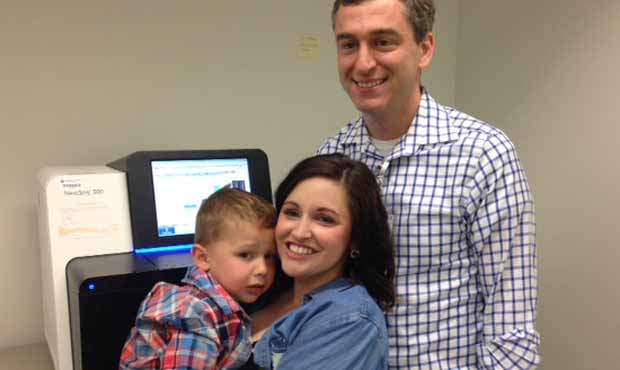
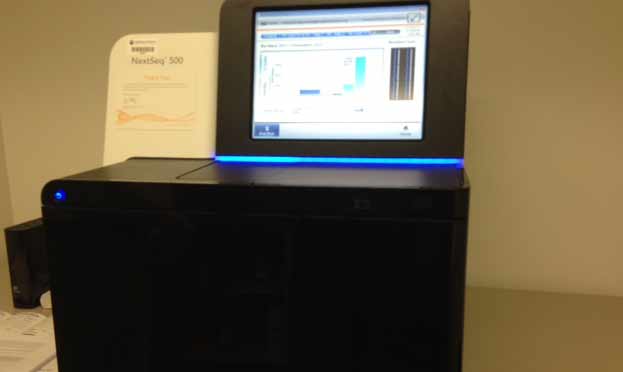
Now, Dr. Bennett is making history at Seattle Children’s with its new and faster gene sequencing machine. The hospital is now home to one of the fastest DNA sequencing machines which means a child with a mysterious medical condition doesn’t have to wait years for a diagnosis because their case can now be cracked in as little as two weeks.
But before the miracle machine called the Illumina NextSeq came along, it took years to find genetic answers — as Kaylyn and her family would discover.
“The previous paradigm for genetic sequencing kind of goes like this: you see the child, you come up with some ideas of what disorder they may have, what would be a gene or genes they would have, you know, a mutation in, and you sequence that gene – gene ‘A’ – and you don’t find any change or mutation,” Bennett said. “And so you go on to gene ‘B’ … and gene ‘C’. And that process takes a long time. Each one of those sequencing steps can take anywhere from a month to year.”
Kaylyn’s case began with the discovery that both of her late children had what’s called a Congenital Diaphragmatic Hernia.
“We have this muscular membrane that separates our belly cavity from our chest cavity that’s called the ‘diaphragm that moves up and down to help you breathe,” Bennett explained. “And it needs to be closed to help seal off the abdominal contents from the chest contents and Colton had a hole on the left side of his diaphragm.”
Bennett got information on family history and found a clue: Kaylyn also had a birth defect. In fact, she had heart surgery as an infant at Seattle Children’s. But could a heart defect and a diaphragm defect be connected?
Gene sequencing was in order. Something that, again, can take a year or more to get results. As both Dr. Bennett and Kaylyn waited, Kaylyn got pregnant for the third time.
“We took a year off, we did not talk about babies, we just enjoyed being married to each other. Then, I said ‘I’m ready,’” Kaylyn said.
Bennett didn’t know, but maybe that was for the best as he poured over about 20,000 lines of data from the results of Kaylyn and her two late children’s genetics. Eventually, Bennett found the answer. One line called “GATA6” was causing the fatal defect.
“I remember very clearly the moment in the lab where I found the GATA6 mutation. I was in the Seattle Children’s research institute on the 10th floor looking over downtown and I was like … you know I might have even cursed to myself like ‘oh my God this is it! This is it!’” Bennett said. “My emotions were super high and honestly, I felt like at the time that it was the most important scientific and clinical discovery I had ever made. In fact, yeah, it is.”
Amazingly, Dr. Bennett called Kaylyn with the news just one day before she was scheduled for an ultrasound of her third child. His name? Owen. And because of the new genetic test — thanks to Dr. Bennett discovery — she was able to know that he did not have the GATA6 mutation. Owen is now 2.
“He’s spoiled,” Kaylyn said. “Sometimes I just want to, like, when people are watching me I can tell they’re judging me and I just want to be like ‘do you know what I’ve been through?!'”
Doctor Bennett feels similarly proud.
“I can’t tell you how I felt the first time I met Owen,” Bennett said. “And I give talks and I get to show this picture at the end of Owen running through the tulip fields I mean it’s amazing.”
The new technology that would have sped up Kaylyn’s case and is now helping current patients find answers quicker will also drive down the cost of these procedures, according to Seattle Children’s. It could help lead to new therapies and medications for patients who have gone un-diagnosed.
Follow @http://twitter.com/ColleenKIROFM