Horror in UW lab aims to save lives on battlefield and streets
Mar 9, 2017, 3:43 PM


We’ve all seen the gore of war played out on the screen, but seeing and dealing with it in real life is another story entirely.
A small group of reporters got as close a look as possible to the real thing this week at the University of Washington’s WWAMI Institute for Simulation in Healthcare (WISH) lab, where a small team of experts is at the forefront of major advances in better training medics in trauma care on the battlefield or the highway.
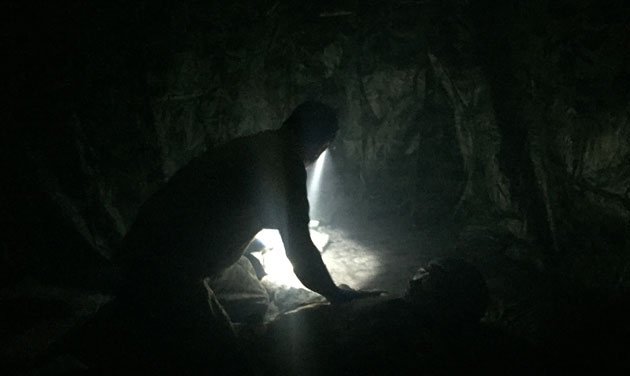
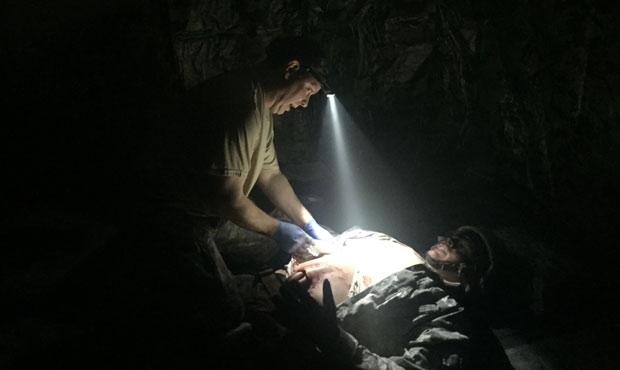
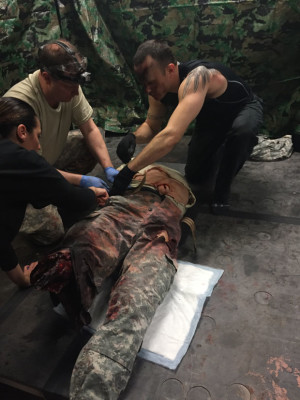
Inside the lab, Doctor Robert Sweet pulls back a curtain soon after the sounds of explosions and plumes of smoke come pouring out from behind to reveal a military medic clad in camouflage frantically trying to help a badly injured soldier hit by an improvised explosive device.
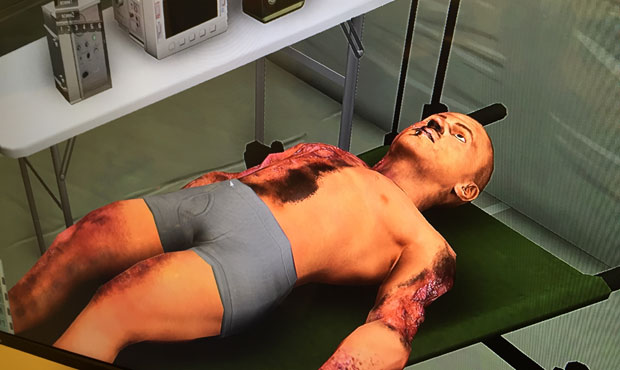
The soldier screams in pain, his leg blown off below the knee. Blood pours from the mangled limb. A gaping stomach wound reveals his insides, while you can see a hole in his side.
Despite the screaming, he’s struggling to breathe.
“I don’t want to die,” the soldier screams, as medic Troy Reihsen tries to calm him while methodically assessing the multiple wounds and trying to staunch the bleeding.
For 22 years, the veteran combat medic repeatedly faced the ravages of war, desperately doing all he could to save soldiers’ lives.
But on this day, he’s reliving the nightmare in hopes of saving far more. He’s dedicated his professional life, along with his colleagues,’ to creating the most realistic medical training simulators possible.
“We need to be able to train people to handle these environments,” Reihsen said. “Until these events stop happening, until we stop having car accidents, until we stop having IEDs and war and combat in these environments, we just need to be able to train folks appropriately on the right models so that when they get in the right circumstance, they don’t freeze and they know what to do.”
The battle demonstration we saw this week seemed plenty realistic, from the mangled limbs to the actor inside their simulated soldier’s torso screaming in excruciating pain, just like on the battlefield.
For the layperson like me, the injuries and the battlefield scenario brought to life by a highly-trained actor is so real, it brought one of my colleagues seeing it for the first time to tears.
“We had some seasoned medics come in and do this and even they say this is, by far, the most real they’ve seen it can be,” said Jordan Gonzales, an Army vet who served in the cavalry in Iraq. Working with Reihsen, his job is to recreate the horror of heavy trauma in a crisis situation.
“If I can get their stress level to a point where they are freaked out enough yet still do their jobs, when it comes to the reality of things, they’ll be able to do it,” Gonzales said.
Suffice it to say, he could be considered for an Academy Award.
It’s so convincing, it continues to move even Dr. Sweet, the executive director of the simulation lab.
“I’ve seen this probably 300 times; I still get affected when I see these,” Sweet said.
Sweet and his team are at the forefront of the emerging field of simulation science.
Although medical simulation has been around since the dawn of medicine, technology and resources have always trailed far behind the actual need.
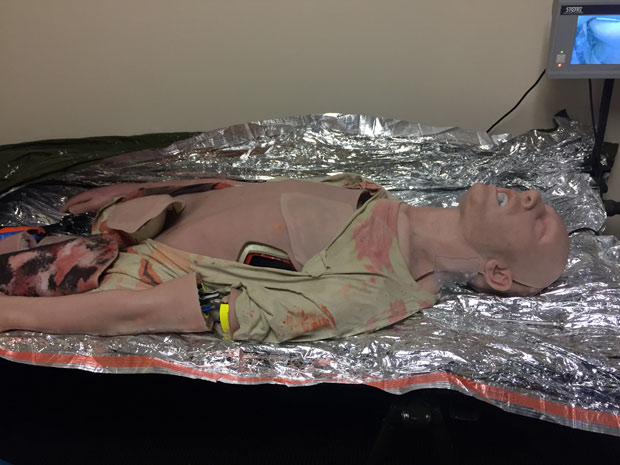
Until now, they’ve taken the best commercially available medical simulation tools to create their own Frankenstein of sorts, even calling the medical manikin “Frank” for short.
Their Frankenstein is an assemblage of the best available simulation components on the market, from prosthetic limbs to pumps that spurt blood.
But it’s still far from where they hope to one day get and Sweet says it’s just the start of major breakthroughs in medical simulation science.
“Our team was made up primarily of artists,” Sweet said. “There’s been a lot of smoke and mirrors, but this is where the shift his happening right now.”
That’s why the Department of Defense recently awarded his team and another at the University of Minnesota an $8 million grant to develop what’s being called the advanced modular manikin.
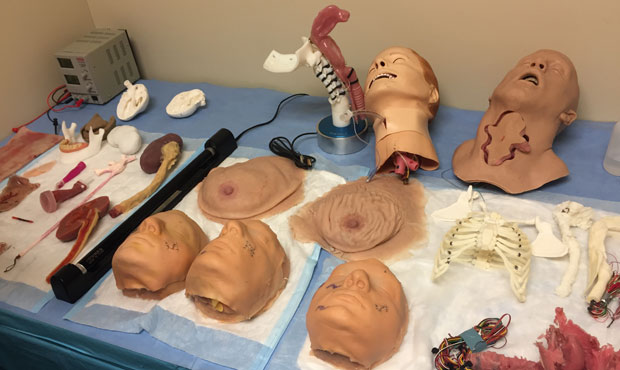
The manikin will ultimately be the closest thing to a real body, painstakingly designed from head to toe.
The synthetic skin has pores and feels real to the touch, changing colors to reflect different medical conditions. The organs feel real, down to the moisture on the tongue.
And the work isn’t limited to their lab. Think of them as the Microsoft Xbox of the medical world.
Their goal is to develop an engine and ecosystem for medical simulation that any other company can develop products and services for, to create the most realistic medical simulators possible.
While they hope to begin having their work available to the military and medical community in the next year or so, their work already has a tremendous impact on the battlefield and in our communities.
Over 1,300 combat medics have gone through the current simulation, along with a number of civilian medics. Medics in Minneapolis – where Sweet’s team was previously in residence – have used their training and revised procedures based on the experience. And Sweet’s team even met with King County Medic One on Wednesday.
“Individuals who have gone through the training program have had significantly different – what I call – stress inoculation,” said Reihsen. “Suddenly when you see it in combat, you’re not freaked out.”
Actor and veteran Jordan Gonzalez, the guy who repeatedly suffers the most heinous injuries, says for many who go through the training, not freaking out can be a tall order.
“You can just see it in their faces,” Gonzalez said. “They’re scared immediately. And those are generally the ones who are very new to it. And to have them get impacted that early will only help them in the future.”
“I think it’s the dream of everyone on our team who has been involved with this to have a project like modular manikin to take on and be able to contribute to the field with such impact.”
And in just a few short years, that impact will likely be profound.
Watch the simulation below. WARNING: Subject matter is for mature audiences.
Follow @http://twitter.com/joshkerns38