Viral ‘eruption threat’ at ‘America’s deadliest volcano’ Mount Rainier not accurate, PNSN says
Nov 19, 2025, 6:01 PM | Updated: 6:42 pm
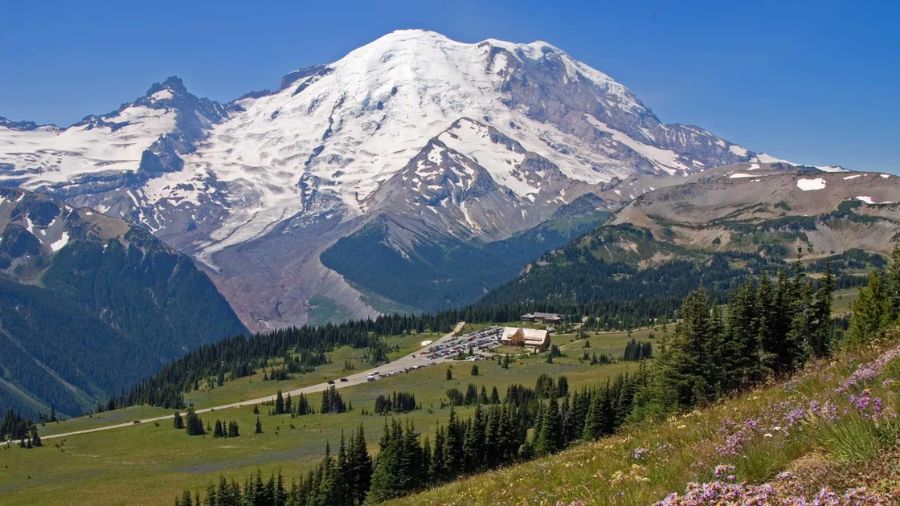
The Mount Rainier Sunrise Corridor. (Photo courtesy of the U.S. National Park Service. NPS/John Chao photo via KIRO 7)
(Photo courtesy of the U.S. National Park Service. NPS/John Chao photo via KIRO 7)
Mount Rainier’s seismic sensors showed unusual activity for several days, prompting widespread attention online, but experts told KIRO 7 News the readings came from a malfunctioning instrument rather than signs of an impending eruption.
An article Tuesday posted by The Daily Mail titled ‘America’s deadliest volcano enters unprecedented 72-hour tremor phase as eruption threat looms over millions’ has garnered attention online, but it is not entirely accurate.
The Pacific Northwest Seismic Network (PNSN) confirmed Tuesday that the anomaly came from the St. Andrews Rock (STAR) station, one of the network’s oldest sensors on the volcano.
While its display appeared to show nonstop, high-energy tremor activity for days, PNSN said nearby instruments — hundreds of them positioned around Rainier — showed no similar behavior.
PNSN told KIRO 7 the station likely experienced radio interference or a hardware issue such as a faulty battery.
Harold Tobin, Director of University of Washington’s Pacific Northwest Seismic Network, told KIRO 7 it might be that the radio antenna is covered in ice.
“Stations go out all the time,” Tobin said. “That’s why we operate hundreds of them.”
Crews will attempt a remote reset, but because of harsh winter conditions, a physical repair likely won’t be possible until after the season passes.
The station is already scheduled for an upgrade next year or in 2027.
The clarification follows a surge of online speculation after the St. Andrews Rock seismograph began showing dense, continuous seismic signals starting Saturday.
To viewers monitoring the public data feed, the readings looked like volcanic tremor — a humming pattern that can occur when magma, gas, or hot water move beneath a volcano.
However, experts say the reading looks very different than how seismic activity would show up.
“It’s very clear the difference between something that’s an earthquake signal or tremor in the volcano from something that it looks like a transmission problem with the data,” Tobin said.

STAR data from PNSN is shown. (Image courtesy of KIRO 7)
By Monday, the display was nearly a solid black stripe, suggesting almost constant motion.

STAR data from PNSN is shown. (Image courtesy of KIRO 7)
While Mount Rainier is an active volcano and considered one of the most hazardous in the nation, PNSN said none of the other expected warning signs have appeared.
There has been no increase in volcanic earthquakes, no ground swelling, and no change in the official alert level.
Rainier’s last minor eruption was recorded in 1884, with its last major eruptive period occurring roughly a thousand years ago.
Still, the USGS classifies Rainier’s long-term risk as “Very High” because of its potential to generate devastating lahars — fast-moving volcanic mudflows capable of destroying communities with little warning.
Earlier this year, Rainier experienced the largest earthquake swarm ever recorded there.
More than 1,000 small quakes shook the volcano from early July through the end of the month, far surpassing a three-day swarm in 2009 that produced about 120 quakes.
Scientists often point to the 1980 eruption of Mount St. Helens — about 50 miles south — to illustrate what Cascade volcanoes are capable of.
That event generated a powerful lahar that destroyed more than 200 homes, damaged over 185 miles of roads, and contributed to 57 deaths.
Despite the intense online attention to this week’s readings, PNSN emphasized that the abnormal signals were isolated to one malfunctioning station.
All other monitoring equipment shows no sign that Rainier’s activity level has changed.