Seattle meetup supports a more diverse tech scene
Feb 10, 2015, 5:54 AM | Updated: 7:38 am
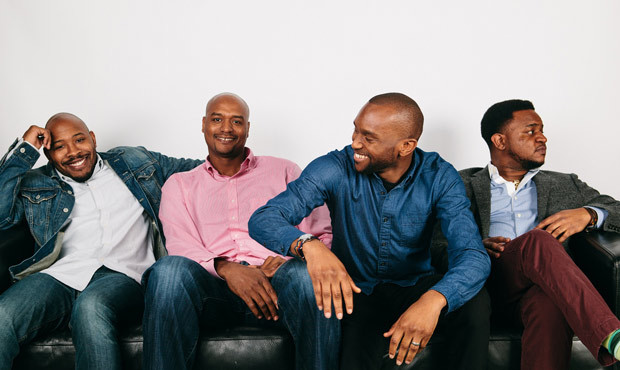
Having a workforce that all looks the same can negatively impact company culture. According to Todd Bennings, pictured second from right, employees who don't fit in could be at-risk for alienation. HERE Seattle founders, left to right: Seth Stell, Eric Osborne, Bennings, Andre Bearfield. (Courtesy HERE Seattle)
(Courtesy HERE Seattle)
African Americans are severely underrepresented in the ranks of Seattle’s booming tech scene, where jobs are overwhelmingly held by white and Asian employees. That dynamic can sometimes lead to awkward encounters around the water cooler.
Like a lot of startups, Andre Bearfield’s office had a pool table. Recently, he was happy to win a friendly 3-ball tournament against some coworkers. The company-wide e-mail that went out next was another story.
“A picture of Barack Obama. A GIF, with dollars raining down behind him,” Bearfield laughs. “It’s the kind of thing that happens so frequently that I wouldn’t even bring it up. I don’t even talk about that kind of thing.”
A few years ago, Seth Stell was working for a creative agency that had a big pitch coming up for BET (Black Entertainment Television). He was invited to be part of the meeting.
“Just by virtue that I was African American, they felt that I needed to be in the pitch. I had no reason to be in the pitch, I brought no value to the pitch,” he remembered, feeling like more of a prop than a contributor. “They thought it would help that I was sitting in the room. I just sat there.”
According to Stell, stories like these are all too common for minorities working in tech. “There’s a bit of a numbness to it. You eventually just understand that it comes along with the territory,” he explained.
“Sometimes it hits you in the face, like getting a Barack Obama GIF in your email,” said Todd Bennings. “Sometimes it’s a little bit more subtle. Like, ‘Hey, you know, it’s Black Entertainment Television, so you need to come out, too.'”
Having a workforce that all looks the same can negatively impact company culture. According to Bennings, employees who don’t fit in could be at-risk for alienation. “It can be hurtful to someone who may not have as much experience as us three,” he said.
Last year, Stell, Bearfield, and Bennings formed HERE Seattle, a networking group for underrepresented minorities working in technology and creative fields.
“We wanted to create visibility to a community that does exist,” said Stell. “It’s very scarce, but it’s still very relevant.”
All three friends are transplants to Seattle from the Southern U.S.,from Texas, Arkansas and Georgia, respectively. They also share similar stories of being inspired by having computers as a tool for art, music, and design at a young age.
“My introduction and love for technology came naturally out of music,” said Bearfield. “That’s when I learned what was possible with a computer, and I started trying to make beats.”
Stell was introduced to building web pages in high school, where a teacher named Mr. Snyder taught him to use HTML to bring information to life online. “I opened the icon, and my picture was in an internet browser locally. I was like, ‘Wow, how did he do that?'”
After watching movies like Toy Story when he was young, Bennings was determined to work at the confluence of art and tech. “I knew in some way, shape, or form what I would be doing would be computer related.”
It’s no secret that technology companies have a diversity problem. Data from 2014 released by the most influential tech giants revealed a disappointing lack of non-Asian minorities and women in their ranks.
Those numbers were stark. Facebook employees were one percent black and three percent Hispanic. At Google, two-thirds of employees were men. Only two percent were black and three percent Hispanic.
“Think about what you can say with more words, or the music you can make with a broader range of tones,” said Bearfield. “An organization is a function of the people who are related to it.”
HERE Seattle’s monthly gatherings focus on empowering members through connecting people, philanthropy and building on industry knowledge.
Stell said you get get to know attendees and make connections, “Trying to identify if there’s other relationships in the group that can help them get to that next level. Mentor them. Or be their next business partner.”
Blacks and Hispanics in leadership roles in tech are even harder to find.
When Don Thompson, the CEO of McDonald’s steps down in 2015, there will only be four African-American CEOs heading up Fortune 500 companies.
“Because there are so few of us, we don’t have a place at the table all the time to just rally and share information,” said Bennings.
Bearfield said the experience of being a minority in tech can also force a certain positive growth. “I guess it is challenging to feel alone. To look around and see not a lot of people like you. But the other side of that coin is you learn a lot of tools. You learn how to communicate across a large and diverse group of people and interactions.”
Many of the largest tech companies are now committing financial resources to fix the diversity problem.
Intel CEO Brian Krzanich says their goal is “full representation” of women and underrepresented minorities by 2020. He pledged $300 million to help his organization achieve that change.
Google gave $775,000 to support CODE2040, a group launching free training programs for black and Latino college engineering students.
HERE Seattle’s co-founders believe change is happening gradually. Bennings joked it could be as simple as having business associates stop remarking how he doesn’t “dress black.”
“Maybe I’ll dress black tomorrow? But this skin does not come off,” he laughed. “Whether I dress in J.Crew or something else, I’m still black.”
“We traversed the landscape that existed,” Bearfield explained. “What we want to do is create an opportunity for others so they don’t have to go through those difficulties.”