Seattle’s presidential parking palace twice hosted most popular president
May 23, 2018, 6:18 AM | Updated: 8:32 am




The first clues are the elaborate arches and windows. Or, maybe it’s the almost completely illegible three words – barely visible above the main entrance – that appear to have been deliberately chipped off a nameplate decades ago.
Welcome to Seattle’s presidential parking palace!
It was in this building in downtown Seattle, on May 23 and May 24, 1903, where President Theodore Roosevelt took part in two separate events. The 44-year-old president was two years into the job, having served briefly as vice president and then succeeded the assassinated President McKinley. He had come to Seattle as part of a long and elaborate Western tour.
Of course, in 1903, the four-story building on the south side of Cherry Street between Second and Third avenues was only about a decade old, and it had not yet been converted to a place to park vehicles.
In those years, the foot-high letters above the arch had not yet been chipped off, either. “GRAND OPERA HOUSE,” they said – and they still say today – if the light is good and you look carefully enough.
RELATED: Famous ship’s forgotten connections to the Pacific Northwest
Roosevelt spent several days in the Evergreen State in late May 1903, crossing the Columbia River from Oregon and traveling by special train, and attracting huge crowds to short “whistle stop” speeches as well as to more elaborate, lengthy visits.
Heading north through Washington from the banks of the Columbia, the president stopped to give brief speeches from the rear of the train at Kalama; at the famous McKinley Stump in Chehalis; and in Centralia.
Then, it was on to the state capitol at Olympia and finally Wright Park in Tacoma, where TR also dedicated the cornerstone of a Masonic Temple, and spent the night of Friday, May 22 at the Tacoma Hotel.
The next morning, the commander-in-chief (and former assistant secretary of the Navy) boarded the steamer SPOKANE for a cruise to an event at the Puget Sound Naval Shipyard at Bremerton. From there, it was back across Puget Sound to Seattle.
Presidential parade
On Elliott Bay, an estimated crowd of 150,000 people was waiting for Teddy Roosevelt to come ashore. The president paraded up and down First, Second and Third Avenues via horse drawn carriage, and arrived at what was called the “old University Grounds” – site of the original University of Washington from 1861 to 1895, and present-day location of Rainier Square and the Fairmont Olympic Hotel – to give a speech.
Scott Woodward is a Teddy Roosevelt scholar and presenter for Humanities Washington. He lives in Richland, but travels around the state giving talks about Roosevelt’s 1903 visit.
“They didn’t even have a PA system,” Woodward said by phone last week. “Hard to believe, isn’t it? He had to stand on a chair to give a speech. But the speech that he gave in Seattle was about how important Washington was to the security of the United States, and a gateway to help us control the Pacific Ocean.”
From the old university, Teddy Roosevelt next headed for Everett by train to give a speech in downtown at the intersection of Hewitt and Colby. From there, it was back onto the SPOKANE for the return trip to Seattle – with a second grand arrival, this time in the evening, with fireworks and searchlights heralding the famous Rough Rider’s return.
Next stop was the aforementioned presidential parking palace – in its original form as the Grand Opera House, of course – for a Saturday night reception honoring Seattle’s economic colony of Alaska, with a guest list comprising Alaska movers and shakers, UW students, recent veterans as well as members of the Grand Old Army of the Republic (the organization made of Union veterans of the Civil War).
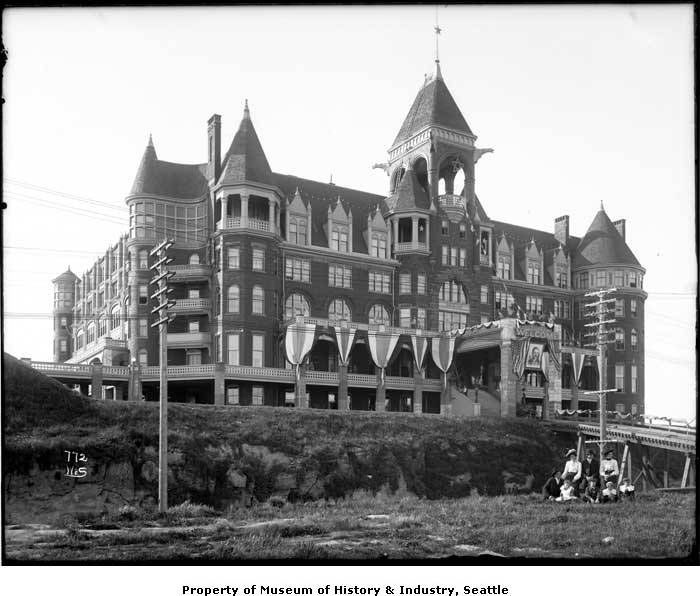
Following the reception, Roosevelt retired to the Hotel Washington, a massive and ornate structure filling up two city blocks (between Stewart and Virginia Streets, and Second and Fourth Avenues) atop the pre-regrade Denny Hill.
The next day, President Roosevelt came back to the Grand Opera House for a Sunday morning memorial service for war veterans. He spent the rest of the day relaxing and recreating, including riding on horseback to Fort Lawton.
Late that night, he boarded his train and headed east to cross over the Cascades, with plans to stop at mountain communities and towns along the Yakima River enroute to Walla Walla and then Spokane.
Scott Woodward says that Roosevelt tailored his remarks for each community where he spoke, and that his straight-talk and sincere Progressive policies struck a chord with Washingtonians wherever he went.
For example, Woodward says, in Everett, Roosevelt spoke about workplace safety in the lumber industry. East of the mountains, it was different.
“His big thing in Spokane was about the connectivity of the railroads to the ports on the West Coast, Seattle, Tacoma and Everett and that Spokane played just as important a role in national security as those ports over on the coast did,” Woodward said.
“I think that was the key . . . that’s kind of the way it went,” Woodward said. “He was loved everywhere he went.”
A trip east
The “everywhere” for the eastbound portion of Teddy Roosevelt’s trip through Washington included stops at Cle Elum; Ellensburg; North Yakima; Prosser; Pasco; Wallula; Walla Walla (with a little-known foiled assassination plot, hatched by a butcher and “radical socialist” from Pendleton, Oregon named Joseph Barker); Starbuck; Tekoa, and finally Spokane.
Woodward says, other than that one assassination plot, Teddy Roosevelt was just as popular in the heart of the Inland Empire as he was on the shores of Puget Sound.
“Imagine today somebody in the political realm from whichever party crossing the mountains and being equally received with love so to speak,” Woodward said. “You and I both know that’s not going to happen.”
From Spokane, President Roosevelt boarded his train and headed east into Idaho and Montana.
RELATED: The twisted tale of Whidbey Island’s big guns
But he’d made a lasting impression and won over voters in the young state.
In the presidential election of 1904, the Republican incumbent Roosevelt carried Washington state with a whopping 70 percent of the vote – the fourth highest percentage in the United States that year. Then, in 1912, Washington was one of only six states Roosevelt carried as a third party candidate – in the election that put the Democrat Woodrow Wilson in office.
When Teddy Roosevelt died in 1919, the high school under construction in Ravenna was named in his honor. After a few fits and starts, what used to be 10th Avenue NE eventually became Roosevelt Way, but not officially until Franklin Roosevelt was elected president in 1932. The street, many people don’t realize, is actually named for two presidents.
Lasting legacy
Woodward says that Teddy Roosevelt also left a lasting legacy that’s still visible today here in Washington, in the form of land set aside by the federal government for protection of natural resources via the 1906 American Antiquities Act.
“On his tour of 17 cities [in Washington], every one of them, with the exception of Walla Walla, has a National Wildlife Refuge within immediate – almost binocular – range,” Woodward said.
Meanwhile, the Grand Opera House was damaged in a fire in 1917. A few years later, as cars became more prevalent in Seattle, the derelict burned out shell of the once-grand venue was salvaged, and the venerable old hall was converted into one of the city’s first structures devoted solely to parking. It would not be the last.
Editor’s Note: Special thanks to Washington resident and Theodore Roosevelt Association executive board member Michele Bryant for sharing her publication about the 1903 tour, The President They Adored.
Follow @https://twitter.com/feliksbanel