Sen. Bob Hasegawa pitches return to ‘community’ as Seattle mayoral candidate
May 10, 2017, 6:05 AM | Updated: 6:10 am
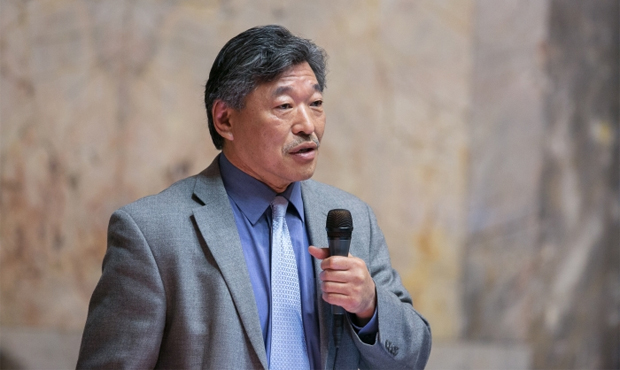
State Sen. Bob Hasegawa. (Washington State Democrats)
(Washington State Democrats)
He can’t officially raise money or campaign until the state legislative session is over, but Senator Bob Hasegawa has said he plans to run for Seattle mayor.
The long-time Beacon Hill resident told KIRO Radio’s Dave Ross that when it comes to his vision for the city, he likes to take people to “back in the day.”
RELATED: Who is running for Seattle mayor?
“Back in the day, we used to hear about things like the Golden Rule: Do unto others as you would have others do unto you,” Hasegawa said. “It was more of a community sense. I recall riding a bus from my home up on Beacon Hill, maybe 9 years old, by myself to the downtown YMCA to take swimming lessons. And the bus driver was a gracious person, looked out for me, made sure I didn’t miss my stop. He even let me play with the lever to open and close the bus door to explain how it worked. And you felt good about being in the community. The community was a nurturing place for families and youth. Since then, there has been a cultural shift around community to individuals. That shift … that sense that we are so busy scrambling over the next person to survive, that’s sociopathic.”
Hasegawa and bringing back equity
Hasegawa reaches for that sense of community through his politics. He was a Bernie Sanders supporter in the last presidential election and believes that the growing gap between top-wage earners and everyone else is a root cause behind many of the issues Seattle faces — from homelessness to housing; potholes to supporting small businesses. He says that Seattle’s decision-making has become corporatized — in system and in influence — and he promotes that shifting the burden to higher earners in Seattle will help put the city back on a more equal track.
“We absolutely need to make the highest income earners return the most back to society bearing the brunt of their increasing wealth, and the social cost of them accumulating that wealth falling on the backs of everybody else,” Hasegawa said.
Take housing for one example of looking back for an answer.
“There’s a model out there that actually works that we moved away from … our strategy has been to try to give enticements for developers for more affordable housing, and if they don’t, they pay some money into some fund that is totally inadequate to meet our housing needs,” Hasegawa said. “To me, what is affordable for one person is not affordable for the next person. So whatever they come up with as a number set aside for affordable housing is going to be inadequate.”
“One thing we used to do is build public housing,” he said. “Create housing stock that is owned by the public and we control that stock. And just by the target numbers we create, we possibly influence the cost of rent in our city … This is a strategy we moved away from, public housing, because of the corporatization, I feel, of our markets here.”
It would mean that Seattle’s top earners would have to pay a greater share than they are now — a share that Hasegawa argues is too small when compared to lower-income earners.
“I’m not saying we go back to the ’50s and ’60s, but I do say we go back to a sense of community and caring for each other and making sure basic social needs are met,” Hasegawa said.
“I was at a technology alliance luncheon last summer and the featured speaker was Satya Nadella, president and CEO of Microsoft,” he said. “And president Nadella, on his own volition, raised the question … how do we look at the way society distributes the wealth that is created by all this technology but displacing workers at the same time – people’s ability to maintain a standard of living? Technology was touted in the ’50s and ’60s when we were growing up as our salvation. It was supposed to make life easier for us. It wasn’t supposed to take away our livelihoods and ability to raise our families. But that’s just what’s happening here. The delta between what it cost for a worker and the machine to do (the job), all of that is being soaked up as strong profits or CEO wages. It’s not being returned into society to make sure that displaced worker actually can survive and raise their family.”
From Hasegawa’s perspective, if Seattle can even out the disparities between the top 1 percent and everybody else, it would address many of the issues the city faces, right down to the feel of the neighborhoods.
“People in their own neighborhoods … people feel like they’ve lost control with gentrification going on all around us, people keep getting squeezed for more and more excess tax levies,” Hasegawa said. “And they’re all for great things, we all want to support putting more money into housing or mental illness, but it keeps falling onto the back of my neighbors who are largely fixed income — at least in (my) neighborhood. You can’t call them upper class, at all. Middle class, barely – trying to survive with their fixed income. They feel alienated from the decision-making process.”
Follow @http://twitter.com/Mynorthwest