The most important Washington lawsuit you have never heard of
Apr 26, 2018, 6:58 AM | Updated: 8:14 am
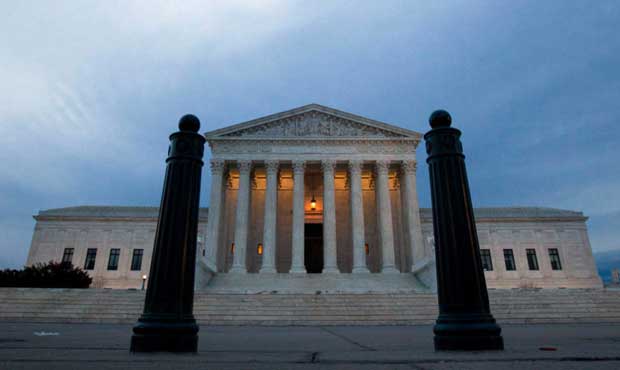
United States Supreme Court. (AP)
(AP)
Former Washington state Attorney General Rob McKenna says it’s the most important case Washingtonians have never heard about, yet its results could dramatically change how government works in the Pacific Northwest.
“It really is breathtaking in its potential implications,” McKenna told KIRO Radio’s Dave Ross.
RELATED: How Washington’s effort led to the seizure of Backpage.com
The issue surrounds the influence Native American tribes have on local and state governments. While the case itself centers on culverts that affect salmon runs, McKenna argues there is legal engineering going on that could place the tribes in a position to co-govern much of the state.
“It’s not because most tribal members depend on fish to make their living; some do, but most don’t,” he said. “It’s because it’s a way to restore sovereign control over lands they used to own. I appreciate that objective. I understand why they are pursuing it. But it’s not what the treaties were about. And it’s not something that the State of Washington or its local governments can accept.”
The right to salmon
The legal relationship between Washington state, the United States government, and the Northwest’s Native American tribes dates back to the mid-1800s when a series of treaties were signed. Those treaties essentially detailed who had a right to what — which lands were exchanged and where tribes could fish. In short, tribes were granted the right to always fish where they traditionally had. That notion was upheld in the 1970s Boldt decision.
But a lingering treaty issue has led to the United States Supreme Court.
“The treaties grant the tribes a right, in perpetuity, to access their traditional fishing grounds,” McKenna said. “The two questions that have been litigated over the last 40-plus years have to do with how much of the fish they are entitled to. In the Boldt decision, it was decided they are entitled to half. Then, in this case, that went to the Supreme Court, the question is what happens when there are fewer fish to catch because of something the state has done. In this case, building culverts under state highways, and on park land, and lands owned by the State of Washington.”
Such culverts can choke off streams that salmon use to spawn, threatening the number of fish that the tribes historically relied upon.
When McKenna was attorney general, he repeatedly offered to settle the culvert case issue. Many culverts under natural resources and state parks have already been replaced. And the Washington State Department of Transportation has been systematically replacing them. McKenna said he offered a fixed schedule to replace all remaining culverts. But those offers were consistently turned down. McKenna says this is because there is a larger plan in the works.
Native American tribes and treaties
McKenna says that Washington state tribes want to establish that their treaty rights to fish give them a role and a right to any decision that affects the fish population. Such authority could touch many governing decisions from water rights and permits, to land use policy, etc.
“It was very telling when the tribes filed their brief through the United States government in the Supreme Court that they shifted from the traditional standard in this case – what would be the right amount of fish to ensure the tribes a ‘moderate living’ – which are the words that have been used for decades,” McKenna said. “They’ve shifted to this idea of a ‘substantial degradation of the fish supply,’ which is a new standard that we haven’t seen before.”
“And it really goes to what I’m saying; they want to go to a guaranteed supply of fish, and therefore, a say in anything that affects the number of fish,” he said. “There is a lot of agreement that culverts should be replaced. There is not an agreement that tribes are co-sovereign with state and local government over any decision that can affect the number of fish.”
McKenna argues that, on one hand, it’s true that the tribes were not signing up for treaties under which the state could block every salmon-bearing stream with a road or a highway. But at the same time, the government of the day was not agreeing to give tribes a co-sovereign role in the management of lands and waters.
“No one thought there would ever be a question about the amount of fish (back then),” McKenna said. “There was so many salmon and natural resources, people thought they were inexhaustible. Of course, they were proved to be wrong.”
Other leaders in the region have argued that the Supreme Court should side with the tribes, such as King County Executive Dow Constantine.
Rob McKenna filed a brief with the Supreme Court on behalf of the Washington State Association of Counties and the Association of Washington Cities opposing the tribes’ case.
Follow @http://twitter.com/Mynorthwest