When ‘The Big One’ hits, it’s not falling cranes you should be worried about
Jul 23, 2015, 7:21 AM | Updated: 10:52 am
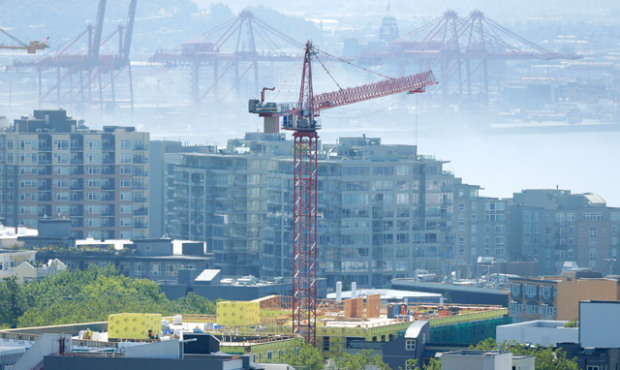
Cranes are built to withstand earthquakes, and are usually anchored to the building they're constructing, making them more stable during seismic activity. (AP)
(AP)
Step onto just about any downtown street, and they’re easy to spot: tower cranes peppering the skyline. They’re an indicator of the Puget Sound’s massive construction boom.
But what happens when a massive earthquake hits, such as the potential 9.2 magnitude quake predicted for the Northwest?
Related: New Yorker reports devastating NW earthquake could happen within 50 years
That’s when decades of research and science will kick into action to keep buildings — and cranes — standing.
John Hooper is the principal earthquake engineer with Seattle-based engineering firm Magnusson Klemencic Associates. He travels the world learning about building techniques that can help carry us through “The Big One,” and says cranes are actually pretty stable.
See where earthquakes occur every day with MyNorthwest’s earthquake tracker
“People look at them they say, wow, they’re way high in the air. But if you look carefully at them,” Hooper said. “They’re usually attached to the building they’re building every 10 or 20 stories. So they’re not just cantillating out of the ground like a tree does. They’re actually connected every so often.”
“So they will go along for the ride with the building they’re helping to construct,” he said.
And Seattle’s growing skyline is built to withstand the worst of it as well. New homes, apartments and skyscrapers are designed so that the risk of collapse is just 2 to 5 percent if the strongest quake hits. While they’re under construction, they’re also stable because of the concrete cores anchoring them to the ground.
The biggest danger of something falling out of the sky, Hooper says, isn’t a crane. It’s the threat of falling glass from the outside of a highrise. That’s something builders are still working on.
“It still may happen, but we’re looking at trying to minimize that potential, so the collateral damage of people walking downtown is minimized,” Hooper said. “There’s no guarantees, but that’s what the goal is.”
And here in Washington, builders, engineers and researchers are on the cutting edge of new technology that’s being developed all the time to improve safety and stability.
Related: The ‘Big One’ won’t be as bad as some say
The Cascadia fault was discovered about 45 years ago, but it was only in the late 1980s that scientists were able to fully grasp the implications of the 700-mile long formation. It was in 1994 that designers started factoring that risk into construction. Since then, seismic technology has grown by leaps and bounds.
Each building that goes up in Washington takes into account very specific conditions, including soil types, like the hard packed glacial dirt that downtown Seattle is based on, and the sand and silt in pioneer square. The softer the soil, the more shaking people will feel, and the higher danger of building damage.
Earthquake engineers, like Hooper, even measure the exact distance to all the faults in the region, the nearest of which sits right on I-90, and simulate an earthquake so they know exactly what to expect — harder shaking from the closer Seattle fault, and longer shaking from the Cascadia.
“Inside the building, the partition walls will be cracked, absolutely,” Hooper said. “Ceiling tiles will drop — that just happens. The piping will be bent, and sprinklers may go off. Stairwells will be damaged, but they should be passable. The structural system that holds up the building itself, there will be elements that will twist and bend and crack. They’re designed to do that.”
That means that even with the technology that allows buildings to stay standing and carry people through the earthquake, they could be a total loss, changing the face of the Puget Sound forever.
“Because, again, our goal is life safety. We want to protect people’s lives. We’re not certain that we protect the total investment,” Hooper said.