Expert: It’s time to use fire to fight wildfires
Aug 21, 2018, 8:35 AM | Updated: 10:59 am
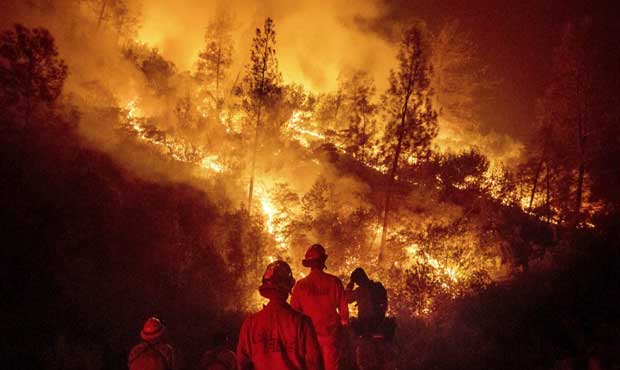
In this Aug. 7, 2018 file photo, firefighters monitor a backfire while battling the Ranch Fire, part of the Mendocino Complex Fire near Ladoga, Calif. (AP Photo/Noah Berger)
(AP Photo/Noah Berger)
In recent memory, year after year, we hear about the latest, largest wildfires ever. While forests burst into flames across California, Oregon, Washington, and British Columbia, the Puget Sound finds itself in the convergence zone of all these massive plumes of smoke.
RELATED: How to protect yourself during smoke days
On Monday, Washington state recorded the worst air quality in the entire United States. And as bad as it was in Seattle, other areas of the state had it worse. People driving down the freeway in Seattle – struggling to make out the silhouette of the Space Needle from a few miles away – are not able to see Puget Sound. But in Spokane and Port Angeles, the smoke was twice as thick.
To add insult to injury, however, it has become apparent that the conditions are likely the result of human intervention in the environment — from poor forest management policies to climate change.
“Climate change plays a significant role in this,” said Robert Gray, a fire management consultant who’s worked in the US Forest Service in Washington state and across the west. “It’s not entirely climate change, but certainly climate change in the sense that the amount of burned area has correlated quite strongly with increases in global temperatures. We have significant increases in fire season; in California, they are talking about a year-round fire season. Other states and territories here in BC, we’ve got an extended fire season now.”
“We’ve got a lazy jet stream, which is giving us these stagnant, high-pressure systems that just park over parts of the west for weeks at a time. Historically, we had a stronger jet stream that moved things around a bit more,” he said. “We know that with every 1 degree Celsius increase with global temperatures, we see a 12 percent increase in lightning. So we’ve got drought creating lots more fuels, we have a longer fire season, larger fuels are drying out earlier, and that is just giving us larger, more severe fires,” he said.
Gray is based in British Columbia now. He works with private landowners, First Nations tribes, and the Canadian government to address the crisis of forest fires burning at an unprecedented scale. He notes that fires are a natural part of our forests. And human intervention in the ecosystem goes back thousands of years. It’s not until recently – within the last few decades – forest fires were able to devastate such massive swaths of land, with such regularity.
“Humans have used fire for a millennia, and they created a landscape that didn’t support large fires,” Gray said. “The research we’ve done in BC, up in the central area where we have these big fires today, and we had the big mountain pine beetle epidemic, historically the average fire size was about 1,500 hectares. So about 4,000 acres. Today, the fires are 10-20 times that size. It’s because we’ve homogenized the landscape. It’s in a contagious state. It allows fires to start wherever and spread wherever.”
He admits Canada isn’t doing anything better than Washington when it comes to managing forests, using fire as a tool for large-scale disaster prevention. Gray says that there aren’t nearly enough intentional burns going on – and without them – every forest ecosystem has the chance to explode into a record-setting blaze.
“In Washington state, there is just not enough burning going on,” Gray said. “Nowhere near enough compared to the scale of the hazard. Our treatments have to match the scale of the disturbance. So if we are seeing 10,000 or 20,000 acre fires, our treatment areas have to be similar size. And they’re just not and they are porous. There’s 200 acres over there, another 1,000 acres over there … they are too few and too dispersed.”
Good fires, bad fires, and wildfires
Part of the problem with doing the right thing – intentional arson – is that the public and the media can react with existential fear. However, what humans instinctively perceive as a threat, we often find to be an integral part of a healthy ecosystem.
“What were once thought of as horrible threats to ecology, we understand now they are horribly important,” Gray said. “… I think the public is starting to come around … there are nuances. There is good fire and there is bad fire.”
Instead of putting tens of thousands of firefighters and smokejumpers on the front lines facing wildfires in the midst of summer – smaller, controlled burns could be accomplished in the off season.
“Spring and fall, especially spring time, we have cooler moisture conditions and we don’t produce nearly as much emissions that a wildfire does,” Gray said. “And spring to fall we also have a lot of changing air pressure systems.”
RELATED: Weather expert says we did this to ourselves
That changing air pressure means wind, which is good for moving smoke out of a region during a burn. This is unlike stagnant air experienced in the winter and summer that can trap smoke in an area.
But any one state won’t solve the problem alone. The solution, Gray argues, requires a multifaceted approach with partnerships across regional governments. No one locale owns the problem; what begins in one place will end up in someone else’s backyard. Especially, since smoke knows no borders.
“We need to look at a West Coast solution to this,” Gray said. “I have been encouraging politicians here to look at their colleagues — Governor Inslee and other governors in California and Oregon — and sit down and discuss how to solve these things on an international scale. Currently, it’s not happening, but it needs to happen.”