A Virginia museum found 4 Confederate soldiers’ remains. It’s trying to identify them
Jun 4, 2025, 8:45 AM
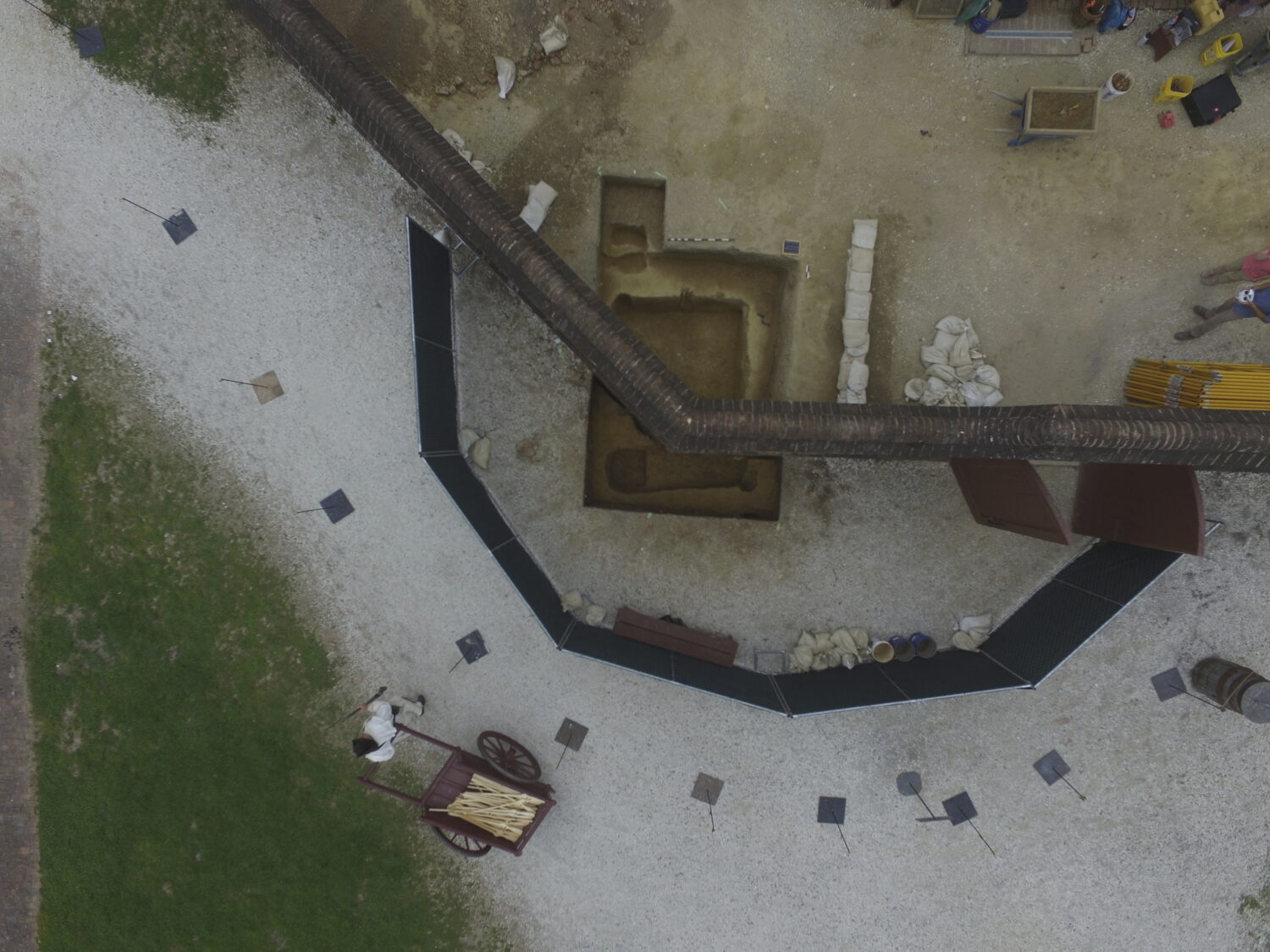
This 2023 photo provided by Colonial Williamsburg Foundation shows staff members from the Colonial Williamsburg museum excavating the remains of Confederate soldiers from the Civil War in Williamsburg, Va. (Colonial Williamsburg Foundation via AP)
Credit: ASSOCIATED PRESS
(Colonial Williamsburg Foundation via AP)

WILLIAMSBURG, Va. (AP) — Archaeologists in Virginia were excavating the grounds of a building that stored gunpowder during the American Revolution when they uncovered the eye sockets of a human skull.
The team carefully unearthed four skeletons, including one with a bullet in the spine, and three amputated legs. They quickly surmised the bones were actually from the Civil War, when a makeshift hospital operated nearby and treated gravely wounded Confederate soldiers.
The archaeologists work at the Colonial Williamsburg Foundation, a museum that owns the land and focuses on the city’s 18th century history. They’re now trying to identify human remains from the 19th century, a rare endeavor that will include searching for living descendants and requesting swabs of DNA.
The museum has recovered enough genetic material from the men’s teeth for possible matches. But the prospect of identifying them emerged only after the team located handwritten lists in an archive that name the soldiers in that hospital.
“It is the key,” said Jack Gary, Colonial Williamsburg’s executive director of archaeology. “If these men were found in a mass grave on a battlefield, and there was no other information, we probably wouldn’t be trying to do this.”
The archaeologists have narrowed the possible identities to four men who served in regiments from Alabama, Louisiana, South Carolina and Virginia. The museum is withholding the names as the work continues.
Meanwhile, the remains were reinterred Tuesday at a Williamsburg cemetery where Confederate soldiers from the same battle are buried.
“Everyone deserves dignity in death,” Gary said. “And being stored in a drawer inside a laboratory does not do that.”
The soldiers fought in the Battle of Williamsburg, a bloody engagement on May 5, 1862. The fighting was part of the Peninsula Campaign, a major Union offensive that tried to end the war quickly.
The campaign’s failure that summer, stalling outside the Confederate capital of Richmond, informed President Abraham Lincoln’s decision to end slavery.
In his first inaugural address, Lincoln said he intended to reunite the nation with slavery intact in the Southern states, while halting its westward expansion, said Timothy Orr, a military historian and professor at Old Dominion University.
But Lincoln realized after the campaign that he needed a more radical approach, Orr said. And while the president faced political pressure for emancipation, freeing people who were enslaved served as “another weapon to defeat the Confederacy.”
“He becomes convinced that slavery is feeding the Confederate war effort,” Orr said. “It had to be taken away.”
Bigger and bloodier battles followed Williamsburg, Orr said, but it was “shockingly costly for both sides.”
Roughly 14,600 Union soldiers fought about 12,500 Confederates, Carol Kettenburg Dubbs wrote in her 2002 book, “Defend This Old Town.” The number of Union killed, wounded, captured or missing was 2,283. The Confederate figure was 1,870.
The fighting moved north, while a Union brigade occupied the southern city. Confederate soldiers too wounded for travel were placed in homes and a church, which was converted into a hospital.
A surgeon from New York treated them, while local women visited the church, Dubbs wrote. One woman noted in her diary on May 26 that there were “only 18 out of 61 left.”
When the remains were discovered in 2023, they were aligned east-west in the Christian tradition, said Gary, the archaeologist. Their arms were crossed.
The careful burial indicates they were not dumped into a mass grave, Gary said. Those who died in the battle were almost immediately placed in trenches and later reinterred at a cemetery.
The men were not in uniform, said Eric Schweickart, a staff archaeologist. Some were in more comfortable clothes, based on artifacts that included buttons and a trouser buckle.
One soldier had two $5 gold coins from 1852. Another had a toothbrush made of animal bone and a snuff bottle, used for sniffing tobacco.
The bullet in the soldier’s spine was a Minié ball, a common round of Civil War ammunition. The foot of one amputated leg also contained a Minié ball. Bones in a second severed leg were shattered.
As the team researched the battle, they learned of the lists of hospitalized soldiers, said Evan Bell, an archaeological lab technician.
The lists were likely copied from Union records by the women who visited the wounded. The documents were with a local family’s papers at William & Mary, a university nearby.
The lists became the project’s Rosetta stone, providing names and regiments of more than 60 soldiers. They included dates of death and notes indicating amputations.
The archaeologists eliminated soldiers on the lists who survived or lost an extremity. The four skeletons had all of their limbs. Death dates were key because three men were buried together, allowing the team to pinpoint three soldiers who died around the same time.
William & Mary’s Institute for Historical Biology examined the remains and estimated their ages. The youngest was between 15 and 19, the oldest between 35 and 55. The estimates helped match names to enlistment records, census data and Union prisoner of war documents.
The soldiers’ remains and the amputated limbs were buried in their own stainless steel boxes in a concrete vault, Gary said. If descendants are confirmed, they can move their ancestor to another burial site.
The identification effort will continue for another several months at least and will include extensive genealogy work, Gary said. Using only DNA tests on remains from the 1800s can risk false positives because “you start becoming related to everyone.”
“We want it to be ironclad,” he said.