Already under financial pressure, Midwest soybean farmers are squeezed further by tariffs, Iran war
Apr 12, 2026, 9:21 PM
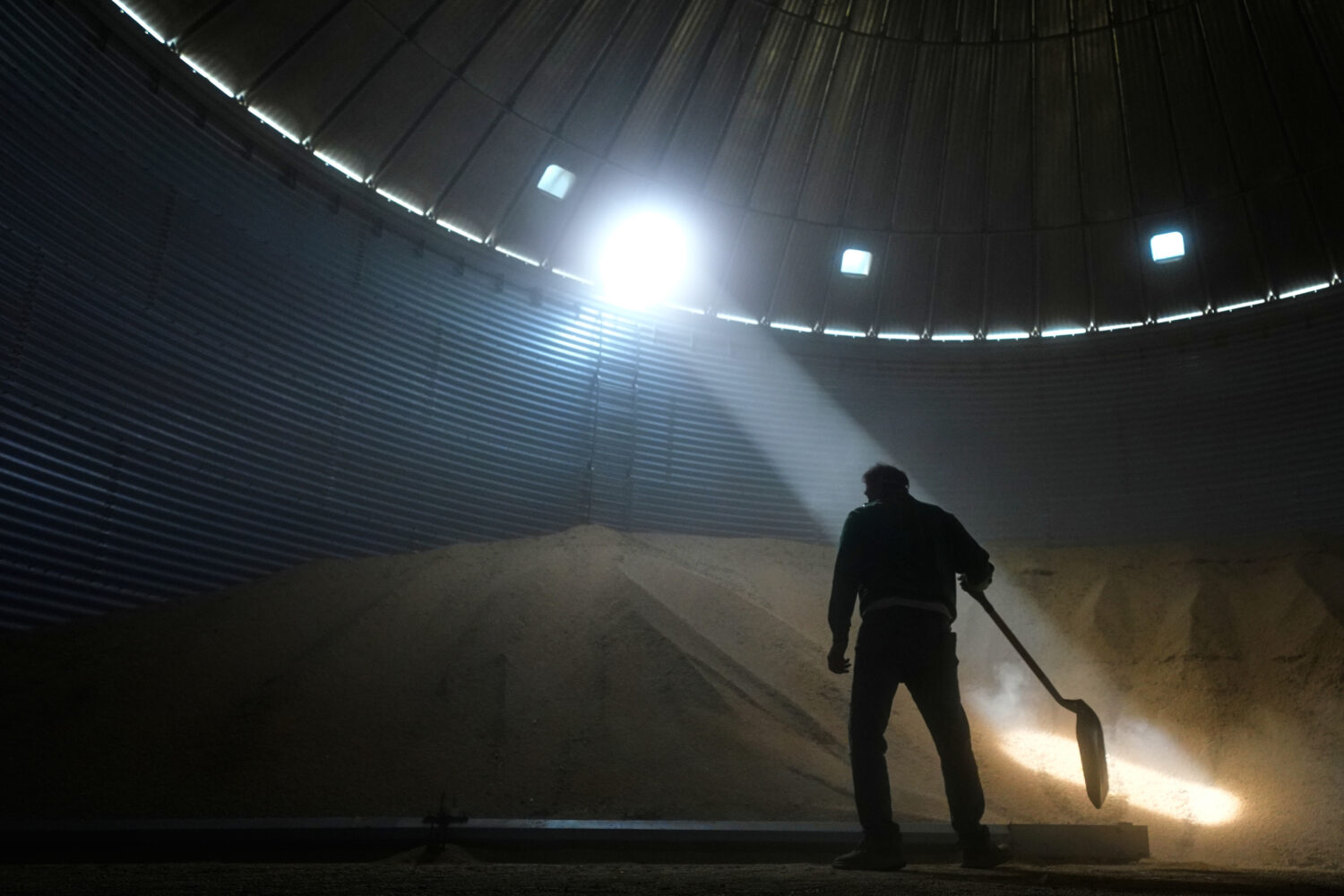
Doug Bartek shovels soybeans in a bin on his farm near Wahoo, Neb., on Monday, April 6, 2026. (AP Photo/Charlie Riedel)
Credit: ASSOCIATED PRESS
(AP Photo/Charlie Riedel)

WAHOO, NE (AP) — Strong winds whipped around Doug Bartek, a fifth-generation farmer, as he headed into a grain bin to shovel soybeans onto a conveyor chute. The 60-year-old was anxious at the onset of the spring planting season, rattling off the long list of issues affecting his family’s livelihood at their 2,000-acre farm near Wahoo, Nebraska.
The high cost of fuel, equipment, and fertilizer — compounded by the Iran war — and also tariffs, perceived “price gouging” by suppliers, and low soybean prices driven by a global supply glut. All of it weighs on Bartek, who is chairman of the Nebraska Soybean Association.
“Our biggest struggles are our inputs, be it fertilizer, seed, chemical, parts,” Bartek said. “There has been so much drastic markup in all of these. And I just kind of feel like the farmer’s kind of painted in the corner.”
Bartek’s concerns are shared by many Midwest soybean producers. Costs, such as equipment, have crept up over time while soybean prices have stayed low. Tariffs levied by the Trump administration last year and the resulting monthslong trade war with China only made things worse, they say. Then the Iran war bottled up shipping through the Strait of Hormuz, restricting global fertilizer supplies and sending fertilizer prices sky high. A ceasefire deal announced April 7 raised hope that bottlenecks in the strait would abate, but the future of the agreement was uncertain.
“A lot of producers are pretty nervous going into this year,” said Justin Sherlock, a soybean farmer and president of the North Dakota Soybean Growers Association. “It looks like we’re going to have another year of negative returns.”
Soybeans, which are used for livestock feed, food and biofuels, are among the top U.S. agricultural exports. That hasn’t always been the case. Before the 1960s soybeans weren’t a major crop in the U.S, according to Chad Hart, an agricultural economist at Iowa State University. It wasn’t until the 1990s that soybean production accelerated due to international demand — primarily from China — and soybeans and corn are now dominant in U.S. agriculture.
But U.S. soybean farmers, who typically also grow corn, have been facing financial issues for years even before the onset of the Iran war. Soybean prices have been persistently low in recent years. The global market has been awash in soybeans, driven in part by Brazil, which surpassed the U.S. as the world’s largest soybean producer years ago.
“If we look at global soybean production over the past several years, it continues to set record, after record, after record,” Hart said. “There’s been just large supplies globally, and that has led to depressed prices.”
Meanwhile, Midwest soybean farmers’ costs have risen. Overall farm production expenses, including seed and pesticide, have increased over time, according to the U.S. Department of Agriculture. Operating costs for soybean production have stayed elevated since 2020 and are projected to increase again in 2026, according to the agency.
The cost of land also is a major issue for farmers, experts say. Midwest crop land values have increased. And most regional farmers rent some of their land, according to Joana Colussi, research assistant professor in the department of agricultural economics at Purdue University.
Bartek, who rents three-quarters of his land, said landowners are increasing rents, causing further financial strain.
“There’s a lot of what I call absentee landowners that have absolutely no idea what goes on on the farm,” he said. “All they know is their taxes went up and you get to make up the difference, some way, somehow.”
“They’re very concerned about negative margins driven by low prices and high cost,” said Paul Mitchell, a professor of agricultural and applied economics at the University of Wisconsin-Madison, of farmers. “There’s just a liquidity cash crunch for a lot of them and they’re just trying to figure out how to deal with everything.”
The number of farms in the U.S. has shrunk over time and consolidation in farming is a long-term trend, though farmers’ financial pressures wrought by high input costs and low commodity prices have contributed, Hart said. Larger farms tend to be more competitive and depend on large, expensive machinery.
“The financial reserves need(ed) on a farm are much greater than they used to be,” Hart said. “We’re a bit more sensitive to the financial conditions these days because so much capital is being utilized within the farm business.”
Market forces aren’t the only issue weighing on farmers. Sweeping tariffs levied by President Donald Trump in April 2025 exacerbated a trade war with China, the cutting off a major export market for Midwest farmers and driving the price of soybeans even lower.
“When that was announced and soybean prices basically collapsed, if you could afford to hold on to your beans and wait for better times, you were OK,” said Mike Cerny, a soybean, and winter wheat corn farmer in Sharon, Wisconsin. “If you had a mortgage due or payments due or cash flow needs and you had to sell at that point, you were taking it pretty rough.”
The U.S. and China eventually reached a deal in late 2025. Beijing committed to buying 12 million metric tons of soybeans by January and at least 25 million metric tons annually for the next three years. China has since met its initial soybean purchase goal and the Trump administration also rolled out a $12 billion temporary aid package in December to boost farmers affected by the trade war.
But the damage is already done, experts and farmers say. While China’s renewed purchases and the federal payments are helping, it’s not enough to recover farmers’ losses. Even after federal assistance, farmers still lost almost $75 per harvested acre of soybeans in the 2025 crop, according to the American Soybean Association. And the trade war further pushed China toward competing soybean exporters, such as Brazil — accelerating a trend of declining U.S. soybean exports to China.
“When China decided to stop purchasing, we couldn’t find enough other markets to replace those sales,” Hart said. “We’re still feeling the impacts today. When you look at where soybean exports are today versus where we would normally expect them to be, we’re still running anywhere from 15% to 20% behind normal.”
Joseph Glauber, former chief economist at the Department of Agriculture between 2008 and 2014, said global competitors to U.S. soybean farmers gained from the trade war.
“When China has put on tariffs against the U.S. they’ve tended to buy then from Brazil or Argentina, largely Brazil,” Glauber added. “We’re not nearly as dominant in the world as we used to be in terms of the global export market for soybeans.”
After the U.S. and Israel attacked Iran on Feb. 28, a severe slowdown in shipping traffic through the Strait of Hormuz sent the price of oil soaring. The shipping disruption also largely stopped the export of nitrogen fertilizers manufactured in the Persian Gulf and limited access to key fertilizer ingredients. The price of urea, the most widely traded nitrogen fertilizer, skyrocketed.
Soybeans don’t require nitrogen fertilizer, but it’s vital for corn and most soybean farmers also grow corn. About half the global supply of urea comes from the Middle East, and Qatar and Saudi Arabia are two of the top sources of U.S. fertilizer imports, according to the American Farm Bureau Federation.
The U.S. and Iran agreed to a two-week ceasefire last week that included reopening the strait of Hormuz, but traffic remained slowed amid disagreements over Israeli attacks in Lebanon, and the price of urea remains elevated.
Many Midwest farmers bought their fertilizer well in advance of the spring planting season. But some farmers who didn’t buy early face elevated prices. Dave Walton, a corn, soybean, and hay farmer in Iowa and vice president of the American Soybean Association, said in March that some of his neighbors didn’t have cash on hand last fall to buy fertilizer and were struggling to budget for fertilizer due to high prices.
The war also caused gasoline and diesel prices to surge, causing further headaches for farmers. Oil prices dropped following the ceasefire announcement, but the war and the closure of the strait will have lasting impacts on farmers, said Seth Goldstein, a senior equity analyst at Morningstar, an investment research company. Facilities in the Middle East that are critical for exporting chemicals, oil and other commodities were damaged or destroyed during the war and it will take time for supply chains to recover, he said.
“Facilities have been hit, like liquid natural gas plants,” Goldstein added. “You are also looking at a big supply crunch in commodity chemicals, which are the inputs for crop chemicals.”
“We burn a lot of diesel fuel,” said Chris Gould, a corn and soybean farmer in Maple Park, Illinois. “It’s hard to say if I’m gonna come out ahead or behind on this whole deal. But I suspect I’m going to come out behind.”
Farmers’ financial problems are showing up in some measures. Farm bankruptcies, while still relatively low, continued to climb in 2025, according to the American Farm Bureau Federation. In a survey of 400 farmers conducted by researchers at the Purdue Center for Commercial Agriculture in late March, almost half said their farm operation is financially worse off than it was a year ago.
Goldstein, the Morningstar analyst, said farmers’ high costs and low revenues contributed to the spike in bankruptcies between 2024 and 2025. If costs rise faster than crop prices going forward, he added, that “would strain farmers again and likely lead to more bankruptcies.”
After 43 years of farming, Bartek said the smell of fresh dirt still gets him excited for spring planting. But he’s also heard of farmer suicides, bankruptcies and “retirement sales” where farmers are forced to auction off their operations due to financial problems. Bartek compares farmers to gamblers who put “millions of dollars in the dirt” hoping for returns.
At times, Bartek doubts his own decision to go into farming. He’s also worried about his son, who purchased a farm a few years ago.
Bartek wonders: “Did I do the right thing helping him get into farming?”
___
Kelety reported from Phoenix.
___
This story is a collaboration between Lee Enterprises and The Associated Press.