Analysis: Iran war becomes a contest of who can take the most pain
Mar 11, 2026, 5:44 AM
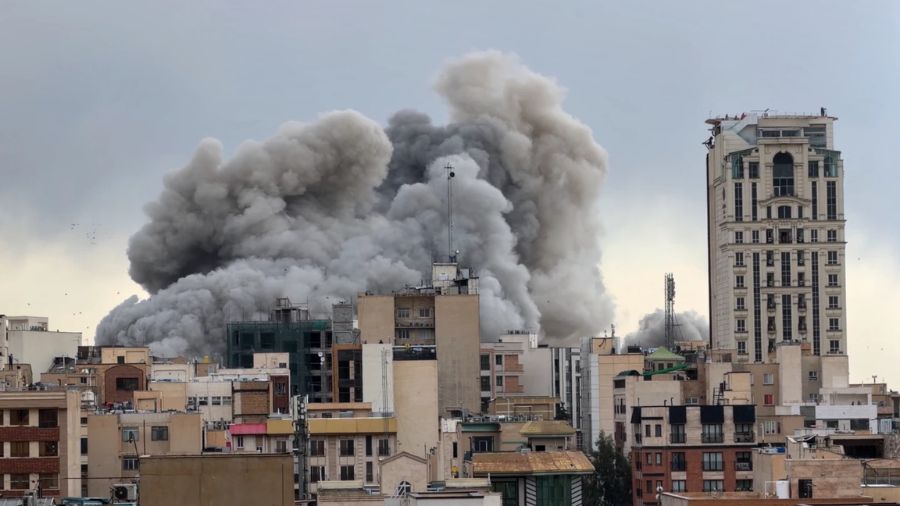
A plume of smoke rises after a strike in Tehran, Iran, Monday, March 2, 2026. (Photo: Mohsen Ganji, The Associated Press)
(Photo: Mohsen Ganji, The Associated Press)

The war with Iran, for all its complexity and global effects, boils down to a single question: Who can take the pain the longest?
A surge in oil prices points to what may be Iran’s most effective weapon and the United States’ biggest vulnerability in continuing the campaign: Damaging the world economy. A sharp rise in gas prices has rattled consumers and financial markets, and international travel and shipping have been severely disrupted.
U.S. President Donald Trump appears aware of the danger. As oil jumped to nearly $120 a barrel on Monday, the highest since 2022, he suggested the war would be “short-term.” That helped reassure markets and the price eased to around $90 — even as Trump, nearly in the same breath, vowed to keep up the war and the punishment on Iran.
On the other side, Iran has to endure a near-constant stream of American and Israeli airstrikes it can’t defend against. So far, the Islamic Republic has been able to keep its leadership and military cohesive and in control. The Iranian public, which already rose up against its theocracy in nationwide protests in January, still boils in anger but have stayed home as they try to survive the heavy bombardment. Security forces have been on the street every day to ensure no anti-government demonstrations form.
The pressure is on U.S. allies as well. Gulf Arab states, while still not combatants in the war, face seemingly unending and occasionally fatal Iranian fire targeting oil fields, cities and critical water works. And Israel, while boasting of inflicting heavy damage on Iran’s missile program and other military targets, continues to be targeted by increasingly sophisticated Iranian missiles that send a buckshot-like bouquet of high explosives raining down on its cities. Frequent air-raid sirens have disrupted daily life, closed schools and workplaces and created a tense atmosphere across the region.
No off-ramps seen in fighting
There’s no immediate end to the war in sight — nor in the rhetoric coming from both America and Iran, whose bad blood extends back decades to the 1979 Islamic Revolution and the U.S. Embassy hostage crisis.
“We’ve already won in many ways, but we haven’t won enough,” Trump said in a speech Monday in Doral, Florida. “We go forward, more determined than ever to achieve ultimate victory that will end this long running danger once and for all.”
Iranian Foreign Ministry official Kazem Gharibabadi offered a mirror image comment from Tehran, boasting that the Islamic Republic had rejected contacts about a ceasefire that he said had come from China, France, Russia and others.
“At the moment, we hold the upper hand,” Gharibabadi told Iranian state television late Monday night. “Just look at the state of the global economy and energy markets — it has been very painful for them.”
He asserted that it was Iran that “will determine the end of the war.”
Iranian strategy remains havoc
For years before Israel and the U.S. launched the war on Feb. 28, Iran warned that, if attacked, it would retaliate on the entire Middle East, targeting the oil infrastructure that made its Gulf Arab neighbors fantastically wealthy. By contrast, Tehran’s economy has been crippled by international sanctions.
Iran has now backed up its threat with barrages of missiles and drones. Qatar was forced to halt its production of natural gas, and Bahrain declared its oil operations couldn’t meet their contractual obligations. Other producers like Saudi Aramco are affected, disrupting a key source of energy for Asia — particularly China, which has sent a top envoy to the region.
Shipping broadly has stopped in the strategic Strait of Hormuz, the narrow mouth of the Persian Gulf through which 20% of all oil and natural gas traded passes, and up to 30% of world fertilizer exports. Iran didn’t need to mine the waterway — its attacks on several ships prompted companies stop sending their vessels through the strait.
Trump has suggested U.S. warships providing escorts to tankers, but that has yet to materialize in a way to restart the traffic.
Early Tuesday morning, he threatened that if Iran stops the oil through the strait, “they will be hit by the United States of America TWENTY TIMES HARDER than they have been hit thus far.”
“Additionally, we will take out easily destroyable targets that will make it virtually impossible for Iran to ever be built back, as a Nation, again — Death, Fire, and Fury will reign upon them — But I hope, and pray, that it does not happen!” he wrote on his Truth Social platform.
Iran, however, only doubled down. The Revolutionary Guard warned on Tuesday that it won’t allow “a single liter of oil” to leave the Persian Gulf.
What is victory?
For Iran’s theocratic rulers, victory means surviving the campaign still in power, no matter the costs to the country and the region.
Trump has been vague and contradictory about his aims in the war. At times, he seems to push for overthrowing Iran’s theocracy; other times, he seems to be willing to stop short of that, saying broadly that he wants to ensure Iran is no longer a threat to Israel, the region and the U.S.
That could give him flexibility in declaring that victory has been achieved, especially if real damage starts to show to the U.S. economy.
But if the war stopped right now, both the U.S and Israel would be left with major challenges.
One is Iran’s leadership. After an Israeli airstrike killed 86-year-old Supreme Leader Ayatollah Ali Khamenei at the start of the war, Iranian clerics named his 56-year-old son Mojtaba to the position, elevating him to the rank of an ayatollah.
Now Iran’s ultimate ruler, the younger Khamenei has long been viewed by analysts as being even more hard-line than his father, with close ties to the paramilitary Revolutionary Guard. Israel already described him as a target in its campaign, while Trump has said he wanted someone else in the role.
Also, Iran still has its stockpile of highly enriched uranium – one reason for the war that Israel and the U.S. have both pointed to. Iran had been enriching up to 60% purity, a short, technical step away from weapons-grade levels of 90%.
The U.S. bombed three Iranian nuclear sites in June during the 12-day war between Israel and Iran, likely burying much of the stockpile in the debris. Those sites to this day remain out of the reach of international inspectors.
Mojtaba Khamenei could issue a religious ruling, or fatwa, reversing his father’s earlier statements and ordering it to be used to make a weapon. That’s something both America and Israel, long believed to be the Mideast’s only nuclear-armed state, don’t want to see.